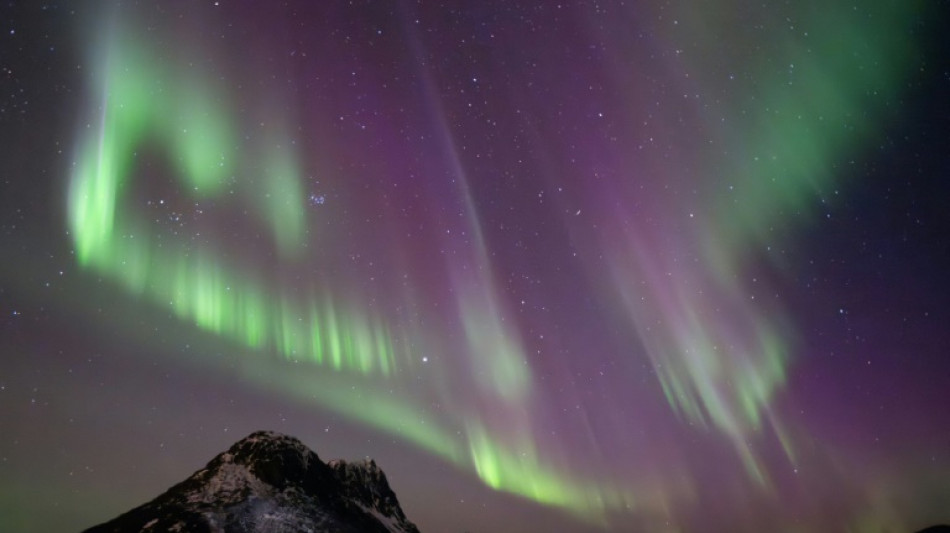
Powerful solar storm pummels Earth, threatening disruption / Photo: © AFP

 Schoolgirl Yu, 13, fastest again in bid for third Asian Games gold
 Oil prices fall after Trump hails 'good' talks with Iran

 AI political ads warp reality ahead of US midterms

 Kenneth Branagh embraces action hero role -- to get in shape

 'New one' Klopp promises fresh approach as Germany reign begins

 Milne returns to New Zealand squad for India T20 series

 US-led Americas coalition backs sanctions against crime groups

 'Star Wars' fans and art lovers line up for new Lucas museum

 Trump renames AI 'super intelligence' as leaders jostle over dangers

 Oil prices retreat as markets welcome US-Iran talks

 US refusing to give Sudan's de facto leader visa for UN: diplomatic sources, UN

 Macron urges world to choose UN over 'law of the jungle'

 All-rounder Jacks stars as England beat Sri Lanka in 1st ODI

 Man City peg back Bayern to start Women's Champions League

 Trump beats 'America first' drum at UN as allies tread carefully

 Snedeker backs Spaun for Ryder Cup after Presidents snub

 French prosecutors probe secret filming of women with smart glasses

 Trump renames AI "super intelligence," rejects international oversight

 Trump rejects international regulation of AI

 How is the EU approaching record fuel prices?

 Sri Lanka's Colombage strikes on debut as England dismissed for 265 in first ODI

 Hurricane Polo strengthens to top category 5 off Mexico

 11 hurt as teen opens fire outside school in western Turkey

 UN chief says 'Big Oil' treats atmosphere as open sewer

 Tunisia says 2026 summer hottest on record

A huge solar storm begun pummeling Earth on Friday, bringing possible disruptions to satellites and power grids -- and stunning auroras -- as it intensifies.
The first of several coronal mass ejections (CMEs) -- expulsions of plasma and magnetic fields from the Sun -- arrived in the early afternoon, US eastern time, the National Oceanic and Atmospheric Administration (NOAA) said.
Severe geomagnetic storm conditions are expected to persist over the weekend, and come as the Sun approaches the peak of an 11-year cycle that brings heightened activity.
"We have notified all of our infrastructure operators that we coordinate with, such as satellite operators, communication folks... and of course, the power grid here in North America," space weather forecaster Shawn Dahl told reporters.
The US Federal Aviation administration, however, said Friday in a social media post that "we do not anticipate any significant impacts to the national airspace system due to the potential geomagnetic storm."
Unlike solar flares, which travel at the speed of light and reach Earth in around eight minutes, CMEs travel at a more sedate pace, with officials putting the current average at 800 kilometers (500 miles) per second.
There were at one point up to seven CMEs in transit, emanating from a sunspot cluster that is 16 times wider than our planet, but it's not clear how they have merged together along the way.
- 'Go outside tonight and look' -
Mathew Owens, a professor of space physics at the University of Reading, told AFP the effects would be largely felt over the planet's northern and southern latitudes. How far they would extend would depend on the storm's final strength.
"Northern Canada, Scotland, those kinds of places are going to get some good auroras -- I think we can confidently say that, but it may build," he said, with the situation mirrored in the southern hemisphere.
"Go outside tonight and look would be my advice because if you see the aurora, it's quite a spectacular thing," he added. If people have eclipse glasses, they can also look for the sunspot cluster during the day.
In the United States, this could be as far south as Northern California and Alabama, officials said.
NOAA's Brent Gordon encouraged the public to try to capture the night sky with phone cameras even if they can't see auroras with their naked eyes.
"Just go out your back door and take a picture with the newer cell phones and you'd be amazed at what you see in that picture versus what you see with your eyes."
- Spacecraft and pigeons -
Fluctuating magnetic fields associated with geomagnetic storms induce currents in long wires, including power lines, which can potentially lead to blackouts. Long pipelines can also become electrified, leading to engineering problems.
Spacecraft are also at risk from high doses of radiation, though the atmosphere prevents this from reaching Earth.
NASA has a dedicated team looking into astronaut safety, and can ask astronauts on the International Space Station to move to places within the outpost that are better shielded.
Pigeons and other species that have internal biological compasses could also be affected. Pigeon handlers have noted a reduction in birds coming home during geomagnetic storms, according to NASA's Jet Propulsion Laboratory.
In October 2003, geomagnetic storms rated as "extreme" led to blackouts in Sweden and damaged power transformers in South Africa. Impacts are also possible on high-frequency radio communication, GPS and satellites.
Officials said people should have the normal backup plans in place for power outages, such as having flashlights, batteries and radios at hand.
The most powerful geomagnetic storm in recorded history, known as the Carrington Event, occurred in September 1859, named after British astronomer Richard Carrington.
Excess currents on telegraph lines at that time caused electrical shocks to technicians and even set some telegraph equipment ablaze.
L.Janezki--BTB