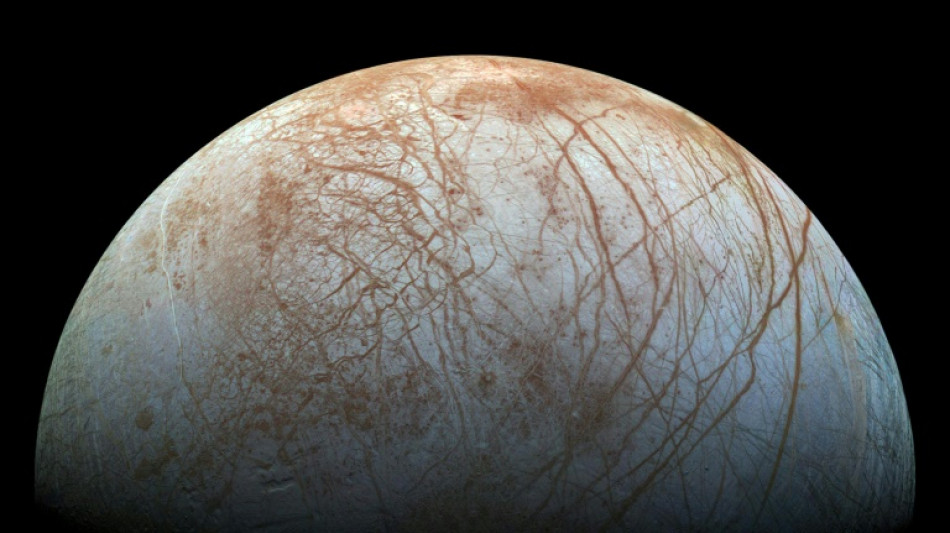
Water on Jupiter's moon closer to surface than thought: study
/ Photo: © NASA/JPL-Caltech/SETI Institute/AFP/File

 Ed Sheeran returns to stage after Palestinian controversy

 Asian Games to open in Japan after troubled build-up

 Drone owners rush to offload devices ahead of Beijing ban

 Trump's beef policies irk Texas ranchers, testing their loyalty

 Nvidia, OpenAI CEOs to attend Xi dinner at White House

 Anthropic picks Accenture for in-house AI safety evaluation

 Balogun returns as Monaco beat Lens to continue strong Ligue 1 start

 'Pause' on overt repression in Venezuela, but reforms still needed: HRW

 Global stocks mixed as yen falls despite Bank of Japan rate hike

 Cuba hit with seventh major blackout of the year

 Murray out with concussion so Wentz will start for Vikings

 UN chief 'deeply regrets' US visa refusal to Abbas for annual meeting

 England quick Carse to face no charges over alleged nightclub assault

 Mancini brings nine newcomers into the first squad of his Italy comeback

 Czechs level Davis Cup tie against USA as South Korea eye Finals

 New France boss Zidane confirms Mbappe as captain after naming first squad

 California governor signs order to explore AI 'kill switch'

 Head leads run spree as Australia win Zimbabwe ODI series

 In-form Raphinha wants to finish career at Barcelona

 Warren Buffett steps down as Berkshire Hathaway chairman

 Carrick confident Man Utd can 'work through' tough time

 Mbappe ends Nike partnership to join Swiss brand On

 Liverpool boss Iraola puts Bournemouth love affair on hold

 'A disaster' if Man City do not win says Maresca after flawless start

 Kerry James Marshall: American 'blackness' painter celebrated in Europe

Ridges that criss-cross the icy surface of Jupiter's moon Europa indicate there are shallow pockets of water beneath, boosting hopes in the search for extra-terrestrial life, scientists said Tuesday.
Europa has long been a candidate for finding life in our solar system due to its vast ocean, which is widely thought to contain liquid water -- a key ingredient for life.
There is a problem: the ocean is predicted to be buried 25-30 kilometres (15-17 miles) beneath the moon's icy shell.
However water could be closer to the surface than previously thought, according to new research published in the journal Nature Communications.
The finding came partly by chance, when geophysicists studying an ice sheet in Greenland watched a presentation about Europa and spotted a feature they recognised.
"We were working on something totally different related to climate change and its impact on the surface of Greenland when we saw these tiny double ridges," said the study's senior author Dustin Schroeder, a geophysics professor at Stanford University.
They realised that the M-shaped icy crests on Greenland looked like smaller versions of double ridges on Europa, which are the most common feature on the moon.
Europa's double ridges were first photographed by NASA's Galileo spacecraft in the 1990s, but little was known about how they were formed.
The scientists used ice-penetrating radar to observe that Greenland's ridges were formed when water pockets around 30 metres (100 feet) below the ice sheet's surface refroze and fractured.
"This is particularly exciting, because scientists have been studying double ridges on Europa for more than 20 years and have not yet come to a definitive answer for how double ridges form," said lead study author Riley Culberg, an electrical engineering PhD student at Stanford.
"This was the first time that we were able to watch something similar happen on Earth and actually observe the subsurface processes that led to the formation of the ridges," he told AFP.
"If Europa's double ridges also form in this way, it suggests that shallow water pockets must have been (or maybe still are) extremely common."
- 'Life has a shot' -
Europa's water pockets could be buried five kilometres beneath the moon’s ice shell -- but that would still be much easier to access than the far deeper ocean.
"Particularly if such water pockets form because ocean water was forced up through fractures into the ice shell, then it's possible that they would preserve evidence of any life in the ocean itself," Culberg said.
Water closer to the surface would also contain "interesting chemicals" from space and other moons, increasing the "possibility that life has a shot," Schroeder said in a statement.
We may not have too long to wait to find out more.
NASA's Europa Clipper mission, scheduled to launch in 2024 and arrive in 2030, will have ice-penetrating radar equipment similar to that used by the scientists studying Greenland's double ridges.
The spacecraft is unlikely to find definitive proof of life because it will not land on Europa, instead flying by and analysing it.
But hopes remain high. The moon's ocean is predicted to have more water than all of Earth's seas combined, according to the Europa Clipper's website.
"If there is life in Europa, it almost certainly was completely independent from the origin of life on Earth... that would mean the origin of life must be pretty easy throughout the galaxy and beyond," project scientist Robert Pappalardo said on the website.
R.Adler--BTB