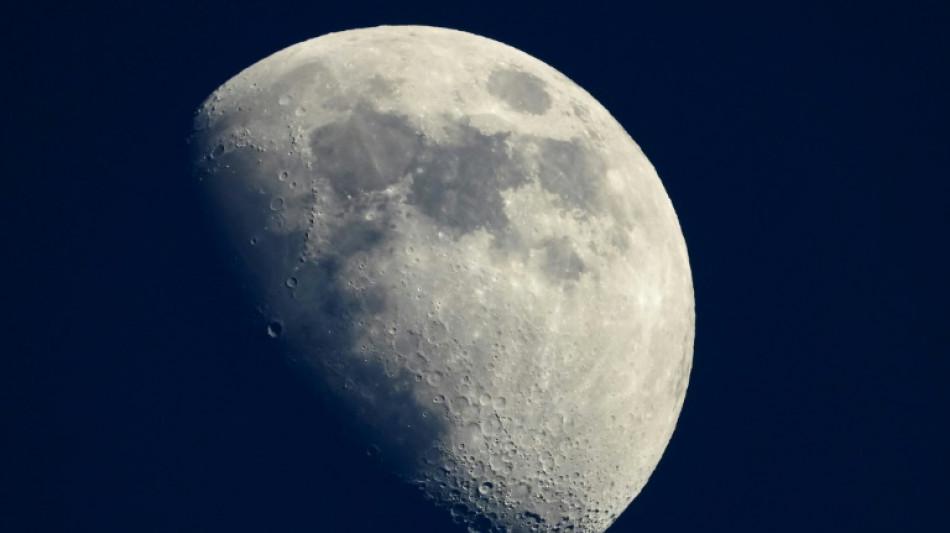
NASA aims to make observations from space junk collision with Moon / Photo: ©

 Ed Sheeran returns to stage after Palestinian controversy

 Asian Games to open in Japan after troubled build-up

 Drone owners rush to offload devices ahead of Beijing ban

 Trump's beef policies irk Texas ranchers, testing their loyalty

 Nvidia, OpenAI CEOs to attend Xi dinner at White House

 Anthropic picks Accenture for in-house AI safety evaluation
 Balogun returns as Monaco beat Lens to continue strong Ligue 1 start

 'Pause' on overt repression in Venezuela, but reforms still needed: HRW

 Global stocks mixed as yen falls despite Bank of Japan rate hike

 Cuba hit with seventh major blackout of the year
 Murray out with concussion so Wentz will start for Vikings

 UN chief 'deeply regrets' US visa refusal to Abbas for annual meeting

 England quick Carse to face no charges over alleged nightclub assault

 Mancini brings nine newcomers into the first squad of his Italy comeback

 Czechs level Davis Cup tie against USA as South Korea eye Finals

 New France boss Zidane confirms Mbappe as captain after naming first squad

 California governor signs order to explore AI 'kill switch'

 Head leads run spree as Australia win Zimbabwe ODI series

 In-form Raphinha wants to finish career at Barcelona

 Warren Buffett steps down as Berkshire Hathaway chairman

 Carrick confident Man Utd can 'work through' tough time

 Mbappe ends Nike partnership to join Swiss brand On

 Liverpool boss Iraola puts Bournemouth love affair on hold

 'A disaster' if Man City do not win says Maresca after flawless start

 Kerry James Marshall: American 'blackness' painter celebrated in Europe

NASA said Thursday it aims to survey the crater formed when the remains of a SpaceX rocket are expected to crash into the Moon in early March, calling the event "an exciting research opportunity."
The rocket was deployed in 2015 to put a NASA satellite into orbit and its second stage, or booster, has been floating in the cosmos ever since, a common fate for such pieces of space technology.
"On its current trajectory, the second stage is expected to impact the far side of the Moon on March 4, 2022," a NASA spokeswoman told AFP.
The impact of the rocket chunk weighing four tons will not be visible from Earth in real time, nor will NASA's Lunar Reconnaissance Orbiter (LRO), which is currently orbiting the Moon, be in a "position to observe the impact as it happens," the spokeswoman said.
The LRO could be used later, however, to capture images for before-and-after comparisons.
Finding the crater "will be challenging and might take weeks to months," the spokeswoman said, adding that the "unique event presents an exciting research opportunity."
Studying a crater formed by a hurtling object with a known mass and speed (it will be traveling at 9,000 kilometers per hour), as well as the material that the impact stirs up, could help advance selenology, or the scientific study of the moon.
Spacecraft have been intentionally crashed into the Moon before for scientific purposes, such as during the Apollo missions to test seismometers, but this is the first unintended collision to be detected.
Astronomer Bill Gray, creator of a software used to determine the trajectories of asteroids and other objects, was the first to calculate the booster's new collision course with the Moon.
He believes that space junk should always be directed towards the moon when possible: "If it hits the moon, then we actually learn something from it," Gray said.
M.Furrer--BTB