China sees commercial sector as next frontier in US space race / Photo: © China National Space Administration/AFP

 Schoolgirl Yu, 13, fastest again in bid for third Asian Games gold

 Oil prices fall after Trump hails 'good' talks with Iran
 AI political ads warp reality ahead of US midterms

 Kenneth Branagh embraces action hero role -- to get in shape

 'New one' Klopp promises fresh approach as Germany reign begins

 Milne returns to New Zealand squad for India T20 series

 US-led Americas coalition backs sanctions against crime groups

 'Star Wars' fans and art lovers line up for new Lucas museum

 Trump renames AI 'super intelligence' as leaders jostle over dangers

 Oil prices retreat as markets welcome US-Iran talks
 US refusing to give Sudan's de facto leader visa for UN: diplomatic sources, UN
 Macron urges world to choose UN over 'law of the jungle'
 All-rounder Jacks stars as England beat Sri Lanka in 1st ODI

 Man City peg back Bayern to start Women's Champions League

 Trump beats 'America first' drum at UN as allies tread carefully

 Snedeker backs Spaun for Ryder Cup after Presidents snub

 French prosecutors probe secret filming of women with smart glasses

 Trump renames AI "super intelligence," rejects international oversight

 Trump rejects international regulation of AI

 How is the EU approaching record fuel prices?

 Sri Lanka's Colombage strikes on debut as England dismissed for 265 in first ODI
 Hurricane Polo strengthens to top category 5 off Mexico

 11 hurt as teen opens fire outside school in western Turkey

 UN chief says 'Big Oil' treats atmosphere as open sewer

 Tunisia says 2026 summer hottest on record

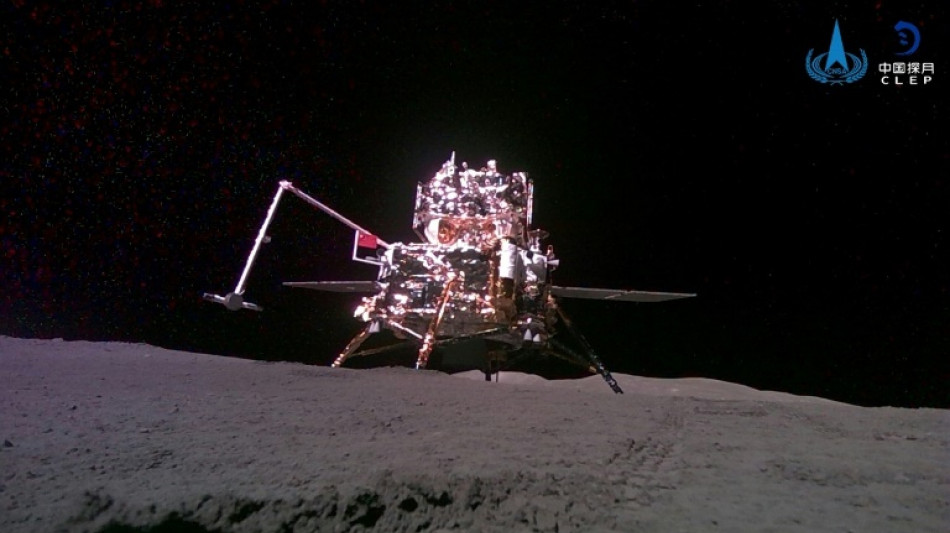
A world-first launch from the far side of the Moon this week showcased China's progress in space, and Beijing now wants its commercial sector to catch up to rivals such as Elon Musk's SpaceX.
Chinese companies lag far behind American frontrunners led by SpaceX, which plans to launch Starship, a massive prototype rocket that may one day send humans to Mars, on Thursday.
The gap is narrowing, however, as Beijing realises the value a solid commercial sector can add to its existing capabilities, experts told AFP.
It could even become similar to the development of electric vehicles where EV pioneer Tesla, also founded by Musk, was an early mover in China but now faces fierce competition from a host of homegrown rivals, said analyst Chen Lan.
"In five years, SpaceX may feel pressure," Chen told AFP.
"The situation in today's EV market will probably happen again when a lion (Tesla or SpaceX) faces a pack of wolves (Chinese companies)."
Tesla was recently overtaken by China's BYD as the world's top seller.
Beijing only opened up parts of the space sector to private capital in late 2014 but hundreds of companies have since sprung up.
A CERES-1 commercial rocket, for example, sent three satellites into orbit on Thursday, one of dozens of launches planned this year.
"China's commercial space sector is impressively large and deep," said Blaine Curcio, founder of Orbital Gateway Consulting.
While SpaceX is "vastly ahead" of its Chinese equivalent, "if we compare the fifth, or the 10th most-developed launch companies in the US and China, China is probably ahead", he said.
- Vital launching capacity -
China's government has sent humans into orbit, built a space station and landed rovers on the Moon and Mars -- where it aims to send crewed missions by 2030 and 2033 respectively.
In contrast, Chen said, the commercial sector is currently focused on low-cost launch vehicles and small satellites.
However, this launching capacity will be critical to China's aim of establishing satellite mega-constellations, state broadcaster CCTV reported in April.
China is developing two such networks: Guowang, set to consist of 13,000 spacecraft, and G60 Starlink, envisioned at 12,000.
Chinese satellites currently in orbit, though, number in the hundreds rather than thousands.
CCTV said speed was vital because China's satellite plans face multiple competitors and a limit on both the number of spacecraft in orbit and available frequencies for use.
Its report made repeated references to SpaceX, whose Falcon 9 rockets act as workhorses for NASA, and whose Starlink satellite constellation now covers dozens of countries.
China harnessing commercial launching capacity in a similar way would "help traditional state-owned players focus on civil and military programmes... while also boosting China's overall launch and space capabilities and meeting national strategic goals", wrote SpaceNews.com's Andrew Jones.
The opportunity must be grasped in the next five to 10 years "to help our country seize the right to speak in the space of the future", CCTV quoted a representative of domestic firm LandSpace as saying.
Control of the cosmos is already another arena for US-China rivalry, with both accusing the other of hiding its space programme's military objectives.
The next decade of competition with China was the "most critical 10 years" in history, a former US Space Command chief said recently.
"We cannot afford to lose," he said.
- 'Deep links' -
There are "deep links" between China's state and commercial sectors, said Curcio, with many companies founded by former employees from state-run companies or academics from government institutes.
Still, the central government is increasingly throwing its weight behind the sector.
It was termed a "strategic emerging industry" to be "nurtured" at an annual meeting of China's top decision-makers last December.
"Almost every province has some kind of space industry development plan, many cities have the same," said Curcio.
China made 26 commercial launches in 2023, according to state media, including LandSpace's Zhuque-2 rocket, the world's first methane-fuelled rocket.
"The next milestone will be a Falcon 9-class launcher and first stage re-use," said Chen, which several companies were expected to achieve in 2024.
The commercial sector should make up 30 of China's planned 100 launches this year.
By comparison, SpaceX comprised 98 of 109 US launches in 2023, according to astrophysicist Jonathan McDowell, highlighting the US company's superiority for now.
But the situation could be "totally different" in five years, said Chen, "as the gap continues to narrow".
N.Fournier--BTB