In first, SpaceX's megarocket Starship nails ocean splashdown / Photo: © SPACEX/AFP

 Schoolgirl Yu, 13, fastest again in bid for third Asian Games gold

 Oil prices fall after Trump hails 'good' talks with Iran

 AI political ads warp reality ahead of US midterms

 Kenneth Branagh embraces action hero role -- to get in shape

 'New one' Klopp promises fresh approach as Germany reign begins

 Milne returns to New Zealand squad for India T20 series

 US-led Americas coalition backs sanctions against crime groups

 'Star Wars' fans and art lovers line up for new Lucas museum

 Trump renames AI 'super intelligence' as leaders jostle over dangers

 Oil prices retreat as markets welcome US-Iran talks

 US refusing to give Sudan's de facto leader visa for UN: diplomatic sources, UN

 Macron urges world to choose UN over 'law of the jungle'

 All-rounder Jacks stars as England beat Sri Lanka in 1st ODI

 Man City peg back Bayern to start Women's Champions League

 Trump beats 'America first' drum at UN as allies tread carefully

 Snedeker backs Spaun for Ryder Cup after Presidents snub

 French prosecutors probe secret filming of women with smart glasses

 Trump renames AI "super intelligence," rejects international oversight

 Trump rejects international regulation of AI

 How is the EU approaching record fuel prices?

 Sri Lanka's Colombage strikes on debut as England dismissed for 265 in first ODI

 Hurricane Polo strengthens to top category 5 off Mexico

 11 hurt as teen opens fire outside school in western Turkey

 UN chief says 'Big Oil' treats atmosphere as open sewer

 Tunisia says 2026 summer hottest on record

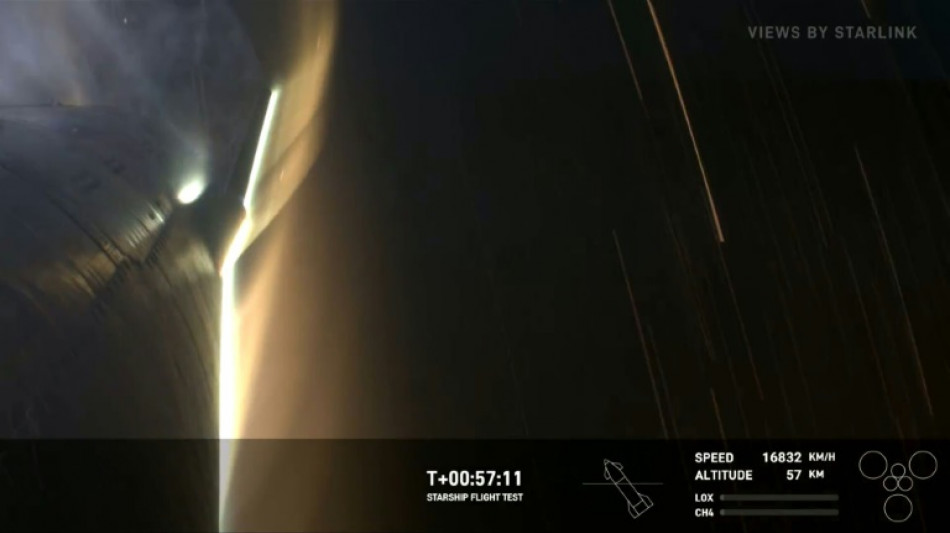
SpaceX's massive Starship rocket achieved its first ever splashdown during a test flight Thursday, in a major milestone for the prototype system that may one day send humans to Mars.
Scraps of fiery debris came flying off the spaceship as it descended over the Indian Ocean northwest of Australia, dramatic video from an onboard camera showed, but it ultimately held together and survived atmospheric reentry.
"Despite loss of many tiles and a damaged flap, Starship made it all the way to a soft landing in the ocean!" SpaceX CEO Elon Musk wrote on X.
"Today was a great day for humanity's future as a spacefaring civilization!" he added.
The most powerful rocket ever built blasted off from the company's Starbase in Boca Chica, Texas, at 7:50 am (1250 GMT), before soaring to space and coasting halfway across the globe, for a journey that lasted around an hour and five minutes.
With its fully reusable design, Starship is essential to fulfilling Musk's ambitious vision of colonizing the Red Planet and making humankind an multiplanetary species.
NASA meanwhile has contracted a modified version to act as the final vehicle that will take astronauts down to the surface of the Moon under the Artemis program later this decade.
- Trial-and-error approach -
Three previous test flights had ended in Starship's destruction, all part of what the company says is an acceptable cost in its rapid trial-and-error approach to development.
"The payload for these flight tests is data," SpaceX said on X, a mantra repeated by the commentary team throughout the flight.
During the last test in March, the spaceship managed to fly for 49 minutes before it was lost as it careened into the atmosphere at around 27,000 kilometers per hour (nearly 17,000 mph).
Since then SpaceX made several software and hardware upgrades.
Around seven minutes after liftoff, the first stage booster, called Super Heavy, succeeded in an upright splashdown in the Gulf of Mexico, to massive applause from engineers at mission control in Hawthorne, California.
The cheers grew even louder in the flight's final minutes. Ground teams whooped and hollered as the upper stage glowed a fiery red, the result of a plasma field generated by the friction of the vehicle streaking through the atmosphere.
Space fans around the world watched in awe, thanks to a live broadcast powered by SpaceX's vast constellation of Starlink internet satellites.
A chunk of flying debris even cracked the camera lens, but in the end, Starship stuck the landing.
"Congratulations SpaceX on Starship's successful test flight this morning!" NASA chief Bill Nelson wrote on X. "We are another step closer to returning humanity to the Moon through #Artemis -- then looking onward to Mars."
- Twice as powerful as Apollo rocket -
Starship stands 397 feet (121 meters) tall with both stages combined -- 90 feet taller than the Statue of Liberty.
Its Super Heavy booster produces 16.7 million pounds (74.3 Meganewtons) of thrust, about twice as powerful as the Saturn V rockets used during the Apollo missions, and later versions should be more powerful still.
SpaceX's strategy of carrying out tests in the real world rather than in labs has paid off in the past.
Its Falcon 9 rockets have come to be workhorses for NASA and the commercial sector, its Dragon capsule sends astronauts and cargo to the International Space Station, and its Starlink internet satellite constellation now covers dozens of countries.
But the clock is ticking for SpaceX to be ready for NASA's planned return of astronauts to the Moon in 2026.
To do this, SpaceX will need to first place a primary Starship in orbit, then use multiple "Starship tankers" to fill it up with supercooled fuel for the onward journey -- a complex engineering feat that has never before been accomplished.
China is planning its own crewed lunar mission in 2030, and has a better track record than the United States as of late of adhering to its timelines.
I.Meyer--BTB