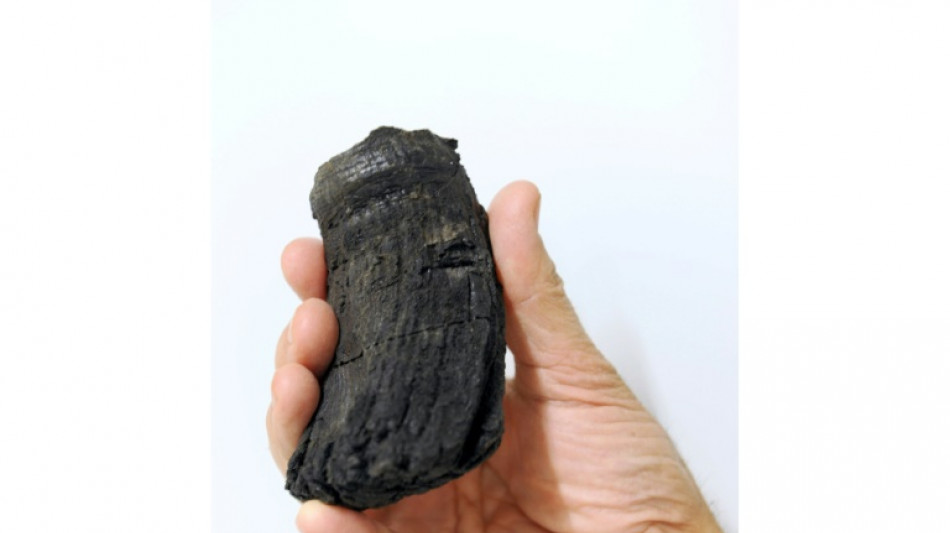
Giant tooth of ancient marine reptile discovered in Alps / Photo: © EUREKALERT!/AFP

 Ed Sheeran returns to stage after Palestinian controversy

 Asian Games to open in Japan after troubled build-up

 Drone owners rush to offload devices ahead of Beijing ban

 Trump's beef policies irk Texas ranchers, testing their loyalty

 Nvidia, OpenAI CEOs to attend Xi dinner at White House

 Anthropic picks Accenture for in-house AI safety evaluation

 Balogun returns as Monaco beat Lens to continue strong Ligue 1 start

 'Pause' on overt repression in Venezuela, but reforms still needed: HRW

 Global stocks mixed as yen falls despite Bank of Japan rate hike

 Cuba hit with seventh major blackout of the year

 Murray out with concussion so Wentz will start for Vikings

 UN chief 'deeply regrets' US visa refusal to Abbas for annual meeting

 England quick Carse to face no charges over alleged nightclub assault

 Mancini brings nine newcomers into the first squad of his Italy comeback

 Czechs level Davis Cup tie against USA as South Korea eye Finals

 New France boss Zidane confirms Mbappe as captain after naming first squad

 California governor signs order to explore AI 'kill switch'

 Head leads run spree as Australia win Zimbabwe ODI series

 In-form Raphinha wants to finish career at Barcelona

 Warren Buffett steps down as Berkshire Hathaway chairman

 Carrick confident Man Utd can 'work through' tough time

 Mbappe ends Nike partnership to join Swiss brand On

 Liverpool boss Iraola puts Bournemouth love affair on hold

 'A disaster' if Man City do not win says Maresca after flawless start

 Kerry James Marshall: American 'blackness' painter celebrated in Europe

The fossils of three ichthyosaurs -- giant marine reptiles that patrolled primordial oceans -- have been discovered high up in the Swiss Alps, and include the largest ever tooth found for the species, a study said Thursday.
With elongated bodies and small heads, the prehistoric leviathans weighed up to 80 metric tons (88 US tons) and grew to 20 meters (yards), making them among the largest animals to have ever lived.
They first appeared 250 million years ago in the early Triassic, and a smaller, dolphin-like subtype survived until 90 million years ago. But the gigantic ichthyosaurs, which comprised most of the species, died out 200 million years ago.
Unlike dinosaurs, ichthyosaurs barely left a trace of fossil remains, and "why that is remains a great mystery to this day," said Martin Sander of the University of Bonn, lead author of the paper in the Journal of Vertebrate Paleontology.
The specimens in question, dated to 205 million years ago in the study, were unearthed between 1976 and 1990 during geological surveys, but were only recently analyzed in detail.
Fun fact: they were discovered at an altitude of 2,800 meters (9,100 feet). During their lifetimes the three swam in waters around the supercontinent Pangea-- but due to plate tectonics and the folding of the Alps, the fossils kept rising.
Ichthyosaurs were previously thought to have only inhabited the deep ocean, but the rocks from which the new fossils derive are believed to have been at the bottom of a shallow coastal area. It could be that some of the giants followed schools of fish there.
There are two sets of skeletal remains. One consists of ten rib fragments and a vertebra, suggesting an animal some 20 meters long, which is more or less equivalent to the largest ichthyosaur to have been found, in Canada.
The second animal measured 15 meters, according to an estimate from the seven vertebrae found.
"From our point of view, however, the tooth is particularly exciting," explained Sander.
"Because this is huge by ichthyosaur standards: Its root was 60 millimeters (2.4 inches) in diameter - the largest specimen still in a complete skull to date was 20 millimeters and came from an ichthyosaur that was nearly 18 meters long."
While this could indicate a beast of epic proportions, it's more likely to have come from an ichthyosaur with particularly gigantic teeth, rather than a particularly gigantic ichthyosaur.
Current research holds that extreme gigantism is incompatible with a predatory lifestyle requiring teeth.
That's why the largest known animal to have ever lived -- the blue whale at 30 meters long and 150 tons -- lacks teeth.
Blue whales are filter feeders, while the much smaller sperm whales, at 20 meters long and 50 tons, are hunters, and use more of their energy to fuel their muscles.
"Marine predators therefore probably can't get much bigger than a sperm whale," Sander said, though more fossils would need to be found to know for certain. "Maybe there are more remains of the giant sea creatures hidden beneath the glaciers," he said.
E.Schubert--BTB