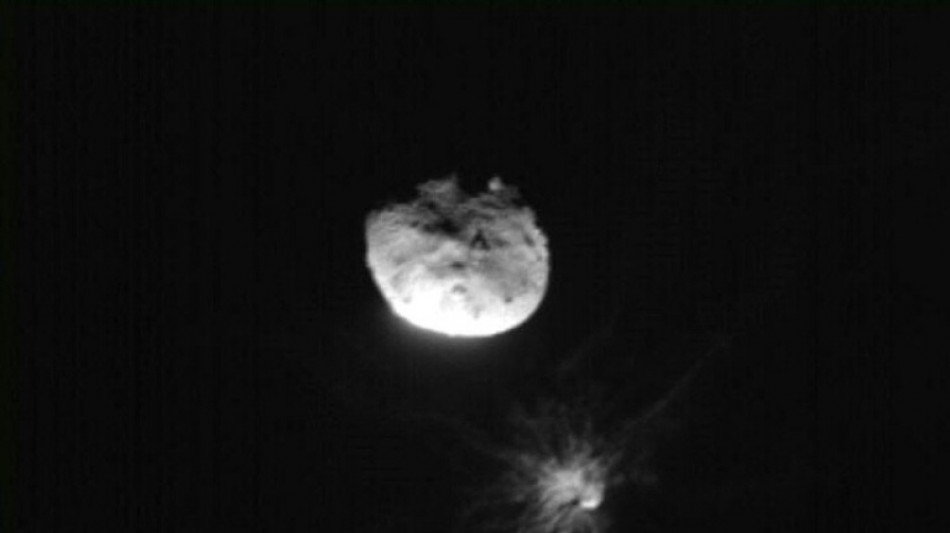
Mission to probe smashed asteroid launches despite hurricane / Photo: © ASI/NASA/AFP/File

 Schoolgirl Yu, 13, fastest again in bid for third Asian Games gold

 Oil prices fall after Trump hails 'good' talks with Iran

 AI political ads warp reality ahead of US midterms

 Kenneth Branagh embraces action hero role -- to get in shape

 'New one' Klopp promises fresh approach as Germany reign begins

 Milne returns to New Zealand squad for India T20 series

 US-led Americas coalition backs sanctions against crime groups

 'Star Wars' fans and art lovers line up for new Lucas museum

 Trump renames AI 'super intelligence' as leaders jostle over dangers

 Oil prices retreat as markets welcome US-Iran talks

 US refusing to give Sudan's de facto leader visa for UN: diplomatic sources, UN

 Macron urges world to choose UN over 'law of the jungle'

 All-rounder Jacks stars as England beat Sri Lanka in 1st ODI

 Man City peg back Bayern to start Women's Champions League

 Trump beats 'America first' drum at UN as allies tread carefully

 Snedeker backs Spaun for Ryder Cup after Presidents snub

 French prosecutors probe secret filming of women with smart glasses

 Trump renames AI "super intelligence," rejects international oversight

 Trump rejects international regulation of AI

 How is the EU approaching record fuel prices?

 Sri Lanka's Colombage strikes on debut as England dismissed for 265 in first ODI

 Hurricane Polo strengthens to top category 5 off Mexico

 11 hurt as teen opens fire outside school in western Turkey

 UN chief says 'Big Oil' treats atmosphere as open sewer

 Tunisia says 2026 summer hottest on record

Europe's Hera probe successfully launched Monday on a mission to inspect the damage done by a NASA spacecraft that smashed into an asteroid during the first test of Earth's planetary defences.
Despite fears that an approaching hurricane could delay the launch, the probe blasted off on a SpaceX rocket into cloudy skies from Cape Canaveral in the US state of Florida just before 11:00 am local time (1500 GMT).
Hera's mission is to investigate the aftermath of NASA's Double Asteroid Redirection Test (DART), which deliberately crashed into the Dimorphos asteroid in 2022 roughly 11 million kilometres (6.8 million miles) from Earth.
The fridge-sized DART spacecraft successfully knocked the asteroid well off course, demonstrating that humanity may no longer be powerless against potentially planet-killing asteroids that could head our way.
The European Space Agency (ESA) said that Hera will conduct what it has dubbed a "crime scene investigation".
"Hera will gather the data we need to turn kinetic impact into a well-understood and repeatable technique on which all of us may rely one day," ESA chief Josef Aschbacher said on the agency's broadcast of the launch.
The tense liftoff on SpaceX's Falcon 9 rocket was met with applause from teams on the ground.
"We had a lot of tears -- and outside in the public event, people were jumping around and spilling their beers," ESA broadcast host Matthew Russell said.
Around an hour after liftoff, Hera then separated from the rocket in space, beginning its two-year journey towards Dimorphos.
There was more applause minutes later when the team on the ground received the first signal from the spacecraft, indicating a successful launch.
- Hurricane, rocket anomaly -
The launch had been put into doubt by the intensifying Hurricane Milton, with SpaceX warning on Sunday that there was only a 15 percent chance of a launch.
Milton is the latest hurricane to hit the Gulf of Mexico after Hurricane Helene, which has killed at least 230 people since striking Florida late last month.
Hurricane Milton has been classified as "an extremely dangerous category 4 hurricane" and is expected to slam into the state by mid-week.
NASA said it will delay the launch of its Europa Clipper mission, which had been scheduled from Cape Canaveral on Thursday, due to "anticipated hurricane conditions" as Milton moves east across Florida over the week.
Hera's launch had also faced a potential delay due to an anomaly involving a Falcon 9 rocket during the launch of SpaceX's Crew-9 astronaut mission late last month.
But on Sunday, the US Federal Aviation Administration gave the last-minute green light, saying the nature of the problem posed little risk for Hera.
Next year, Hera is planned to get a gravitational boost as it flies past Mars, arriving near Dimorphos in December 2026 to begin its six-month investigation.
Dimorphos, which is actually a moonlet orbiting its big brother Didymos, never posed a threat to Earth.
After DART's impact, Dimorphos shed material to the point where its orbit around Didymos was shortened by 33 minutes -- proof that it was successfully deflected.
Analysis of the DART mission has suggested that rather than being a single hard rock, Dimorphos was more a loose pile of rubble held together by gravity.
"The consequence of this is that, instead of making a crater" on Dimorphos, DART may have "completely deformed" the asteroid, said Hera's principal investigator Patrick Michel.
- Nothing heading our way -
The 363-million-euro ($400 million) mission will be equipped with two nanosatellites.
One will land on Dimorphos and probe inside the asteroid with radar, a first on such an asteroid. The other will study its composition from farther out.
An asteroid wider than a kilometre (0.6 miles) -- which could trigger a global catastrophe on a scale that wiped out the dinosaurs -- is estimated to strike Earth every 500,000 years or so.
An asteroid around 140 metres (460 feet) wide -- which is a little smaller than Dimorphos but could still take out a major city -- hits our home planet around every 20,000 years.
There are also no known 140-metre asteroids on a collision course with Earth -- but only 40 percent of those space rocks are believed to have been identified.
P.Anderson--BTB