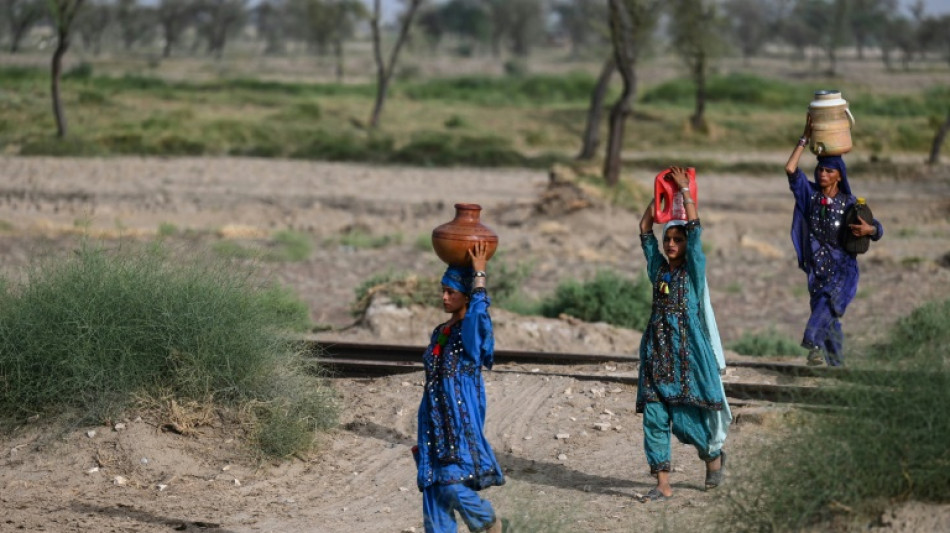
South Asia pummelled by heatwave that hits 50C in Pakistan / Photo: © AFP

 Germans vote in elections threatening fresh blow to Merz

 US fears rapid escalation in Mideast after Houthis attack Riyadh

 Japan triathlete Hojo wins first gold of Asian Games

 IOC president impressed by 'beautiful' Asian Games wooden huts

 First Asian Games gold goes to Japan as China's 13-year-old Yu lights up pool

 Data centre command hub keeps AI up and running

 Pope Leo in France: the issues on the table

 Packing for a pope: behind the scenes on foreign trips

 Republicans find transgender issues a powerful political weapon in midterm campaigning

 German state elections threaten new shock waves for Merz

 Chile's Bachelet quits race to be next UN chief

 Raphinha treble fires perfect Barca to win at Sevilla

 Thiam makes winning heptathlon return at Decastar meet

 Czechs beat USA to qualify for Davis Cup finals

 Dortmund sink Stuttgart to climb to Bundesliga summit

 Trump says will not tolerate attempts to slow AI growth

 'It has to stop': runners protest women's murders in S.Africa district

 Fire erupts near Riyadh airport as Houthis claim strikes

 Cuba works to restore power after another blackout

 England thrash Sri Lanka again to return to top of T20 rankings

 Arsenal thrashed by Brighton, sorry Spurs lose again

 South Korea, Austria qualify for Davis Cup finals

 Seare shocks Ingebrigtsen to win world 5km gold

 Brigitte Bardot widower slams sale of star's belongings

 Aston Villa compound Tottenham's misery despite late rally

South Asia was in the grip of an extreme heatwave on Friday, with parts of Pakistan reaching a temperature of 50 degrees Celsius as officials warned of acute water shortages and a health threat.
Swathes of Pakistan and neighbouring India have been smothered by high temperatures since April in extreme weather that the World Meteorological Organization has warned is consistent with climate change.
On Friday, the city of Jacobabad in Sindh province hit 50C (122 degrees Fahrenheit), the Pakistan Meteorological Department (PMD) said, with temperatures forecast to remain high until Sunday.
"It's like fire burning all around," said labourer Shafi Mohammad, who is from a village on the outskirts of Jacobabad where residents struggle to find reliable access to drinking water.
Nationwide, the PMD alerted temperatures were between 6C and 9C above normal, with the capital Islamabad -- as well as provincial hubs Karachi, Lahore and Peshawar -- recording temperatures around 40C on Friday.
"This year we have jumped from winter right into summer," said PMD chief forecaster Zaheer Ahmad Babar.
Pakistan has endured heightened heatwaves since 2015, he said, especially in upper Sindh province and southern Punjab province.
"The intensity is increasing, and the duration is increasing, and the frequency is increasing," he told AFP.
Jacobabad nurse Bashir Ahmed says that, for the past six years, heatstroke cases in the city have been diagnosed earlier in the year -- starting in May, rather than June or July.
"This is just increasing," he said.
Far worse may be on the horizon for South Asia as climate change continues apace, top climate scientists have said.
- 'Take cover' -
Punjab province irrigation spokesman Adnan Hassan said the Indus river -- Pakistan's key waterway -- had shrunk by 65 per cent "due to a lack of rains and snow" this year.
Sheep have reportedly died from heatstroke and dehydration in the Cholistan Desert of Punjab -- Pakistan's most populous province, which also serves as the national breadbasket.
"There is a real danger of a shortfall in food and crop supply this year in the country should the water shortage persist," Hassan said.
Pakistan's climate minister Sherry Rehman this week warned residents in the megacity of Lahore "to take cover for the hottest hours of the day".
The heatwave has also ravaged India, with temperatures in parts of Rajasthan hitting 48.1C on Thursday and expected to hit 46C in Delhi anytime from Sunday.
Suman Kumari, 19, a student who lives in northwest Delhi, told AFP: "It was so hot today that I felt exhausted and sick while returning from college in a bus. The bus seemed like an oven. With no air conditioning, it was sizzling hot inside," she said.
Most schools have declared summer holidays from Monday for junior classes.
Heatwaves were also predicted in parts of northwest India including areas of Rajasthan, Madhya Pradesh, Maharashtra and Uttar Pradesh -- collectively home to hundreds of millions of people -- over the coming days.
But some respite is expected when the southwest monsoon makes its advance into the Andaman Sea and adjoining Bay of Bengal around May 15, said the India Meteorological Department.
As power outages exacerbate heatwaves, India plans to lease abandoned coal pits to private mining companies, a government official said on Friday, in an effort to ramp up production.
Pakistan has also faced severe power outages, with some rural areas getting as few as six hours of electricity a day.
- Rapid glacier melt -
Home to 220 million -- Pakistan says it is responsible for less than one percent of global greenhouse gas emissions.
But it ranks as the nation eighth most affected by extreme weather events, according to a 2021 study by environmental group Germanwatch.
Extreme heat can also trigger cascading disasters that could pummel Pakistan's generally impoverished population.
The mountainous portions of the country are home to more than 7,000 glaciers, a number larger than any region outside the poles.
Quickly melting glaciers can swell lakes, which then burst their banks and unleash torrents of ice, rock and water in events known as glacial lake outburst floods.
Last weekend a key highway bridge in the Gilgit-Baltistan region was swept away in flash flooding caused by glacier melt.
In April, officials warned there were 33 lakes in Pakistan in danger of unleashing similar dangerous deluges.
L.Janezki--BTB