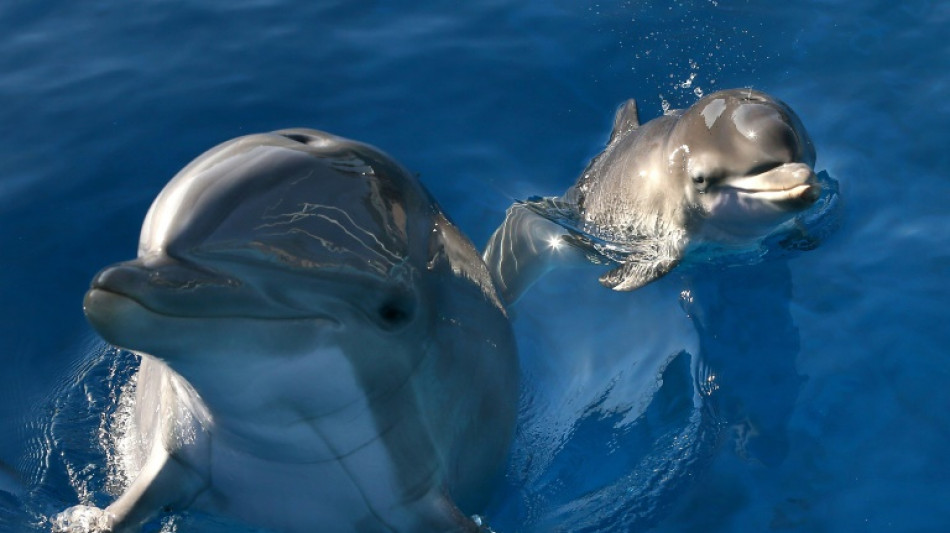
Pee pals: Dolphins taste friends' urine to know they're around / Photo: © GETTY IMAGES NORTH AMERICA/AFP/File

 Drones hit Moscow as Russians go to the polls

 New England boss Fleming says 'wrong' to ask Stokes to end retirement

 Germans vote in elections threatening fresh blow to Merz

 US fears rapid escalation in Mideast after Houthis attack Riyadh

 Japan triathlete Hojo wins first gold of Asian Games

 IOC president impressed by 'beautiful' Asian Games wooden huts

 First Asian Games gold goes to Japan as China's 13-year-old Yu lights up pool

 Data centre command hub keeps AI up and running

 Pope Leo in France: the issues on the table

 Packing for a pope: behind the scenes on foreign trips

 Republicans find transgender issues a powerful political weapon in midterm campaigning

 German state elections threaten new shock waves for Merz

 Chile's Bachelet quits race to be next UN chief

 Raphinha treble fires perfect Barca to win at Sevilla

 Thiam makes winning heptathlon return at Decastar meet

 Czechs beat USA to qualify for Davis Cup finals

 Dortmund sink Stuttgart to climb to Bundesliga summit

 Trump says will not tolerate attempts to slow AI growth

 'It has to stop': runners protest women's murders in S.Africa district

 Fire erupts near Riyadh airport as Houthis claim strikes

 Cuba works to restore power after another blackout

 England thrash Sri Lanka again to return to top of T20 rankings

 Arsenal thrashed by Brighton, sorry Spurs lose again

 South Korea, Austria qualify for Davis Cup finals

 Seare shocks Ingebrigtsen to win world 5km gold

Think about people you know, and how you could tell they were around even if you couldn't see them: perhaps their voice, or a favored perfume.
For bottlenose dolphins, it's the taste of urine and signature whistles that allow them to recognize their friends at a distance, according to a study published Wednesday in Science Advances.
"Dolphins keep their mouths open and sample urine longer from familiar individuals than unfamiliar ones," first author Jason Bruck of the Stephen F. Austin State University in Texas wrote in an email to AFP.
"This is important because dolphins are the first vertebrate ever shown to have social recognition through taste alone."
The team, which included Sam Walmsley and Vincent Janik from the University of St Andrews, wrote that the use of taste could be highly beneficial in the open ocean because urine plumes persist for a while after an animal has left.
This alerts dolphins to the recent presence of that individual even if it had not signaled its presence vocally.
The question of whether animals can attach "labels" to their friends in their minds has been difficult to answer.
Bottlenose dolphins, which use signature whistles to selectively address specific individuals, and can remember these for over 20 years, were thus an interesting test case.
To investigate, the team presented eight dolphins with urine samples from familiar and unfamiliar individuals, finding they spent around three times as long sampling urine from those they knew.
Genital inspection, in which a dolphin uses its jaw to touch the genitals of another individual, is common in their social interactions, providing a good opportunity to learn the taste of others' urine.
For the purposes of this study, the dolphins were trained to provide urine samples on demand in exchange for food.
Dolphins do not have olfactory bulbs, leaving the team certain it was taste and not smell at play.
For the second part of the experiment, the team paired urine samples with recordings of signature whistles played via underwater speakers, corresponding to either the same dolphin that provided the urine sample, or a mismatched sample.
Dolphins remained close to the speaker longer when the vocalizations matched the urine samples -- potentially indicating that the two congruent lines of evidence together evoked more interest.
"It is not every day that scientists find evidence of 'noun'-like use of signals in a non-human vocal system. That's pretty exciting," Bruck told AFP.
Dolphins have rich social worlds, he added, and it may be "just as advantageous for a dolphin to recognize alliance members as it is for them to recognize potential antagonists."
- Obesity connection? -
The team suggested that lipids were likely responsible for individual chemical signatures.
"Given the recognition skills revealed in our study, we think that it is likely that dolphins can also extract other information from urine, such as reproductive state, or use pheromones to influence each other's behavior," they wrote.
In a surprising twist, the research could have implications for human obesity: the same gene that allows dolphins to identify lipids in urine is present in humans, where it helps people know when they have had enough to eat.
Studying the gene in dolphins could therefore improve understanding of how it works in people.
The work could also have other implications: human-caused pollution such as oil spills or other chemical runoff may impede the dolphins' ability to signal one another, thus doing even more harm than previously thought, said Bruck.
H.Seidel--BTB

