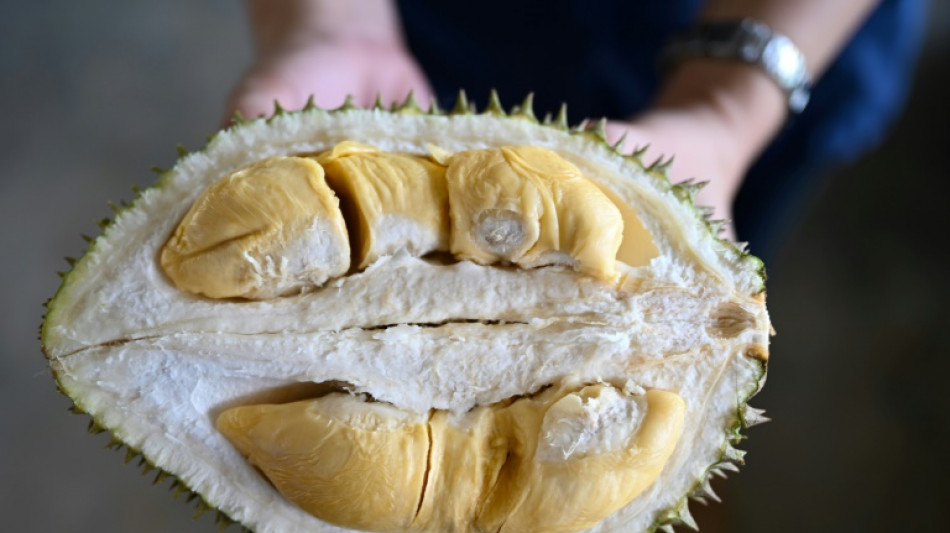
From drones to sensors, Malaysian durian grower goes high-tech / Photo: © AFP

 Drones hit Moscow as Russians go to the polls

 New England boss Fleming says 'wrong' to ask Stokes to end retirement
 Germans vote in elections threatening fresh blow to Merz

 US fears rapid escalation in Mideast after Houthis attack Riyadh

 Japan triathlete Hojo wins first gold of Asian Games

 IOC president impressed by 'beautiful' Asian Games wooden huts
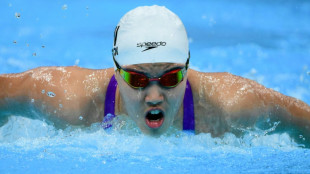 First Asian Games gold goes to Japan as China's 13-year-old Yu lights up pool

 Data centre command hub keeps AI up and running
 Pope Leo in France: the issues on the table

 Packing for a pope: behind the scenes on foreign trips

 Republicans find transgender issues a powerful political weapon in midterm campaigning

 German state elections threaten new shock waves for Merz

 Chile's Bachelet quits race to be next UN chief

 Raphinha treble fires perfect Barca to win at Sevilla

 Thiam makes winning heptathlon return at Decastar meet

 Czechs beat USA to qualify for Davis Cup finals

 Dortmund sink Stuttgart to climb to Bundesliga summit

 Trump says will not tolerate attempts to slow AI growth

 'It has to stop': runners protest women's murders in S.Africa district

 Fire erupts near Riyadh airport as Houthis claim strikes

 Cuba works to restore power after another blackout

 England thrash Sri Lanka again to return to top of T20 rankings

 Arsenal thrashed by Brighton, sorry Spurs lose again

 South Korea, Austria qualify for Davis Cup finals

 Seare shocks Ingebrigtsen to win world 5km gold

Drones spraying pesticide, sensors taking soil readings, sprinklers that squirt fertiliser at the touch of a button -- a Malaysian plantation is using high-tech methods to boost its crop of pungent durians.
Grown across Southeast Asia, fans hail the spiky durian as the "king of fruit" due to its bittersweet flavours and creamy golden flesh, and it is particularly popular in China.
But to its detractors it is the world's smelliest fruit, with an overpowering stench like rotting food that has seen it banned in hotels and on public transport across the region.
In a competitive market, Malaysian grower Top Fruits Plantations has turned to high-tech methods to lift its output.
"It's a much faster way to get more consistent results," managing director Tan Sue Sian told AFP during a recent tour of one of the company's plantations in Batu Pahat, southern Johor state.
Using technology allows farmers to gauge more precisely how much fertiliser and water the trees need, he said.
"When you give what is needed, the fruit will be much more consistent. The shape will be better, and the aroma will be better," added Tan, who has more than 30 years' experience growing durians.
- Sensors essential -
Key in the drive are sensors spread across 400 acres (160 hectares) of Top Fruits' 700-acre Batu Pahat plantation, relaying data on soil quality and content to workers' handheld devices.
The sensors are boxes mounted on poles, connected to the soil with a series of cables. By 2024, the entire plantation should be kitted out with them.
Sprinklers attached to a network of pipes are remotely activated to spray fertiliser onto the trees, while drones hover over the plantation squirting pesticide.
Such methods are unheard of on Malaysian durian farms, where growers typically rely on a large labour force, instinct and educated guesses.
The investment has been hefty -- Top Fruits has spent about four million ringgit ($900,000) over the past three years on the technology.
But it has led to an increase in yields of 40 percent, while its workforce has shrunk by 30 percent.
The company is now able to produce 800 tonnes of durians from its farms every year, with more than 80 per cent of its crop frozen in factories to be exported overseas, much of it to China.
In a bid to further boost their crop, Top Fruits is getting into research by setting up a lab and collaborating with local universities.
K.Thomson--BTB