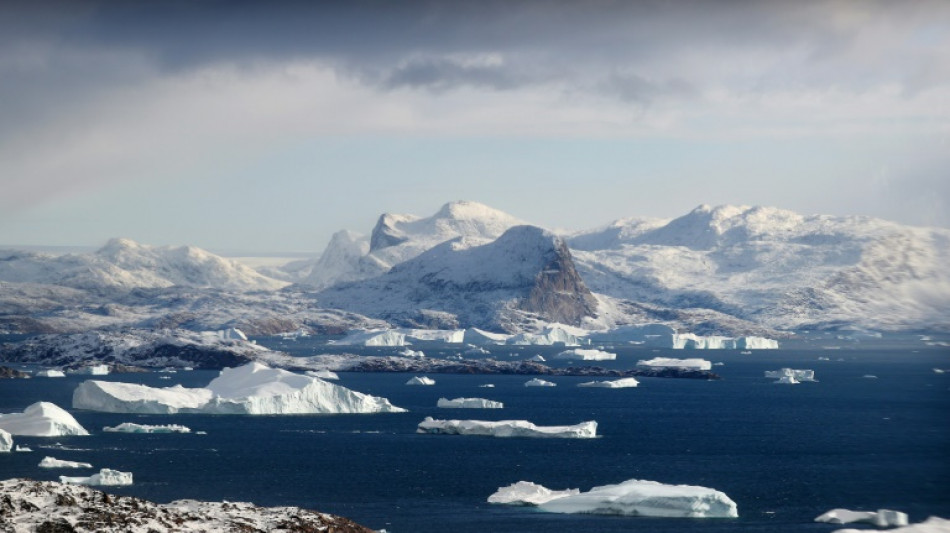
Greenland ice cap loses enough water in 20 years to cover US: study / Photo: ©

 Ed Sheeran returns to stage after Palestinian controversy

 Asian Games to open in Japan after troubled build-up

 Drone owners rush to offload devices ahead of Beijing ban

 Trump's beef policies irk Texas ranchers, testing their loyalty

 Nvidia, OpenAI CEOs to attend Xi dinner at White House

 Anthropic picks Accenture for in-house AI safety evaluation
 Balogun returns as Monaco beat Lens to continue strong Ligue 1 start

 'Pause' on overt repression in Venezuela, but reforms still needed: HRW

 Global stocks mixed as yen falls despite Bank of Japan rate hike

 Cuba hit with seventh major blackout of the year

 Murray out with concussion so Wentz will start for Vikings

 UN chief 'deeply regrets' US visa refusal to Abbas for annual meeting

 England quick Carse to face no charges over alleged nightclub assault

 Mancini brings nine newcomers into the first squad of his Italy comeback

 Czechs level Davis Cup tie against USA as South Korea eye Finals

 New France boss Zidane confirms Mbappe as captain after naming first squad

 California governor signs order to explore AI 'kill switch'

 Head leads run spree as Australia win Zimbabwe ODI series

 In-form Raphinha wants to finish career at Barcelona

 Warren Buffett steps down as Berkshire Hathaway chairman

 Carrick confident Man Utd can 'work through' tough time

 Mbappe ends Nike partnership to join Swiss brand On

 Liverpool boss Iraola puts Bournemouth love affair on hold

 'A disaster' if Man City do not win says Maresca after flawless start

 Kerry James Marshall: American 'blackness' painter celebrated in Europe

Greenland's immense ice sheet has lost enough ice in the past 20 years to submerge the entire United States in half a metre of water, according to data released this week by Danish researchers.
The climate is warming faster in the Arctic than anywhere else on the planet and melting ice from Greenland is now the main factor in the rise in the Earth's oceans, according to NASA.
Since measurements began in 2002, the Greenland ice sheet has lost about 4,700 billion tonnes of ice, said Polar Portal, a joint project involving several Danish Arctic research institutes.
This represents 4,700 cubic kilometres of melted water -- "enough to cover the entire US by half a meter" -- and has contributed 1.2 centimetres to sea level rise, the Arctic monitoring website added.
Polar Portal's findings are based on satellite imagery from the US-German GRACE programme (Gravity Recovery and Climate Experiment), which showed the ice melt to be most severe near the coasts of the Arctic territory, at the edge of the ice sheet.
In these peripheral zones, "independent observations also indicate that the ice is thinning, that the glacier fronts are retreating in fjords and on land, and that there is a greater degree of melting from the surface of the ice", the website said.
The west coast of Greenland is particularly affected, according to the data.
Climate change is particularly alarming in the Arctic, which scientists say is warming at a rate three to four times the global average.
According to a study published by NASA in late January, the accelerated melting near Greenland's coasts can be explained by the warming of the Arctic Ocean.
The phenomenon "is melting Greenland's glaciers at least as much as warm air is melting them from above".
Melting ice from Greenland is currently the main factor in the rise in the Earth's oceans and the territory's glaciers are now retreating six to seven times faster than they were 25 years ago, the US agency added.
According to climate scientists, the Greenland ice sheet contains enough water to raise the oceans by more than seven metres, and the ice sheet in Antarctica contains enough for a rise of almost 50 metres.
Arctic sea ice cover, although its melting has no effect on sea levels, has also shrunk considerably, losing almost 13 percent of its average surface area every 10 years.
O.Krause--BTB