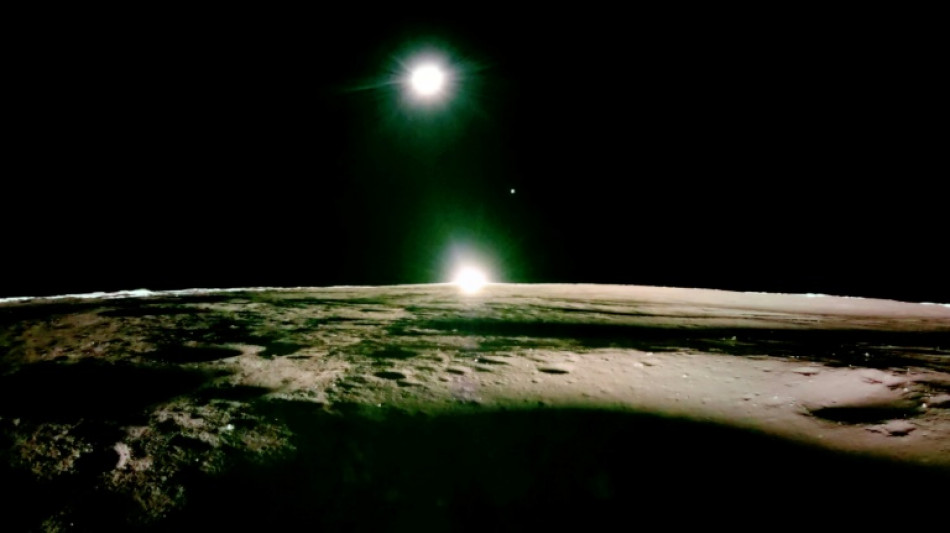
Ghostly lunar sunsets shot by private lander / Photo: © Firefly Aerospace/AFP

 Malta Stuns Sweden with Late Penalty Comeback in Rugby Europe Trophy

 BingX: Major Announcement of Far-Reaching Significance

 Élan Opens as Late-Night Wine Bar in Honolulu

 Shiv Sena (UBT) Criticizes NCP Merger Talks as 'Ridiculous Laughing Stock'

 Dell Announces AI-Integrated PC Lineup for 2026 with Wi-Fi 7 Support

 Rocky Fans Break Guinness World Record at Philadelphia Museum Steps

 FAA Grounds All US Flights Amid Nationwide Air Traffic Control Communication Failure

 Argentina vs Uruguay Kick-off Time, TV Channels & Free Streaming Guide

A private US lander has captured eerie high-definition images of a lunar sunset, which NASA hopes will help unravel the mystery of a strange haze first observed on the Moon in the 1960s.
Texas-based Firefly Aerospace, which published the pictures on Tuesday, became the first private company to land a robotic spacecraft upright on the Moon earlier this month.
Its Blue Ghost lander -- roughly the size of two rhinos side by side -- touched down on March 2 at Mons Latreille, a volcanic feature within Mare Crisium on the Moon's northeastern near side, and operated until March 16 when it powered down with the onset of the lunar night.
One of the new images shows the Sun glowing just above the horizon, its halo tinged with green.
Above it, a small dot marks Venus, while Earth's bright reflection appears almost as large as the Sun at the top of the frame. Another view reveals the setting Sun bathed in a green glow, as seen from a west-facing camera.
"We are taking time to have scientific specialists go over all the imagery," said Joel Kearns, deputy associate administrator for exploration at NASA's Science Mission Directorate.
"One of the things they will be looking for is to see if they can identify 'horizon glow' or a mechanism called 'dust lofting.'"
Scientists believe lunar dust particles may become electrically charged due to ultraviolet radiation from the Sun, causing them to levitate above the surface. The phenomenon was first spotted by NASA's Surveyor probes in the 1960s and later observed by Apollo astronauts.
Kearns noted that scientists will compare the images with complementary readings from Blue Ghost's instruments, including electromagnetic field and radiation sensors, to refine existing theories.
"The images themselves are beautiful, they're really aesthetic," he said.
The west-facing image, in particular, shows soil in front of the lander illuminated by light reflected from mountains behind it. The picture's level of detail could help scientists refine models of how light scatters on the lunar surface.
Earlier in the mission, Blue Ghost also captured high-definition imagery of a total solar eclipse from the Moon on March 14.
The mission was part of a NASA-industry collaboration aimed at cutting costs and supporting Artemis, the program to return astronauts to the Moon and use lessons learned there to go to Mars.
Firefly Aerospace's spaceflight program director, Ray Allensworth, said the company is already applying lessons to future flights, including Blue Ghost-2 and Blue Ghost-3.
"The lander is absolutely not designed to survive the extreme cold of lunar night, so I think the probability is very low that we will power back on -- but this lander has surprised me," she added.
P.Anderson--BTB