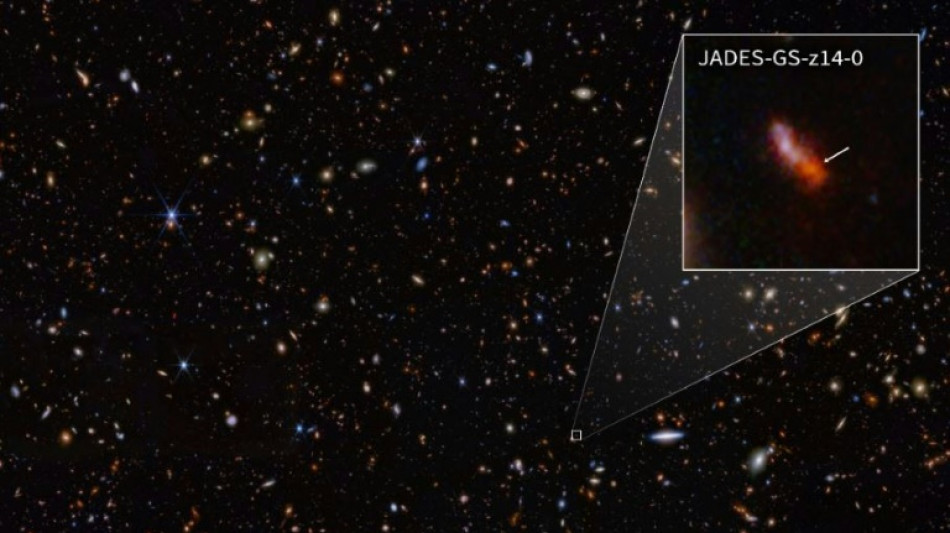
Oxygen detected in most distant galaxy: 'astonished' astronomers / Photo: © ESA, NASA, CSA, STScI/AFP/File

 Trump renames AI "super intelligence," rejects international oversight

 Trump rejects international regulation of AI

 How is the EU approaching record fuel prices?

 Sri Lanka's Colombage strikes on debut as England dismissed for 265 in first ODI

 Hurricane Polo strengthens to top category 5 off Mexico

 11 hurt as teen opens fire outside school in western Turkey

 UN chief says 'Big Oil' treats atmosphere as open sewer

 Tunisia says 2026 summer hottest on record

 England's Rashid out of Sri Lanka ODIs with hand injury

 Houthis accuse Saudi Arabia of deadly strikes as thousands flee

 Stocks climb as oil slides, AI buzz returns

 India cricketers win in style as Afghan savours 'special' Games silver

 La Liga president hits out at Real Madrid refereeing 'conspiracy' claims

 MEXC Launches “Real Stocks, Real Friends” with Rewards for Bringing Friends to Wall Street

 Mbappe continues media push for Ballon d'Or recognition

 Stocks rise on AI buzz, oil prices cool

 India narrowly survive huge scare against minnows Japan

 Missing F-35 fighter parts 'not sensitive', says Australia minister

 Cambodia showcases scams crackdown with global conference

 Afghan cyclist who disguised herself as man wins Asian Games silver

 Typhoon Dujuan leaves four dead in Japan, 45,000 houses without power

 G7 leaders condemn Houthi strikes on Saudi Arabia

 Google data centre sparks protests in Austria

 Shin Ohashi: Junk food-loving teen and Japan's next big swimming hope

 Stocks rise on AI buzz, drop in oil prices

Oxygen has been detected in the most distant galaxy ever discovered, surprised astronomers said Thursday, offering further evidence that stars in the early universe matured far quicker than had been thought possible.
The galaxy JADES-GS-z14-0, which was discovered by the James Webb Space Telescope last year, is so far away that its light took 13.4 billion years to reach Earth.
This means the galaxy can also reveal what the universe was like in its infancy, when it was just 300 million years old -- two percent of its current age.
Since coming online in 2022, the powerful Webb telescope has discovered that galaxies in the young universe were much brighter, more advanced and more numerous than scientists had expected.
These discoveries have been so startling they have raised doubts about whether something important is missing in our understanding of the universe.
For the latest research, two international teams led by Dutch and Italian astronomers probed the JADES-GS-z14-0 galaxy using the ALMA radio telescope in Chile's Atacama desert.
They detected traces of oxygen, according to the European Southern Observatory, confirming hints previously spotted by the Webb telescope.
During this period known as the cosmic dawn, newly born galaxies were thought to only have young stars, which mostly contain light elements like hydrogen and helium.
Only later were they supposed to get heavier stuff such as oxygen.
But the two new studies found that JADES-GS-z14-0 has around 10 times more heavy elements than had been anticipated.
"It is like finding an adolescent where you would only expect babies," said Sander Schouws of Leiden Observatory, the first author of a Dutch-led study to be published in The Astrophysical Journal.
"The results show the galaxy has formed very rapidly and is also maturing rapidly, adding to a growing body of evidence that the formation of galaxies happens much faster than was expected," he said in a statement.
Astrophysicist Stefano Carniani, lead author of the Italian-led paper to be published in Astronomy & Astrophysics, said he was "astonished by the unexpected results".
"The evidence that a galaxy is already mature in the infant universe raises questions about when and how galaxies formed."
K.Thomson--BTB