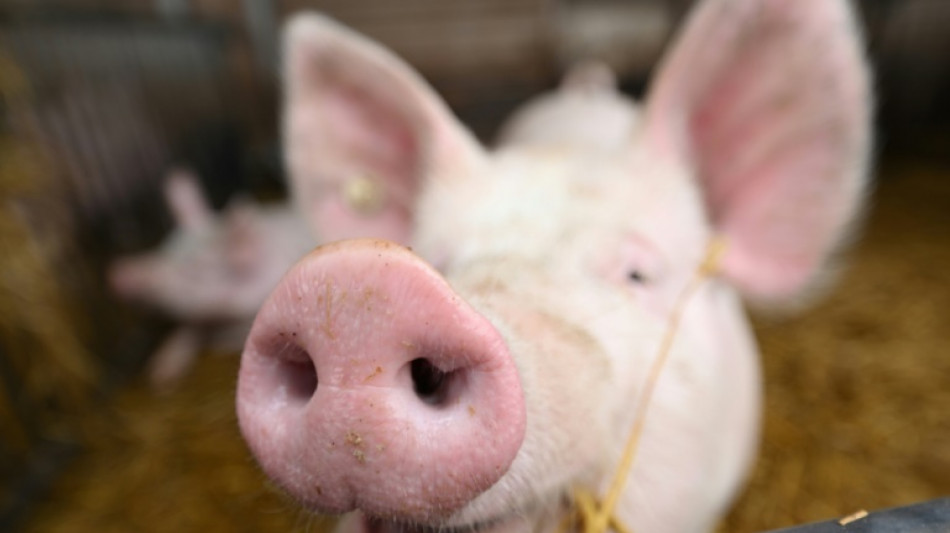
Chinese doctors implant pig liver in human for first time / Photo: © AFP/File

 Trump renames AI "super intelligence," rejects international oversight

 Trump rejects international regulation of AI

 How is the EU approaching record fuel prices?

 Sri Lanka's Colombage strikes on debut as England dismissed for 265 in first ODI

 Hurricane Polo strengthens to top category 5 off Mexico

 11 hurt as teen opens fire outside school in western Turkey

 UN chief says 'Big Oil' treats atmosphere as open sewer

 Tunisia says 2026 summer hottest on record

 England's Rashid out of Sri Lanka ODIs with hand injury

 Houthis accuse Saudi Arabia of deadly strikes as thousands flee

 Stocks climb as oil slides, AI buzz returns

 India cricketers win in style as Afghan savours 'special' Games silver

 La Liga president hits out at Real Madrid refereeing 'conspiracy' claims

 MEXC Launches “Real Stocks, Real Friends” with Rewards for Bringing Friends to Wall Street

 Mbappe continues media push for Ballon d'Or recognition

 Stocks rise on AI buzz, oil prices cool

 India narrowly survive huge scare against minnows Japan

 Missing F-35 fighter parts 'not sensitive', says Australia minister

 Cambodia showcases scams crackdown with global conference

 Afghan cyclist who disguised herself as man wins Asian Games silver

 Typhoon Dujuan leaves four dead in Japan, 45,000 houses without power

 G7 leaders condemn Houthi strikes on Saudi Arabia

 Google data centre sparks protests in Austria

 Shin Ohashi: Junk food-loving teen and Japan's next big swimming hope

 Stocks rise on AI buzz, drop in oil prices

Chinese doctors said Wednesday that they had transplanted a liver from a genetically modified pig into a brain-dead human for the first time, raising hopes of a live-saving donor option for patients in the future.
Pigs have emerged as the best animal organ donors, with several living patients in the United States having received pig kidneys or hearts in the last few years.
Livers have proved trickier -- and had not previously been tested out inside a human body.
But with a huge and growing demand for liver donations across the world, researchers hope that gene-edited pigs can offer at least temporary relief to seriously ill patients on long waiting lists.
Doctors at the Fourth Military Medical University in Xi'an, China, announced the field's latest breakthrough in a study in the journal Nature.
A liver from a miniature pig, which had six edited genes to make it a better donor, was transplanted into a brain-dead adult at the hospital on March 10, 2024, according to the study.
The trial was terminated after 10 days at the request of the family, the doctors said, adding that they had followed strict ethical guidelines.
- 'Bridge organ' -
The patient, whose name, gender and other details were not revealed, still had their original liver, receiving what is called an auxiliary transplant.
The hope is that this kind of transplant can serve as a "bridge organ" to support the existing liver of sick people waiting on a human donor.
Over the 10 days, the doctors monitored the liver's blood flow, bile production, immune response and other key functions.
The pig liver "functioned really well" and "smoothly secreted bile" as well as producing the key protein albumin, study co-author Lin Wang of the Xi'an hospital told a press conference.
"It's a great achievement" that could help people with liver problems in the future, he added.
Other researchers also hailed the breakthrough but emphasised that this early step could not confirm whether the pig organ would work as a replacement for human livers.
Transplants of livers have proved difficult because they carry out several different functions -- unlike hearts, for example, which simply pump blood, Lin said.
Livers filter the body's blood, breaking down things like drugs and alcohol, as well as producing bile that carries away waste and breaks down fats.
The pig liver produced far smaller amounts of bile and albumin than a human liver could achieve, Lin said.
More research is needed -- including studying the pig liver for more than 10 days, he added.
Next, the doctors plan to trial the gene-edited pig liver in a living human.
- 'Impressive' -
Oxford University transplantation professor Peter Friend, who was not involved in the study, said the results were "valuable and impressive".
However, "this is not a replacement for liver transplantation from human donors (at least in the near-term)," he told AFP in an email.
"This is a useful test of the compatibility of genetically modified livers with humans and points to a future in which such livers can provide support for patients in liver failure."
Lin emphasised that collaboration with US researchers was crucial.
"To be frank, we have learned quite a lot from all the research performed and investigated by the United States doctors," he said.
Last year, scientists at the University of Pennsylvania attached a pig liver to a brain-dead patient -- but instead of being transplanted, the organ remained outside the body.
Both US recipients of pig heart transplants died.
But Towana Looney, 53, is back home in Alabama after receiving a pig kidney on November 25, 2024.
J.Fankhauser--BTB