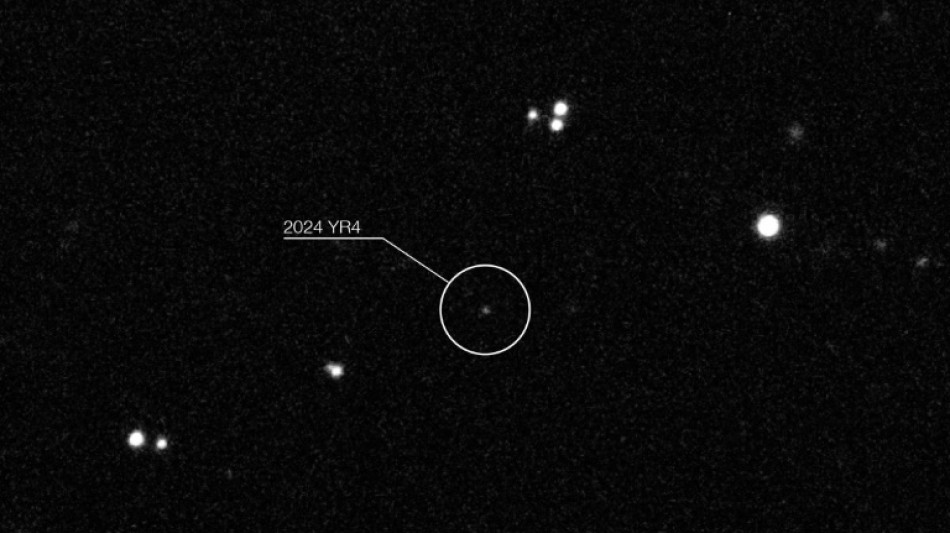
Rising odds asteroid that briefly threatened Earth will hit Moon / Photo: © European Southern Observatory/AFP/File

 Trump renames AI "super intelligence," rejects international oversight

 Trump rejects international regulation of AI

 How is the EU approaching record fuel prices?
 Sri Lanka's Colombage strikes on debut as England dismissed for 265 in first ODI

 Hurricane Polo strengthens to top category 5 off Mexico

 11 hurt as teen opens fire outside school in western Turkey

 UN chief says 'Big Oil' treats atmosphere as open sewer

 Tunisia says 2026 summer hottest on record

 England's Rashid out of Sri Lanka ODIs with hand injury

 Houthis accuse Saudi Arabia of deadly strikes as thousands flee

 Stocks climb as oil slides, AI buzz returns

 India cricketers win in style as Afghan savours 'special' Games silver

 La Liga president hits out at Real Madrid refereeing 'conspiracy' claims

 MEXC Launches “Real Stocks, Real Friends” with Rewards for Bringing Friends to Wall Street

 Mbappe continues media push for Ballon d'Or recognition

 Stocks rise on AI buzz, oil prices cool

 India narrowly survive huge scare against minnows Japan

 Missing F-35 fighter parts 'not sensitive', says Australia minister

 Cambodia showcases scams crackdown with global conference
 Afghan cyclist who disguised herself as man wins Asian Games silver

 Typhoon Dujuan leaves four dead in Japan, 45,000 houses without power

 G7 leaders condemn Houthi strikes on Saudi Arabia

 Google data centre sparks protests in Austria

 Shin Ohashi: Junk food-loving teen and Japan's next big swimming hope

 Stocks rise on AI buzz, drop in oil prices

An huge asteroid that was briefly feared to strike Earth now has a nearly four percent chance of smashing into the Moon, according to new data from the James Webb Space Telescope.
The asteroid, thought to be capable of levelling a city, set a new record in February for having the highest chance -- 3.1 percent -- of hitting our home planet than scientists have ever measured.
Earth's planetary defence community leapt into action and further observations quickly ruled out that the asteroid -- called 2024 YR4 -- will strike Earth on December 22, 2032.
But the odds that it will instead crash into Earth's satellite have been steadily rising.
After the Webb telescope turned its powerful gaze towards the asteroid last month, the chance of a Moon shot is now at 3.8 percent, NASA said.
"There is still a 96.2 percent chance that the asteroid will miss the Moon," NASA said in a statement on Thursday.
Richard Moissl, head of the European Space Agency's planetary defence office, told AFP that this aligned with their internal estimates of around four percent.
The new Webb data also shed light on the size of the space rock, which was previously estimated to be between 40 and 90 metres (131 to 295 feet).
It is now believed to be 53 to 67 metres, roughly the height of a 15-storey building.
This is significant because it is bigger than the 50-metre threshold for activating planetary defence plans.
If the asteroid still had a more than one percent chance of hitting Earth, "the development of one or more deflection missions would already be starting now", Moissl said.
There are a range of ideas for how Earth could fend off an oncoming asteroid, including nuclear weapons and lasers.
But only one has been tested on an actual asteroid. In 2022, NASA's DART mission successfully altered a harmless asteroid's trajectory by smashing a spacecraft into it.
- 'Perfect opportunity' -
While no one wanted to need to test Earth's defences on the potentially hugely destructive asteroid 2024 YR4, many scientists are hoping it will strike the Moon.
"The possibility of getting a chance for an observation of a sizeable Moon impact is indeed an interesting scenario from a scientific point of view," Moissl said.
It could offer up a range of information that would be "valuable for planetary defence purposes," he added.
Mark Burchell, a space scientist at the UK's University of Kent, told New Scientist that a Moon hit would be "a great experiment and a perfect opportunity".
And on Earth, "telescopes would certainly see it, I would say, and binoculars might see it," he added.
The asteroid is the smallest object ever targeted by the Webb telescope.
Webb's measurements of the space rock's thermal data indicate that it "does not share properties observed in larger asteroids", the European Space agency said in a statement.
"This is likely a combination of its fast spin and lack of fine-grained sand on its surface," it said, adding that this was more common in fist-sized asteroids.
More information will come when Webb again observes the asteroid again next month.
J.Bergmann--BTB