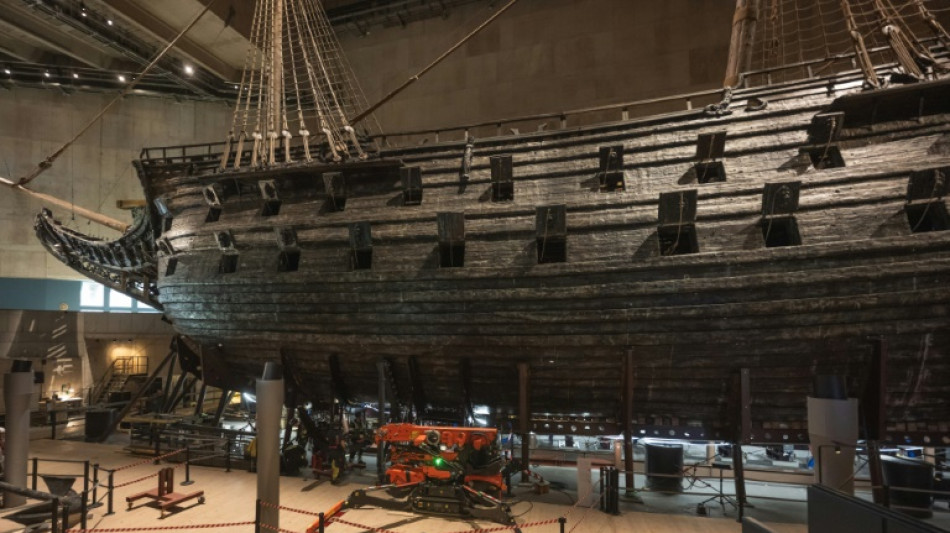
Race to save Sweden's 17th century warship in preservation project / Photo: © AFP

 Shiv Sena (UBT) Criticizes NCP Merger Talks as 'Ridiculous Laughing Stock'

 Dell Announces AI-Integrated PC Lineup for 2026 with Wi-Fi 7 Support

 Rocky Fans Break Guinness World Record at Philadelphia Museum Steps

 FAA Grounds All US Flights Amid Nationwide Air Traffic Control Communication Failure

 Argentina vs Uruguay Kick-off Time, TV Channels & Free Streaming Guide

 Wedding Etiquette: When Is It Appropriate to Bring a Plus-One?

A Swedish museum has launched a massive four-year project to preserve the sagging hull of the Vasa, a majestic warship that sank nearly 400 years ago and is now one of Sweden's most popular tourist attractions.
Experts have begun putting in place a complex metal structure to support the hull, which more than 60 years after its salvage has begun to sag in the Stockholm museum custom-built for it.
"Today we put in a part of the new support structure, one cradle, and it's needed because the ship needs better support, because the old one from 1961 doesn't cut it anymore," said project leader Peter Rydebjork, showing off the new structure around the 17th century warship.
Due for completion in 2028, in time to mark the 400th anniversary of the shipwreck, the cost of the project is estimated at up to 17.7 million euros ($19.5 million).
Originally intended to sail to the southern Baltic, the three-masted Vasa -- a symbol of a rising Swedish kingdom -- sank only a few hundred metres into its maiden voyage in 1628.
After just fifteen minutes at sea, it capsized and sank in Stockholm's harbour due to a design flaw. The incident claimed the lives of several dozen crewmembers.
Well-preserved in the cold mud and low-salinity waters of the Baltic for more than three centuries, the Vasa was brought to the surface in 1961 after a delicate salvage operation.
Since then, the ship, which is largely intact, has been exhibited at the popular Vasa Museum.
But preserving the wreck is complex: the wood has shrunk over the years and the hull is sagging due to gravity.
It is also listing to one side.
Rydebjork said the old support structure "doesn't really do the work that it should be doing, because the Vasa needs to be supported in the right places."
"The new support structure will actually support the ship where it's strongest on the inside," he added.
The first phase of the project involves stabilising the exterior of the wreck, while a second phase will stabilise the interior.
A third and final phase will right the ship so it no longer lists.
F.Müller--BTB