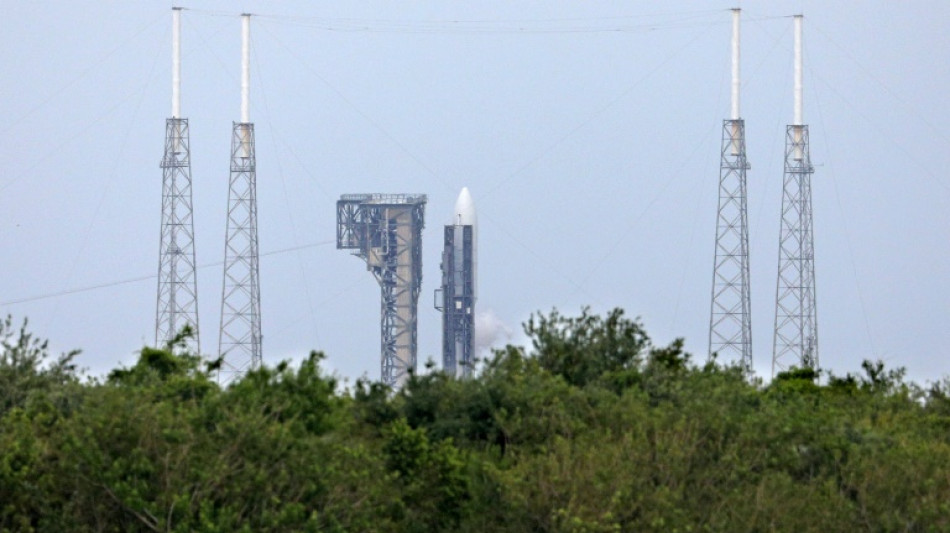
Amazon set for launch of Starlink-rival satellites / Photo: © AFP/File

 Daily Horoscope for November 14, 2026: Astrological Predictions for All Zodiac Signs

 Yes Bank Petitions Supreme Court to Reverse AT-1 Bond Write-Off Ruling

 TK Maxx Beauty Gift Sets Offer Alternative to Christmas Candles

 AI Unlocks Hundreds of Proved Theorems in Kurt Gödel’s Hidden Notebooks

 Info Edge’s Naukri Hits Rs 240 Crore Annualized AI Revenue Run Rate

 Honda Recalls 635,000 Vehicles Over Software-Induced Power Steering Failure

After delaying an earlier attempt due to bad weather, Amazon is preparing to launch its first batch of Project Kuiper internet satellites on Monday, stepping into direct competition with Elon Musk's Starlink.
The mission, called Kuiper Atlas 1, is scheduled to lift off from Cape Canaveral Space Force Station in Florida at 7:00 pm local time (2300 GMT), aboard a United Launch Alliance Atlas V rocket that will carry 27 satellites into orbit.
Weather conditions appeared 75 percent favorable.
Project Kuiper, a subsidiary of the online retail giant founded by Jeff Bezos, is playing catch-up with Starlink -- SpaceX's sprawling network of internet satellites that has reshaped the sector and handed Musk significant geopolitical clout.
The $10 billion initiative plans to deploy 3,200 satellites into low Earth orbit -- the region of space up to 1,200 miles (1,900 kilometers) above the planet -- with hopes of going live later this year.
Pricing has not yet been revealed, but Amazon has pledged it will align with its reputation as a low-cost retailer.
With Monday's launch, Amazon will formally enter a crowded and fast-growing field that includes not just Starlink but other emerging players in the satellite internet race.
SpaceX launched the first batch of Starlink satellites in 2019 and now boasts more than 6,750 operational units, serving over five million customers worldwide -- by far the sector's dominant force.
Starlink has also provided crucial internet access in disaster and war zones, including Morocco after its devastating 2023 earthquake and on the frontlines in Ukraine's war against Russia.
Amazon plans to accelerate launches in the coming months and years, with more than 80 flights booked through United Launch Alliance (a Boeing-Lockheed Martin joint venture), France's Arianespace, Bezos's own Blue Origin, and even Musk's SpaceX.
Its satellites will gradually join the swelling ranks of low Earth orbit, alongside Starlink, Europe's OneWeb, and China's Guowang constellation.
The increasing crowding of this orbital neighborhood has sparked concerns about congestion, potential collisions, and disruptions to astronomical observations.
The expanding role of private companies in space has also raised thorny political questions, especially as Musk's influence stretches beyond business into politics and diplomacy.
Musk has sent mixed signals on Starlink's future role in Ukraine, where it remains vital to Kyiv's war effort -- a conflict that Musk ally US President Donald Trump has vowed to bring to an end.
F.Müller--BTB