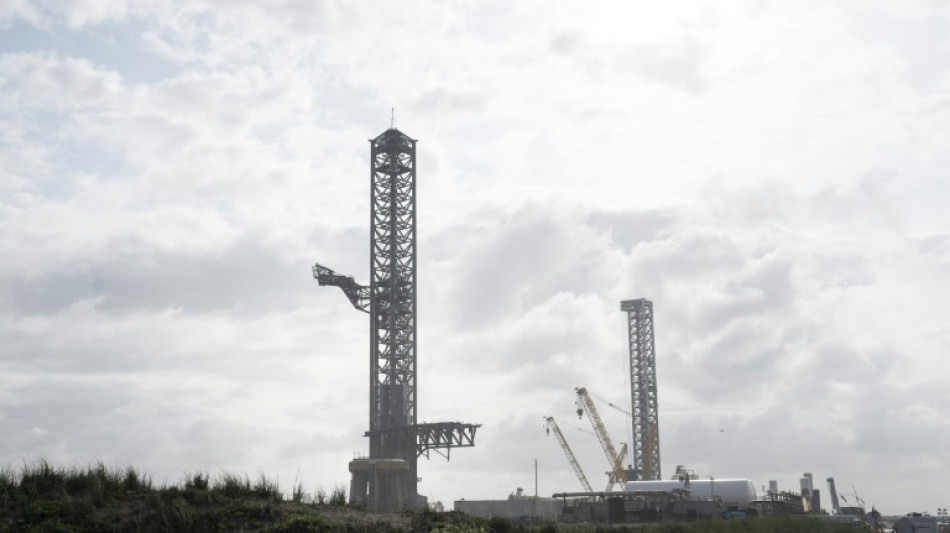
SpaceX gets US approval to launch more Starship flights from Texas / Photo: © AFP/File

 FAA Grounds All US Flights Amid Nationwide Air Traffic Control Communication Failure

 Argentina vs Uruguay Kick-off Time, TV Channels & Free Streaming Guide

 Wedding Etiquette: When Is It Appropriate to Bring a Plus-One?

 North Dakota Enacts Bipartisan Insulin Price Cap Amid National Push
 Readers Question Naughty Dog’s ‘Intergalactic’ Hype and GTA 6 Marketing Strategy

 Westminster Council Unanimously Rejects Green Party Motion in 'Zionism is not racism' Vote
Elon Musk's SpaceX on Tuesday received approval from the US Federal Aviation Administration (FAA) to increase the number of annual Starship rocket launches from five to 25 at its Texas base, marking a major boost for the company's ambitions.
Following a multi-year environmental review, the FAA concluded that the expanded cadence of launches and landings would not significantly affect the environment, overruling objections from conservation groups who warned the move could endanger species such as sea turtles and shorebirds.
Musk's massive campaign donations and close ties to US President Donald Trump have raised concerns over possible conflicts of interest, particularly given the influence of the Department of Government Efficiency -- an entity Musk led -- which exerts significant sway over federal agencies.
"The purpose of SpaceX's proposed action is to provide greater mission capability to NASA and the Department of Defense," the FAA said in its finding.
"SpaceX's activities would continue to fulfill the US expectation that increased capabilities and reduced space transportation costs will enhance exploration (including within the Artemis and Human Landing System programs), support US national security, and make space access more affordable."
The agency reviewed SpaceX's application across multiple criteria, including air quality, noise pollution, and impacts on historic buildings, as well as biological effects at the company's Starbase facility in southern Texas.
A couple weeks after winning the election, Trump visited the facility built by Musk, the world's richest person, who donated more than $270 million to Trump's 2024 presidential campaign.
That facility officially became Starbase City on Saturday, following an election involving 283 eligible voters -- most of whom were SpaceX employees or connected to the company.
The FAA noted that SpaceX was back in compliance after previous unpermitted water discharges associated with launch operations, which made it subject to state and federal enforcement.
It further stated that while launches and sonic booms could "startle" sensitive species, including shorebirds, the overall impact would be minimal.
Ahead of the decision, the public and environmental groups submitted numerous objections.
"In April 2023, a Super Heavy exploded during a failed launch attempt, raining boulder-sized chunks of concrete and flaming debris onto the wildlife refuge," Defenders of Wildlife and Audubon Texas wrote in a joint letter.
"Even a relatively uneventful launch in June 2024 propelled a high-velocity gravel plume that destroyed bird nests."
The groups also flagged potential impacts to critically endangered Rice's whales -- of which only a few dozen are thought to remain -- stemming from ocean landings.
Starship is key to Musk's long-term goal of colonizing Mars, and NASA is relying on a modified version of the vehicle to land astronauts on the Moon under its Artemis 3 mission.
To date, Starship has completed eight integrated test flights atop the Super Heavy booster, with four successes and four failures ending in explosions.
F.Müller--BTB