Margot Friedlaender, Germany's voice of Holocaust remembrance / Photo: © AFP/File

 Hurricane Polo strengthens to top category 5 off Mexico
 11 hurt as teen opens fire outside school in western Turkey

 UN chief says 'Big Oil' treats atmosphere as open sewer
 Tunisia says 2026 summer hottest on record
 England's Rashid out of Sri Lanka ODIs with hand injury
 Houthis accuse Saudi Arabia of deadly strikes as thousands flee

 Stocks climb as oil slides, AI buzz returns
 India cricketers win in style as Afghan savours 'special' Games silver

 La Liga president hits out at Real Madrid refereeing 'conspiracy' claims

 MEXC Launches “Real Stocks, Real Friends” with Rewards for Bringing Friends to Wall Street

 Mbappe continues media push for Ballon d'Or recognition

 Stocks rise on AI buzz, oil prices cool
 India narrowly survive huge scare against minnows Japan
 Missing F-35 fighter parts 'not sensitive', says Australia minister
 Cambodia showcases scams crackdown with global conference
 Afghan cyclist who disguised herself as man wins Asian Games silver
 Typhoon Dujuan leaves four dead in Japan, 45,000 houses without power
 G7 leaders condemn Houthi strikes on Saudi Arabia
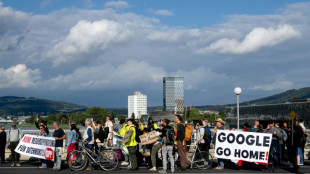 Google data centre sparks protests in Austria
 Shin Ohashi: Junk food-loving teen and Japan's next big swimming hope
 Stocks rise on AI buzz, drop in oil prices

 China's robot dancers limber up for America's Got Talent final
 Despite military might, Saudi struggles to crush the Houthis
 Trump to tout deals, defend Iran war in UN speech
 Sri Lanka to issue verdict in landmark Easter attack trial

German Holocaust survivor Margot Friedlaender, who has died at the age of 103, won plaudits at home and abroad for her tireless efforts to foster reconciliation and understanding.
Born and raised in Berlin, Friedlaender's family were among the hundreds of thousands of Jews killed by the Nazis at Auschwitz over the course of World War II.
Friedlander herself was interned at the camp in Theresienstadt in the modern-day Czech Republic, but survived the end of the war and emigrated to the United States.
The death of her husband, Adolf Friedlaender, and a memoir writing course at a community centre in New York propelled her back to her hometown.
Friedlander's prodigal return to Germany, where she dedicated herself to sharing her story with young people, made her one of the most prominent witnesses to the horrors of Adolf Hitler's regime.
For her work promoting historical memory, she was given awards and showered by praise from political leaders from both sides of the Atlantic.
"Perhaps the generation now that hears me in schools will say something to their children. I have no idea how far that will go," Friedlaender told German broadcaster ARD in 2021.
Friedlaender preached for mutual empathy as an antidote to the world's evils.
"Don't look at what separates you. Look at what unites you. Be human. Be reasonable," she said in 2024.
- 'Try to make your life' -
Born Margot Bendheim in 1921 to a family of button makers, young Margot had trained as a fashion illustrator.
The family had lived through Hitler's rise to power and witnessed the Kristallnacht pogroms against Jewish businesses in 1938 but remained in Berlin.
Friedlaender was 21 in 1943 when the Nazi secret police, the Gestapo, came for her 17-year-old brother Ralph.
Arriving home, Friedlaender spotted a stranger by the entrance to their building. The young girl covered her Jewish Star of David, passed the man and knocked on a neighbour's door.
Soon after, she learnt that her brother had been taken and her mother, Auguste Bendheim, had turned herself in to the police to be by her son. She left Friedlaender a note: "Try to make your life."
The invocation would stay with Friedlaender, as would the amber necklace left to her by her mother.
Auguste Bendheim and brother Ralph were deported to Auschwitz and killed. Friedlaender's father, she would learn much later, was also murdered in the gas chambers at the camp.
Friedlaender lived for more than a year in the underground, dying her hair red, submitting to nasal surgery to appear less Jewish.
The people who protected her "risked everything to share a bed or their food with me", she told the Hamburger Abendblatt in 2010.
Eventually, she was stopped and asked for her papers. Friedlaender confessed to her Jewish identity and was deported to Theresienstadt.
- 'Stay careful' -
At the concentration camp, she found Adolf Friedlaender, who she had known through the Jewish community in Berlin. After the Red Army liberated the camp in 1945, he asked her to marry him.
A year later the couple emigrated to the United States and settled in the New York borough of Queens. Adolf worked for Jewish organisations in the city, while Margot worked as a seamstress and a travel agent.
In 1997, Adolf passed away and Friedlaender began taking classes at the 92nd Street Y, where he had worked, including a memoir writing course.
At the centre she met the German producer Thomas Halaczinsky, who on hearing her recollections wanted to return with Friedlaender to Berlin to film a documentary.
Friedlaender returned to Germany in 2003 for the first time since she left, a step her husband had never been willing to contemplate. The resulting documentary was released in 2004 and her autobiography, whose title reused her mother's words, was published in 2008.
In 2010 at the age of 88, Friedlaender decided to move permanently to Berlin and recovered her German citizenship.
"I only got back what belonged to me," she said at the time.
After her improbable return home, Friedlaender became a voice of moral authority in a country still trying to make amends for the atrocities of the Nazis.
Friedlaender was garlanded with awards, including Germany's federal order of merit, and graced the cover of the German edition of fashion magazine Vogue in 2024.
On a visit to Berlin, then US President Joe Biden emotionally told the survivor of the Holocaust he was "actually honoured to be in your presence".
In Germany, she dedicated herself to speaking to young people, touring schools and answering questions on her life.
"I don't want to know what people's parents or grandparents did," Friedlaender told German weekly Die Zeit around her centenary.
"I concentrate on telling them: stay careful, watch that something like that never happens again. Not for me, but for yourselves."
Her last public engagement was just a few days before her death, at Berlin city hall, to mark the 80th anniversary of the end of World War II.
"Be human! That is what I ask you to do: be human!," she said.
O.Krause--BTB