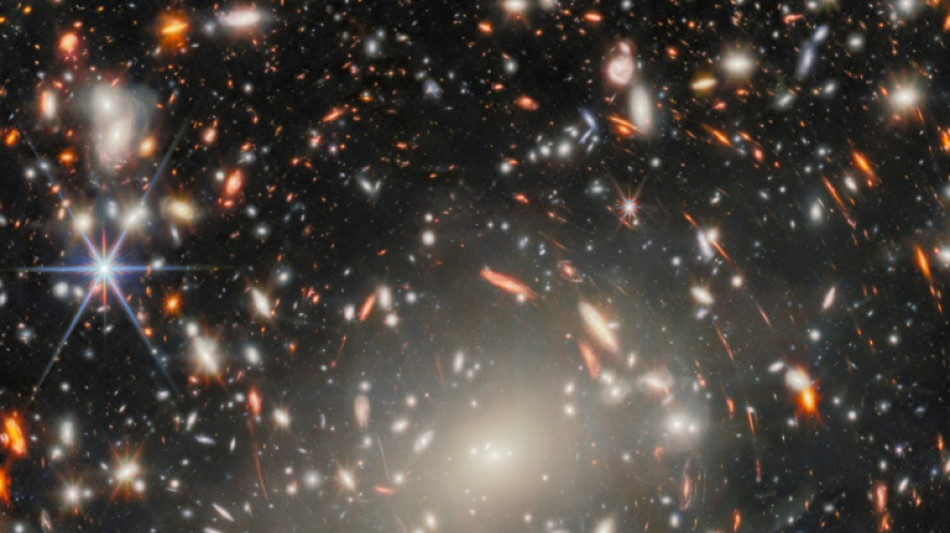
Webb telescope captures deep view of ancient galaxies / Photo: © ESA/WEBB/AFP

 Republican senator seeks probe of Trump Jr Russian-funded wedding

 Memoir by Diana's brother goes on sale after rocking UK monarchy

 Newcomers South Korea face holders Italy in Davis Cup finals

 Japan's Kojima sounds Marchand warning with Asian Games gold

 England rugby star Pollock signs new Northampton deal

 STARTRADER Expands Its Chinese Equity CFD Range with CXMT and Unitree Robotics

 MEXC Expands Opportunity Compass with Stock Trading Handbook to Help Crypto Users Build Investment Knowledge

 England paceman Wood retires from international cricket

 Magnificent Mandhana's 79 helps India to Asian Games cricket gold

 Marchand 'stressed' about racing Japanese rivals at LA Olympics
 Mobile boat clinics bring healthcare to India's remote islands

 Former India paceman Zaheer Khan named Chennai coach in IPL

 Six-year-old Chinese girl sets world record with Rubik's Cube
 Swimming prodigy Yu, 13, says 'interviews way harder than racing'

 Star coaches make their bows as Nations League returns

 Rams bounce back as Giants reel from Dart injury

 In Bangladesh, Pakistan's Jinnah photo stirs anger

 Two New Zealand naval ships transit Taiwan Strait

 Zidane gets down to work as France start new era

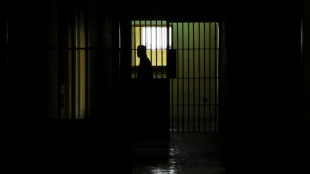 Inside the Venezuelan prison meant to 'drive you insane'

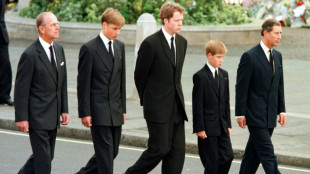 UK king braces as memoir by Diana's brother goes on sale

 Akkodis and Hamburg Public Transport Association Showcase hvv mia at InnoTrans 2026, Demonstrating the Future of AI-Powered Mobility
 No green light to lift EU sanctions on Russian oligarchs, talks to resume

 UK agrees support for Saudi in struggle with Houthis: reports

 EU foreign policy chief calls for continued sanctions on Russia
The James Webb space telescope's deepest view of a single target yet depicts spinning arcs of light that are galaxies from the universe's distant past, the European Space Agency said Tuesday.
The new image took the world's most powerful telescope more than 120 hours to capture, making it the longest Webb has ever focused on a single target.
It is also "Webb's deepest gaze on a single target to date", the European Space Agency (ESA) said in a statement, making the image one of the deepest ever captured of the cosmos.
At the bright centre of the image is a massive cluster of galaxies called Abell S1063, which is 4.5 billion light years from Earth.
But it is not the true target.
Such huge celestial objects can bend the light of things behind them, creating a kind of magnifying glass called a gravitational lens.
Therefore the "warped arcs" spinning around the Abell S1063 are what really interest scientists, the ESA said in a statement.
Because looking into distant space also means looking back in time, scientists hope to learn how the first galaxies formed during a period known as the Cosmic Dawn, when the universe was only a few million years old.
The image includes nine separate shots of different near-infrared wavelengths of light, the ESA said.
Since coming online in 2022, the Webb telescope has ushered in a new era of scientific breakthroughs.
It has also revealed that galaxies in the early universe are far bigger than scientists expected, leading some to suspect there might be something wrong with our understanding of the cosmos.
J.Horn--BTB