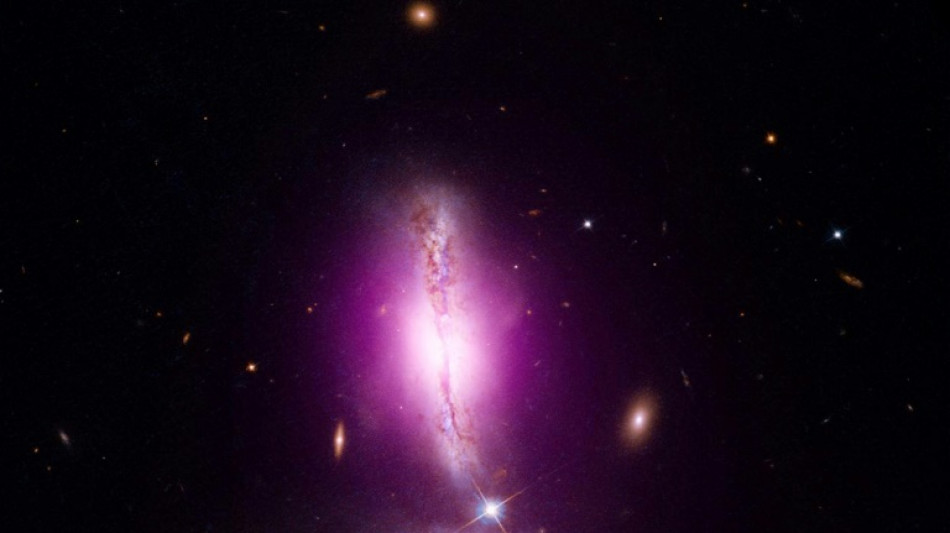
Milky Way may not be destroyed in galactic smash-up after all / Photo: © NASA/AFP/File

 Republican senator seeks probe of Trump Jr Russian-funded wedding

 Memoir by Diana's brother goes on sale after rocking UK monarchy

 Newcomers South Korea face holders Italy in Davis Cup finals

 Japan's Kojima sounds Marchand warning with Asian Games gold

 England rugby star Pollock signs new Northampton deal

 STARTRADER Expands Its Chinese Equity CFD Range with CXMT and Unitree Robotics

 MEXC Expands Opportunity Compass with Stock Trading Handbook to Help Crypto Users Build Investment Knowledge

 England paceman Wood retires from international cricket

 Magnificent Mandhana's 79 helps India to Asian Games cricket gold

 Marchand 'stressed' about racing Japanese rivals at LA Olympics
 Mobile boat clinics bring healthcare to India's remote islands

 Former India paceman Zaheer Khan named Chennai coach in IPL

 Six-year-old Chinese girl sets world record with Rubik's Cube
 Swimming prodigy Yu, 13, says 'interviews way harder than racing'

 Star coaches make their bows as Nations League returns

 Rams bounce back as Giants reel from Dart injury

 In Bangladesh, Pakistan's Jinnah photo stirs anger

 Two New Zealand naval ships transit Taiwan Strait

 Zidane gets down to work as France start new era
 Inside the Venezuelan prison meant to 'drive you insane'
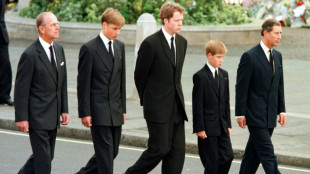 UK king braces as memoir by Diana's brother goes on sale

 Akkodis and Hamburg Public Transport Association Showcase hvv mia at InnoTrans 2026, Demonstrating the Future of AI-Powered Mobility
 No green light to lift EU sanctions on Russian oligarchs, talks to resume

 UK agrees support for Saudi in struggle with Houthis: reports

 EU foreign policy chief calls for continued sanctions on Russia

The Milky Way may not have a catastrophic collision with another huge galaxy as has been predicted, computer simulations revealed Monday, giving our home galaxy a coin-flip chance of avoiding destruction.
But don't worry either way: no galactic smash-up is expected for billions of years, long after our ageing Sun will have burnt away all life on Earth.
The Milky Way and the even-larger galaxy Andromeda are speeding towards each other at 100 kilometres (60 miles) a second, and scientists have long predicted they will collide in around 4.5 billion years.
That would be bad news for our neighbourhood.
Previous research has suggested that the Sun -- and our Earth -- could wind up in the centre of this newly merged "Milkomeda" galaxy and get sucked into its supermassive black hole. Alternatively, the Sun could be shot out into the emptiness of intergalactic space.
However "proclamations of the impending demise of our galaxy seem greatly exaggerated", according to a new study in the journal Nature Astronomy.
There is only a roughly 50 percent chance the Milky Way and Andromeda will smash into each other in the next 10 billion years, the international team of astrophysicists determined.
"It's basically a coin flip," lead study author Till Sawala of the University of Helsinki told AFP.
The researchers ran more than 100,000 computer simulations of our universe's future, using new observations from space telescopes.
A galaxy merger in the next five billion years is "extremely unlikely", Sawala said.
Much more likely is that the galaxies will zoom relatively close to each other -- say, a little under 500,000 light years away.
In only half of the simulations did dark matter then eventually drag the two galaxies together into a cataclysmic embrace.
But this would likely only occur in around eight billion years -- long after our Sun has died, the researchers found.
"So it could be that our galaxy will end up destroyed," Sawala said.
"But it's also possible that our galaxy and Andromeda will orbit one another for tens of billions of years -- we just don't know."
- Galaxy's fate 'open' -
"The fate of our galaxy is still completely open," the study summarised.
The researchers emphasised that their findings did not mean that previous calculations were incorrect, just that they had used newer observations and taken into account the effect of more satellite galaxies.
Future data releases from Europe's recently retired Gaia space telescope as well as Hubble could provide a definitive answer to this question within the next decade, Sawala predicted.
How much all this all matters to us is a matter of debate. The Sun is expected to make Earth inhospitable to life in around a billion years.
"We might have some emotional attachment" to what happens after we're gone, Sawala said.
"I might prefer the Milky Way not to collide with Andromeda, even though it has absolutely no relevance to my own life -- or the lives of my children or great-great grandchildren."
M.Ouellet--BTB