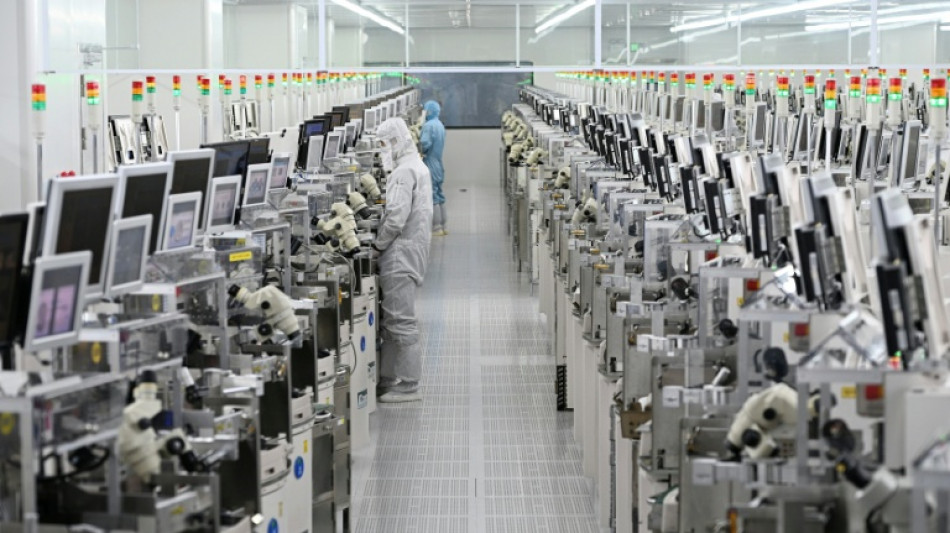
Memory chip crunch set to drive up smartphone prices / Photo: © AFP

 Inside the Venezuelan prison meant to 'drive you insane'

 UK king braces as memoir by Diana's brother goes on sale

 No green light to lift EU sanctions on Russian oligarchs, talks to resume

 UK agrees support for Saudi in struggle with Houthis: reports

 EU foreign policy chief calls for continued sanctions on Russia

 Flights scrapped, evacuations urged as Typhoon Dujuan wallops Japan

 Fonseca to take break from tennis

 A Cuban zoo, and its animals, in epic battle for survival

 Infantino proposes consulting federations to reform FIFA

 El Nino weather pattern enters record territory: scientist

 OpenAI calls for US to lead global effort on AI standards

 South African ostriches plucked alive for luxury fashion: report

 US networks halt Trump coverage in revolt over White House ban

 Paramount settles with US states to clear Warner Bros. mega-merger
 Climate crisis a job for world leaders, not just activists: UK FM

 US networks halt Trump coverage over White House ban

 French singer accuses Miley Cyrus of plagiarism

 EU fines Google 403 mn euros for location data breach

 'Best is yet to come,' says De la Fuente after Spain extension

 Why diesel prices are rising more than crude oil

 COP31 host says AI's climate footprint to be a summit priority

 Renewables hit record in 2025, but world must move faster: report

 US media outlets to sue Trump administration after White House ban

 Global stocks rally on lower oil prices, US-China hopes

 EU proposes energy rating for data centres

Shoppers could face higher prices for phones, laptops and other gadgets next year, manufacturers and analysts warn, as AI data centres hoover up memory chips used in consumer electronics.
The world's biggest tech companies are ploughing head-spinningly huge sums into building the hardware that powers artificial intelligence tools like ChatGPT.
Their insatiable demand is snarling up a supply chain kept tight on purpose by chipmakers who are keen to avoid price drops that dent profits, experts say.
In 2026, supply chain pressure for memory chips "will be far greater than this year", Lu Weibing, president of Chinese electronics giant Xiaomi, said this week.
"Everyone will likely observe that retail prices for products will see a significant increase," he told an earnings call.
William Keating, head of semiconductor and tech consulting firm Ingenuity, expects the same.
"All companies that manufacture PCs, smartphones, servers etc will be impacted by the shortage," Keating told AFP.
"End result: consumers will pay more."
In high demand are key chips known as DRAM and storage components called NAND, which are found in everyday gadgets but are also needed to help process the vast amounts of data crunched by generative AI.
That's driving up memory chip prices, which in turn is turbocharging revenue for the firms that produce them such as South Korea's Samsung and SK hynix, and Micron and SanDisk in the United States.
"AI-related server demand keeps growing, and this demand significantly exceeds industry supply," Kim Jae-june of Samsung Electronics said last month.
- 'Keep prices high' -
Samsung said Sunday that it plans to build a new semiconductor plant in South Korea to meet the soaring demand, while SK hynix recently reported its best-ever quarterly performance, "driven by the full-scale rise in prices of DRAM and NAND".
Industry analysts TrendForce have lowered their 2026 global production forecasts for smartphones and notebook laptops.
"The memory industry has begun a robust upward pricing cycle," which "forces downstream brands to hike retail prices," TrendForce said.
Cars may also be affected, although Keating noted that a smaller portion of their tech relies on memory chips.
Last week China's largest contract chipmaker SMIC said customers were hesitant to place orders owing to uncertainty over how many phones, cars, or other products the memory chip industry can supply.
The cause of the shortage is two-fold.
AI-driven demand is greater than anticipated, but memory chip makers have also been "drastically cutting" spending on expanding capacity in recent years, Keating explained.
"Keep capacity tight, keep prices high is basically their mantra," he said.
"They've done this deliberately to ensure that there's no repeat of the most recent memory price collapse, which cost the memory makers tens of billions in losses."
Price jumps for memory chips "are huge and the trend is continuing", said Stephen Wu, founder of the Carthage Capital investment fund.
"Consumers and enterprises should expect higher memory prices, longer lead times, and more take-or-pay contracts through at least early 2026," Wu said.
burs-kaf/dan
A.Gasser--BTB