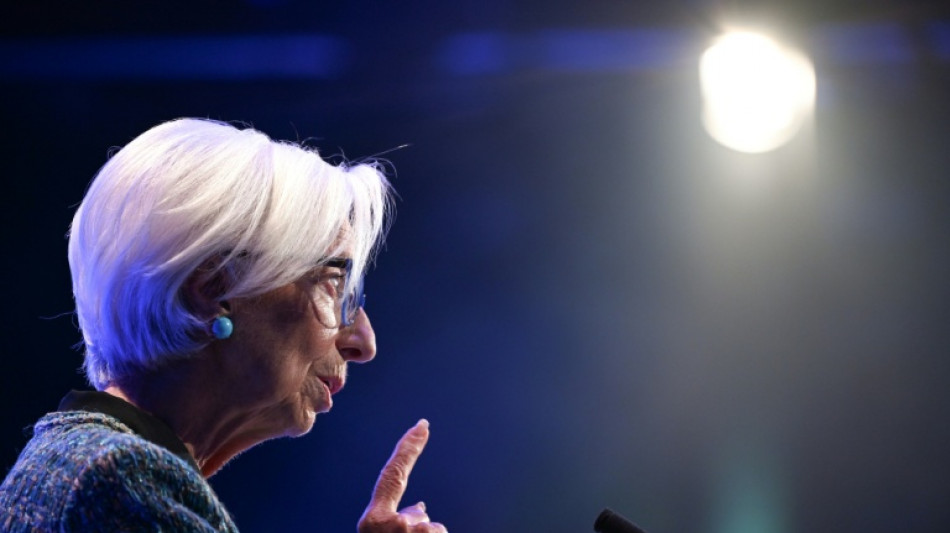
AI delay may affect Europe's future, says ECB chief / Photo: © AFP

 Inside the Venezuelan prison meant to 'drive you insane'

 UK king braces as memoir by Diana's brother goes on sale

 No green light to lift EU sanctions on Russian oligarchs, talks to resume

 UK agrees support for Saudi in struggle with Houthis: reports

 EU foreign policy chief calls for continued sanctions on Russia

 Flights scrapped, evacuations urged as Typhoon Dujuan wallops Japan

 Fonseca to take break from tennis

 A Cuban zoo, and its animals, in epic battle for survival

 Infantino proposes consulting federations to reform FIFA

 El Nino weather pattern enters record territory: scientist

 OpenAI calls for US to lead global effort on AI standards

 South African ostriches plucked alive for luxury fashion: report

 US networks halt Trump coverage in revolt over White House ban

 Paramount settles with US states to clear Warner Bros. mega-merger

 Climate crisis a job for world leaders, not just activists: UK FM

 US networks halt Trump coverage over White House ban

 French singer accuses Miley Cyrus of plagiarism

 EU fines Google 403 mn euros for location data breach

 'Best is yet to come,' says De la Fuente after Spain extension

 Why diesel prices are rising more than crude oil

 COP31 host says AI's climate footprint to be a summit priority

 Renewables hit record in 2025, but world must move faster: report

 US media outlets to sue Trump administration after White House ban
 Global stocks rally on lower oil prices, US-China hopes

 EU proposes energy rating for data centres

European Central Bank chief Christine Lagarde warned Monday that a delay in embracing artificial intelligence could "jeopardise" the continent's future, urging barriers to its adoption to be swiftly lifted.
Her comments add to growing fears that Europe is lagging behind the United States and China when it comes to AI, with proponents of the technology blaming issues from overregulation to underinvestment.
"We need to remove all the obstacles that stop us from embracing this transformation," she told a Bratislava conference.
"Otherwise we risk letting the wave of AI adoption pass us by and jeopardise Europe's future."
Lagarde, who heads the central bank for the 20-nation euro area, conceded that Europe had "already missed the opportunity to be a first mover in AI".
But if the continent deploys the technology decisively across its key industries, "Europe can turn a late start into a competitive edge", she emphasised.
She listed several barriers to rapid adoption in Europe, ranging from fragmented regulations to the high cost of energy -- which makes it expensive to run the enormous data centres that power AI.
Bureaucratic obstacles, such as delays in obtaining permits, made it harder to quickly build up data centres, and the region's computing power, she said.
As of last year, Europe's data centres had computing capacity of just 16 gigawatts, compared with 48 in the Untied States and 38 in China, according to a recent study by German digital business association Bitkom.
- 'Losing competitiveness' -
Facing mounting concerns from businesses and governments that regulations are hobbling the digital sector and hampering growth, the EU last week proposed rolling back key AI and data privacy rules.
Privacy defenders, however, were unhappy with the proposed changes, arguing they weaken safeguards protecting Europeans' data.
European governments have also been stepping up calls to reduce over-reliance on US tech giants and strengthen the local industry, particularly at a time of uneasy ties with Washington under the Trump administration.
Echoing these sentiments, Lagarde urged Europe to "diversify critical parts of the AI supply chain and avoid single points of failure.
"If our data spaces use technology stacks that are owned and governed outside Europe, we deepen -- rather than reduce -- our strategic dependencies."
While some European leaders fret that losing out in the AI race could weaken the continent's already fragile economy, others are warning against a head-long rush to adopt the technology.
UN rights chief Volker Turk warned Monday that generative AI could become "a modern-day Frankenstein's monster" that could threaten human rights, including to privacy, political participation and free expression.
Lagarde nevertheless warned that the consequences of further foot-dragging go beyond "losing the race in AI models".
"We would eventually face a further loss of competitiveness for many of our sectors and industries."
P.Anderson--BTB