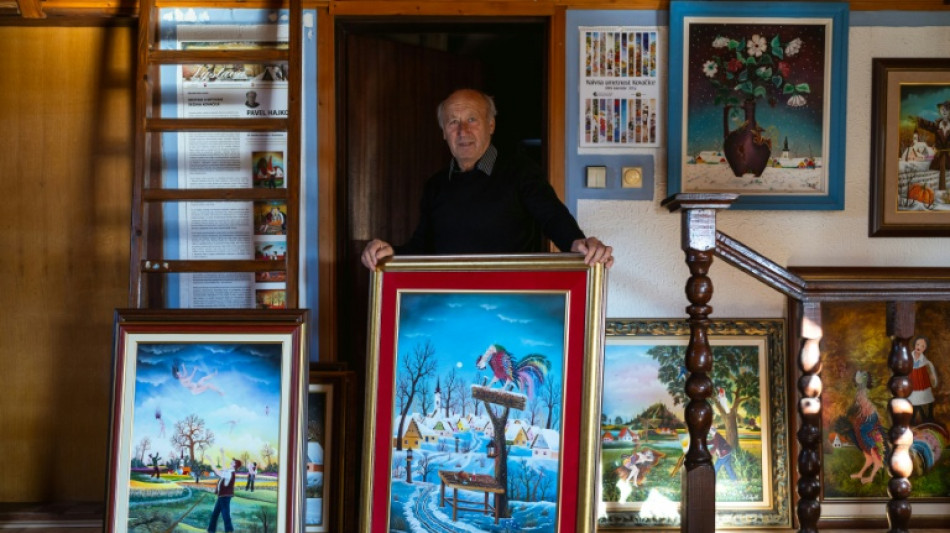
Naively brilliant: Serbia's world-famous village painters / Photo: © AFP

 Inside the Venezuelan prison meant to 'drive you insane'

 UK king braces as memoir by Diana's brother goes on sale

 No green light to lift EU sanctions on Russian oligarchs, talks to resume

 UK agrees support for Saudi in struggle with Houthis: reports

 EU foreign policy chief calls for continued sanctions on Russia

 Flights scrapped, evacuations urged as Typhoon Dujuan wallops Japan

 Fonseca to take break from tennis

 A Cuban zoo, and its animals, in epic battle for survival

 Infantino proposes consulting federations to reform FIFA

 El Nino weather pattern enters record territory: scientist

 OpenAI calls for US to lead global effort on AI standards

 South African ostriches plucked alive for luxury fashion: report

 US networks halt Trump coverage in revolt over White House ban

 Paramount settles with US states to clear Warner Bros. mega-merger

 Climate crisis a job for world leaders, not just activists: UK FM

 US networks halt Trump coverage over White House ban

 French singer accuses Miley Cyrus of plagiarism

 EU fines Google 403 mn euros for location data breach

 'Best is yet to come,' says De la Fuente after Spain extension

 Why diesel prices are rising more than crude oil

 COP31 host says AI's climate footprint to be a summit priority

 Renewables hit record in 2025, but world must move faster: report

 US media outlets to sue Trump administration after White House ban

 Global stocks rally on lower oil prices, US-China hopes

 EU proposes energy rating for data centres

Pavel Hajko never tires of painting roosters. Inside his home studio in Kovacica -- a sleepy town in northern Serbia famous for its style of naive art -- the brightly coloured creatures cover the walls.
"From the beginning, even in elementary school, I painted only roosters," the 73-year-old artist told AFP, as he worked on an unfinished canvas in the afternoon light.
Outside, a cockerel obligingly crowed.
Hajko and his fellow artists have become world-famous for their childlike renderings of the traditional village life of the Slovak minority in the flatlands of the Banat region, north of the Danube.
"In naive painting, everything is done as you learn. It's not a school where the colour has to be this or that... we can put any colour," Hajko said.
The naive painting movement of self-taught artists first emerged in the 1930s, depicting everything from harvests to the traditional dress of the region.
Last year UNESCO recognised the Kovacica painters on its list of Intangible Cultural Heritage of Humanity, a milestone for a movement shaped by unschooled artists.
- Preserving identity -
In the leafy centre of town, Pavel Babka runs a gallery showing the art, which he said is key to preserving the traditions of the ethnic Slovaks who settled in the Vojvodina region more than two centuries ago.
"I think the Slovak minority preserves its identity in this way, by painting what the previous generation did," Babka said.
The style quickly spread to other Slovak communities, and the first major exhibitions of work began in the 1950s.
But Babka said its beginnings lie in the folk art of the region, from the decoration of everyday objects to the murals in homes, mostly painted by women.
A key figure in the foundation of the style is Zuzana Chalupova, who Babka credits with giving naive painting its bold colours.
"Today, more women paint than men. And what women paint is more authentic than men," he said.
Across the walls of his gallery, Babka traces the symbols and signature "handwriting" of each artist through the decades.
"They paint life here, but they have not forgotten where they come from," he said.
The curator sees a discernible style through the early days of peasant painters in the Austro-Hungarian empire through the movement's boom in 1970s Yugoslavia, and even in today's crop of artists.
"The youngest generation paints according to the stories of their grandparents," he said.
- 'There must be sincerity' -
But with UNESCO's recognition comes a new challenge -- the over-commercialisation of the art form, driven by tourists' tastes rather than authenticity.
"When we say Kovacica, it should evoke Kovacica," Babka said.
Since founding his gallery 35 years ago, he has helped promote the movement, and now urges painters to preserve their style and keep the region's Slovak culture at its core.
"There must be sincerity and no deception."
The Slovak minority accounted for less than one percent of Serbia's population in the 2022 census, with the vast majority living in the multiethnic northern Vojvodina region.
A 2024 study found the community has declined over the last three decades, partly due to its ageing population and migration to Slovakia.
- Global recognition -
For art historian Elenka Djuris, this makes preserving the paintings of the unique culture "tied to the area of Kovacica" all the more critical.
"In this way, we actually ensure the longevity of our identity, traditions and customs, especially in this time when traditions and customs are truly being lost, everything is becoming globalised," the 36-year-old academic said.
But Djuris hopes that global recognition of the movement's value will also spur renewed efforts to preserve it at home.
"Unfortunately, it often takes someone from outside to show us the wealth we have, and then we realise that our culture is truly valuable and worthy of attention."
J.Bergmann--BTB