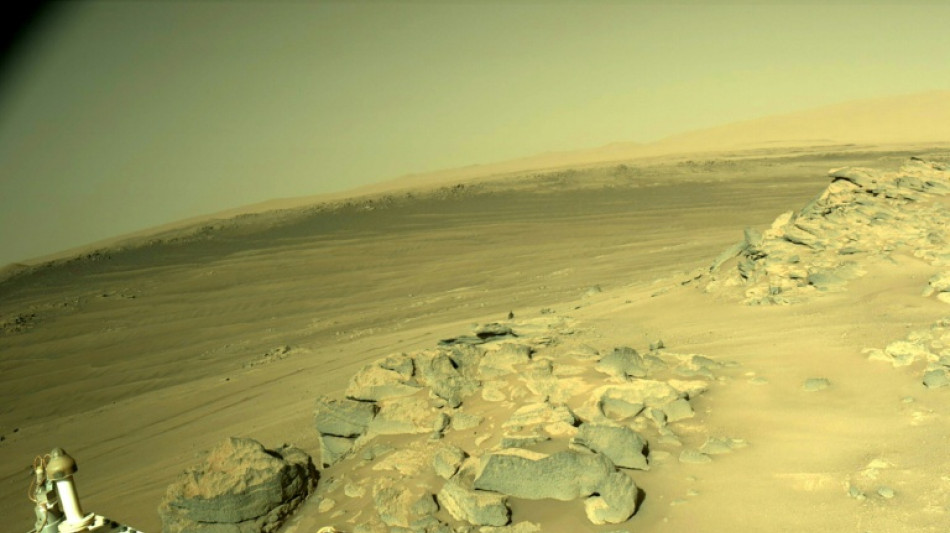
NASA rover records first evidence of lightning on Mars / Photo: © NASA/AFP/File

 Inside the Venezuelan prison meant to 'drive you insane'

 UK king braces as memoir by Diana's brother goes on sale

 No green light to lift EU sanctions on Russian oligarchs, talks to resume

 UK agrees support for Saudi in struggle with Houthis: reports

 EU foreign policy chief calls for continued sanctions on Russia

 Flights scrapped, evacuations urged as Typhoon Dujuan wallops Japan

 Fonseca to take break from tennis

 A Cuban zoo, and its animals, in epic battle for survival

 Infantino proposes consulting federations to reform FIFA

 El Nino weather pattern enters record territory: scientist

 OpenAI calls for US to lead global effort on AI standards

 South African ostriches plucked alive for luxury fashion: report

 US networks halt Trump coverage in revolt over White House ban

 Paramount settles with US states to clear Warner Bros. mega-merger

 Climate crisis a job for world leaders, not just activists: UK FM

 US networks halt Trump coverage over White House ban

 French singer accuses Miley Cyrus of plagiarism

 EU fines Google 403 mn euros for location data breach

 'Best is yet to come,' says De la Fuente after Spain extension

 Why diesel prices are rising more than crude oil

 COP31 host says AI's climate footprint to be a summit priority

 Renewables hit record in 2025, but world must move faster: report

 US media outlets to sue Trump administration after White House ban

 Global stocks rally on lower oil prices, US-China hopes

 EU proposes energy rating for data centres

A NASA rover has recorded evidence of lightning on Mars for the first time, its microphone picking up the sounds of tiny "zaps" whipped up by the dust storms constantly sweeping across the planet.
Scientists have long debated whether electrical discharges could be sparking in the dusty and little-known Martian climate -- but proof has been hard to come by.
It turns out that NASA's Perseverance rover, which has been roaming the red planet since 2021, was inadvertently recording the sounds of lightning, according to a study published in Nature this week.
These are far from the thundering, kilometre-long lightning bolts we see on Earth.
Instead, they are "little zaps" similar to "what you might feel in dry weather when you touch your car door and there's a bit of static electricity," lead author Baptiste Chide of France's CNRS research centre told AFP.
While low in energy, these discharges are happening "absolutely all the time -- and everywhere" on Mars, the planetary scientist said.
The process starts when tiny grains of dust rub against each other. They become charged with electrons and release this energy in electrical arcs a few centimetres (inches) -- or even millimetres -- long, sending off an audible shock wave.
Here on Earth, dust storms and dust devils in desert areas also create electrical fields. But they rarely build up into electrical discharges.
However on Mars, "because of the very low pressure and the composition of the atmosphere, the amount of charge that needs to accumulate to generate a discharge is much smaller," Chide explained.
This phenomenon has been theorised since Mars first started to be explored -- and has been reproduced in the laboratory.
Chide said it had been "such an important issue for Martian science" that an instrument on the European Space Agency's Schiaparelli lander was dedicated to searching for it.
Unfortunately the spacecraft crashed while trying to land on Mars in 2016.
Since then, "it was somewhat of a forgotten area for Martian exploration," Chide said.
That is, until "by chance" the microphone on Perserverance's SuperCam recorded signals of what appeared to be electrical discharges, he added.
Daniel Mitchard, a lightning expert at Cardiff University not involved in the study, commented in Nature that the research provided "persuasive evidence of dust-induced discharges".
But because the discharges "were only heard and not seen," he expected debate between scientists on the subject "to continue for some time".
- Electrified astronauts? -
The research could shed some light on the mysterious Martian climate.
"Dust drives the Martian climate", similar to the water cycle on Earth, Chide said. For example, a season of dust storms will have begun by the end of the year.
The electrical discharges could also kick off a process that destroys organic molecules -- which are the building blocks of life -- on the Martian surface.
It could also explain the surprisingly rapid disappearance of methane on the planet -- a phenomenon that has baffled scientists.
It may also have implications for future Mars missions.
Scientists will now be able to design their instruments to better protect the future robots sent to Mars, Chide said.
And of course, there are also plans for humans to finally step foot on the planet's red surface.
"In the long term, isn't there a risk that the suits of the astronauts who stay on the Martian surface for a long time will be damaged by these discharges?" Chide asked.
"We will have to ask ourselves this question."
T.Bondarenko--BTB