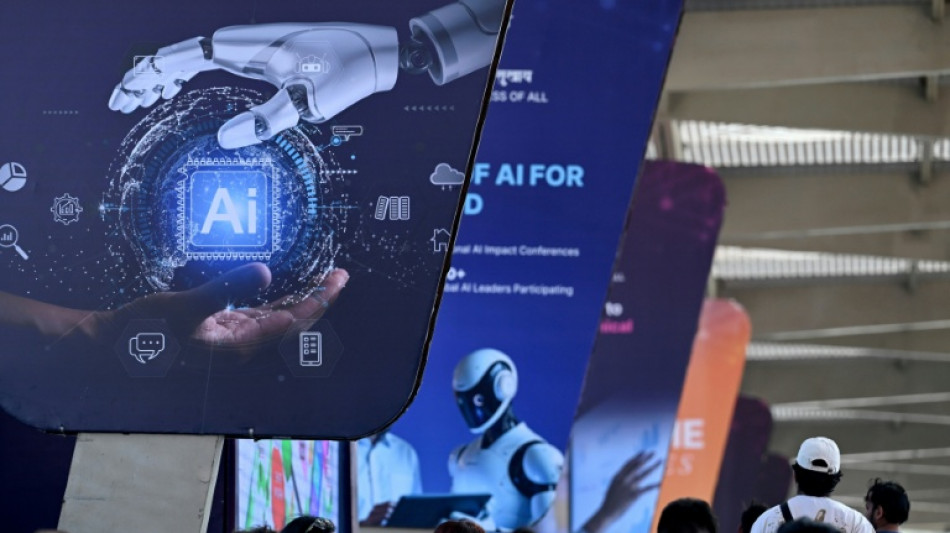
Global summit calls for 'secure, trustworthy and robust AI' / Photo: © AFP

 Liverpool boss Iraola urges Isak to raise his level

 Evenepoel wins record 4th straight world time-trial title

 France's Macron, Canada's Carney announce closer ties

 Carrick defends troubled Man Utd after Fulham escape

 Horror movie 'Resident Evil' tops N. American box office

 Germany's Merz vows to stay course despite new vote losses

 Man City outgun Sunderland despite Brobbey hat-trick, Man Utd rescue Fulham draw

 Mourinho blames ref committee for Real Madrid derby defeat

 Maresca craves a 1-0 win after eight-goal Man City thriller
 Atletico Madrid beat Real Madrid in tense derby clash

 Reusser retains world time-trial title

 Man City outgun Sunderland despite Brobbey hat-trick, Liverpool win at Bournemouth

 Top US, Chinese economic officials meet ahead of Trump-Xi summit

 Erdogan's LGBTQ crackdown 'first step of election campaign': activist

 Mass drone barrage on Moscow kills two

 82-year-old dies after beach fight in Greece over sun lounger

 US warns of rapid escalation in Mideast war
 Iran 'put hearts on the court' to win Asian Games basketball bronze

 School girl Yu helps China dominate in Asian Games swimming openers

 Myanmar win first Asian Games teqball gold as Spain great Puyol watches

 China's 13-year-old Yu scorches to first major gold at Asian Games
 Russians vote on last day of parliamentary elections

 Hong Kong pays final respects to former city leader Tung
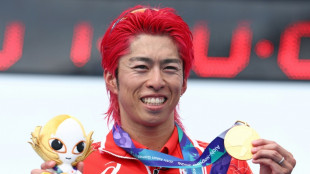
 Typhoon put people off Asian Games opening ceremony, official says

 China's 13-year-old Yu cruises as Asian Games swimming begins

Dozens of nations including the United States and China called for "secure, trustworthy and robust" artificial intelligence, in a declaration issued Saturday after a major summit on the technology in New Delhi.
The statement signed by 86 countries did not include concrete commitments to regulate the fast-developing technology, instead highlighting several voluntary, non-binding initiatives.
"AI's promise is best realised only when its benefits are shared by humanity," said the statement, released by the five-day AI Impact Summit.
It called the advent of generative AI "an inflection point in the trajectory of technological evolution".
"Advancing secure, trustworthy and robust AI is foundational to building trust and maximising societal and economic benefits," it said.
The summit -- attended by tens of thousands including top tech CEOs -- was the fourth annual global meeting to discuss the promises and pitfalls of AI, and the first hosted by a developing country.
Hot topics discussed included AI's potential societal benefits, such as drug discovery and translation tools, but also the threat of job losses, online abuse and the heavy power consumption of data centres.
Analysts had said earlier that the summit's broad focus, and vague promises made at the previous meetings in France, South Korea and Britain, would make strong pledges or immediate action unlikely.
- US signs on -
The United States, home to industry-leading companies such as Google and ChatGPT maker OpenAI, did not sign last year's summit statement, warning that regulation could be a drag on innovation.
"We totally reject global governance of AI," US delegation head Michael Kratsios had said at the Delhi summit on Friday.
The United States signed a bilateral declaration on AI with India on Friday, pledging to "pursue a global approach to AI that is unapologetically friendly to entrepreneurship and innovation".
But it also put its name to the main summit statement, the release of which was originally expected Friday but was delayed by one day to maximise the number of signatories, India's government said.
On AI safety risks -- from misinformation and surveillance to fears of the creation of devastating new pathogens -- Saturday's summit declaration struck a cautious tone.
"Deepening our understanding of the potential security aspects remains important," it said.
"We recognize the importance of security in AI systems, industry-led voluntary measures, and the adoption of technical solutions, and appropriate policy frameworks that enable innovation."
On jobs, it emphasised reskilling initiatives to "support participants in preparation for a future AI driven economy".
And "we underscore the importance of developing energy-efficient AI systems" given the technology's growing demands on natural resources, it said.
- 'Unacceptable risk' -
Computing expert and AI safety campaigner Stuart Russell told AFP that Saturday's commitments were "not completely inconsequential".
"The most important thing is that there are any commitments at all," he said.
Countries should "build on these voluntary agreements to develop binding legal commitments to protect their peoples so that AI development and deployment can proceed without imposing unacceptable risks", Russell said.
Some visitors had complained of poor organisation, including chaotic entry and exit points, at the vast summit and expo site in Delhi.
The event was also the source of several viral moments, including the awkward refusal of rival US tech CEOs -- OpenAI's Sam Altman and Dario Amodei of Anthropic -- to hold hands on stage.
The next AI summit will take place in Geneva in 2027. In the meantime, a UN panel on AI will start work towards "science-led governance", the global body's chief Antonio Guterres said Friday.
The UN General Assembly has confirmed 40 members for a group called the Independent International Scientific Panel on Artificial Intelligence.
It was created in August, aiming to be to AI what the UN's Intergovernmental Panel on Climate Change (IPCC) is to global environmental policy.
India has used the summit to push its ambition to catch up with the United States and China in the AI field, including through large-scale data centre construction powered by new nuclear plants.
Delhi expects more than $200 billion in investments over the next two years, and US tech giants unveiled a raft of new deals and infrastructure projects in the country during the summit.
M.Ouellet--BTB