Turkey in cultural diplomacy push to bring history home / Photo: © AFP

 Germany's Merz vows to stay course despite new vote losses
 Man City outgun Sunderland despite Brobbey hat-trick, Man Utd rescue Fulham draw

 Mourinho blames ref committee for Real Madrid derby defeat
 Maresca craves a 1-0 win after eight-goal Man City thriller
 Atletico Madrid beat Real Madrid in tense derby clash
 Reusser retains world time-trial title

 Man City outgun Sunderland despite Brobbey hat-trick, Liverpool win at Bournemouth

 Top US, Chinese economic officials meet ahead of Trump-Xi summit
 Erdogan's LGBTQ crackdown 'first step of election campaign': activist
 Mass drone barrage on Moscow kills two

 82-year-old dies after beach fight in Greece over sun lounger

 US warns of rapid escalation in Mideast war
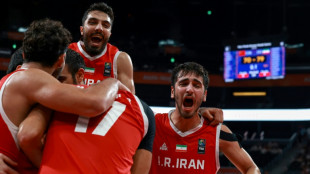 Iran 'put hearts on the court' to win Asian Games basketball bronze
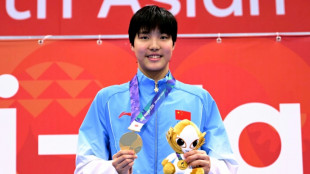
 School girl Yu helps China dominate in Asian Games swimming openers
 Myanmar win first Asian Games teqball gold as Spain great Puyol watches
 China's 13-year-old Yu scorches to first major gold at Asian Games
 Russians vote on last day of parliamentary elections
 Hong Kong pays final respects to former city leader Tung
 Typhoon put people off Asian Games opening ceremony, official says
 China's 13-year-old Yu cruises as Asian Games swimming begins
 AI 'warning shots' focus Beijing on national security risks
 Philippine tribe in limbo over US-led tech hub
 Leo XIV, first US pope transcends his restrained style
 Singer Ed Sheeran says Gaza situation 'unjustifiable' following controversy

 In 'Tenzing', a Sherpa mountaineer gets his due
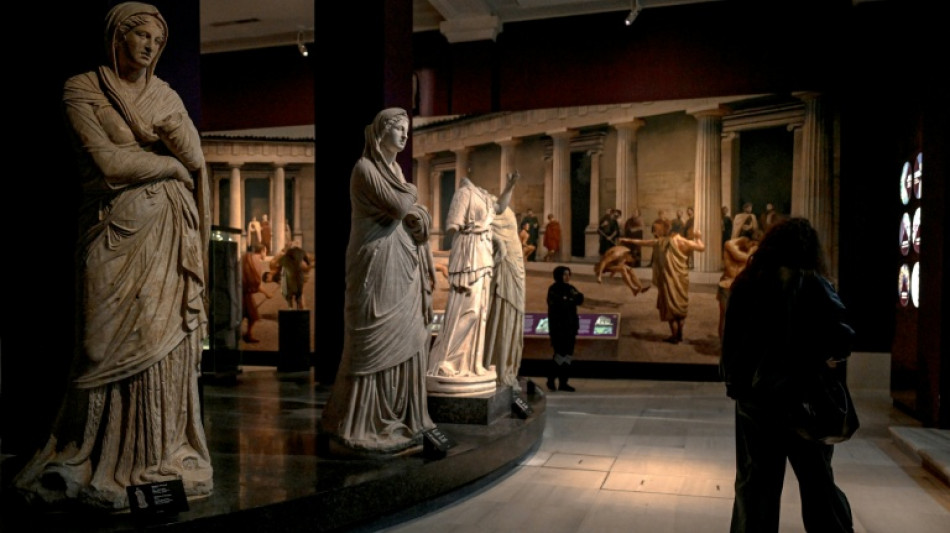
When an ancient bronze statue of Roman Emperor Marcus Aurelius landed back on Turkish soil after decades abroad, it was more than a symbolic homecoming.
It marked the latest victory in Turkey's increasingly assertive push to recover antiquities illegally taken abroad -- a campaign supported by a newly-developed AI tool for identifying cultural assets of Turkish origin.
The life-sized bronze, which dates back to the second- or third-century, was taken in the 1960s from the ancient city of Bubon near Turkey's southwestern Antalya resort.
After a years-long investigation involving research, scientific testing and statements from now elderly witnesses, the headless statue arrived back in Turkey last year.
Its repatriation from an Ohio museum involved cooperation with the US Department of Homeland Security and the Manhattan District Attorney's Office.
For Zeynep Boz, director of Turkey's department for combating the illicit trafficking of cultural property, one moment stands out.
"I clearly remember when the computer finally processed the data and we saw the match come together. It was an exciting moment," she told AFP at Istanbul's archaeology museum.
That the statue survived at all is exceptional: in antiquity, bronze was a valuable raw material routinely melted down for weapons, coins or everyday objects.
"For this reason, bronze statues of this scale have rarely been preserved until today," she said.
For years, Cleveland's Museum of Art had dragged its feet, claiming there was insufficient evidence to prove where it came from, Boz said.
But that changed after archaeometry expert Professor Ernst Pernicka concluded there was "no doubt whatsoever" the statue came from Bubon, where an imperial shrine housed bronze sculptures of Roman emperors.
Soil and lead samples provided crucial scientific evidence which convinced the museum, Boz said.
"It was a long struggle. We were determined and patient and we won," Culture Minister Mehmet Nuri Ersoy said when the statue returned in July.
Turkey has stepped up efforts to combat illicit antiquities trading and in 2025 alone secured the repatriation of 180 cultural artefacts.
- AI to identify trafficked objects -
Although its newly-developed AI-powered "TraceART" system was not involved in recovering the Marcus Aurelius statue, the tool helped identify two 16th-century Iznik tiles that were recovered from Britain this month.
Developed by the culture ministry, it scans images on sales platforms, auctions and social media to identify any cultural assets of Turkish origin that may have been trafficked, with flagged items sent for expert assessment.
TraceART went operational in 2025 and has since identified hundreds of objects for review, Boz said.
In January, Turkey recovered an Anatolian-style marble head from Denver Art Museum in Colorado, said Burcu Ozdemir of the antiquities trafficking unit.
The museum contacted Ankara because the piece "had been donated by the wife of a US consul general who served in Istanbul in the 1940s", she said.
Turkey's campaign also involves returning items to countries like Iran, China and Egypt.
"We returned two of the artefacts stolen from temples in China," Boz told AFP.
Turkey also returned "a key of the Kaaba to Egypt" after realising it had ended up in Turkey illegally, she said of the cube-shaped stone structure at Mecca's Grand Mosque.
- Ottoman tiles at the Louvre -
Turkey is now seeking the repatriation of other antiquities taken during the Ottoman era: an ancient marble torso called the "Old Fisherman" from Berlin, and dozens of Iznik tiles held at France's Louvre museum.
"There's an assumption that artefacts taken in the 18th-19th centuries were acquired legally. We don't share that view," Boz said.
The illegal tile swap came to light in 2003 when one fell from the wall of an Ottoman-era library and on the back was the French manufacturer's mark.
The original and others were taken in the late 1800s by a Frenchman who claimed to be restoring them, then replaced them with fakes.
"We have repeatedly shared evidence with France and talked with the Louvre but no resolution has been reached," she said.
The tiles were on a panel by the tomb of Ottoman Sultan Selim II in the garden of the Hagia Sophia.
Today it bears a plaque in English, French and Turkish reading: "The tiles before us are replicas."
The originals are currently on display at a branch of the Louvre in Lens, 200 kilometres north of Paris, which says they were "bought in 1895".
The museum did not respond to several requests for comment from AFP.
L.Janezki--BTB