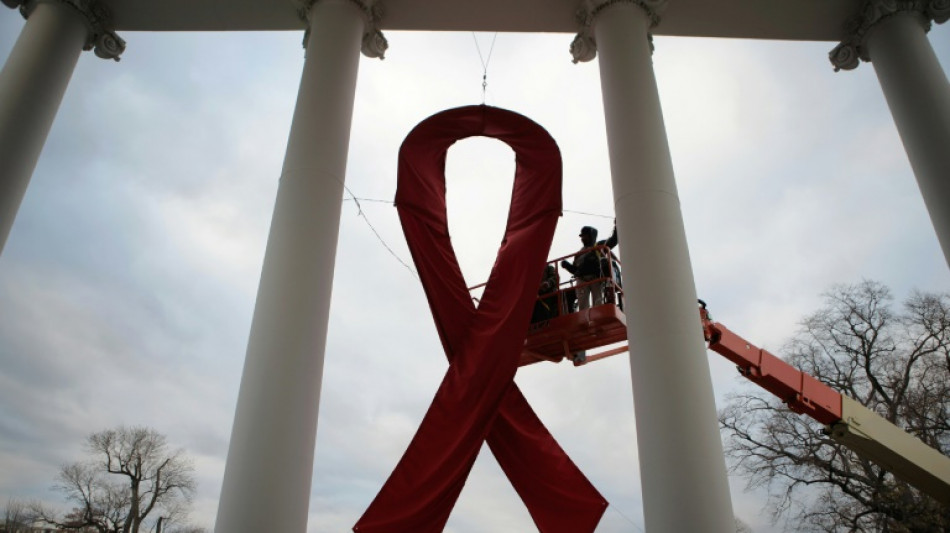
Norwegian effectively cured of HIV after transplant from brother / Photo: © GETTY IMAGES NORTH AMERICA/AFP/File

 Multi-Asset Trading Venue Monochrome Exchange Announces IEO of Its Native Token, $MCR

 South Korea break Japan hearts to win Asian Games basketball gold

 Acosta takes first victory at Austrian MotoGP

 PSG president Nasser al-Khelaifi under investigation in France for conflict of interest

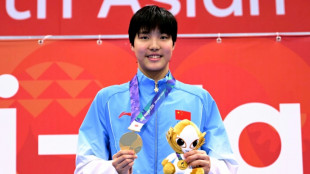 China swim sensation, 13, sets Games record after Japan win early
 Drones hit Moscow as Russians go to the polls

 New England boss Fleming says 'wrong' to ask Stokes to end retirement

 Germans vote in elections threatening fresh blow to Merz
 US fears rapid escalation in Mideast after Houthis attack Riyadh

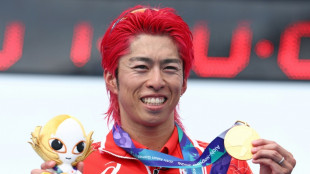 Japan triathlete Hojo wins first gold of Asian Games

 IOC president impressed by 'beautiful' Asian Games wooden huts

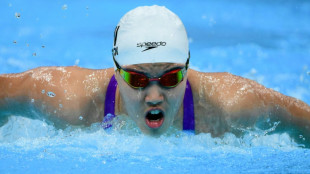 First Asian Games gold goes to Japan as China's 13-year-old Yu lights up pool

 Data centre command hub keeps AI up and running
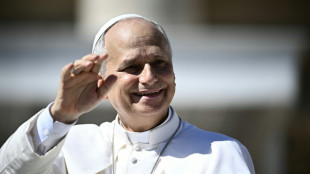 Pope Leo in France: the issues on the table
 Packing for a pope: behind the scenes on foreign trips

 Republicans find transgender issues a powerful political weapon in midterm campaigning

 German state elections threaten new shock waves for Merz

 Chile's Bachelet quits race to be next UN chief

 Raphinha treble fires perfect Barca to win at Sevilla

 Thiam makes winning heptathlon return at Decastar meet

 Czechs beat USA to qualify for Davis Cup finals

 Dortmund sink Stuttgart to climb to Bundesliga summit

 Trump says will not tolerate attempts to slow AI growth

 'It has to stop': runners protest women's murders in S.Africa district

 Fire erupts near Riyadh airport as Houthis claim strikes

A Norwegian man has been effectively cured of HIV after receiving a stem cell transplant from his brother, doctors announced on Monday.
The patient's brother happened to carry a rare, virus-blocking genetic mutation.
The 63-year-old man, dubbed the "Oslo patient", is the latest in around 10 people worldwide who have gone into long-term remission from HIV after receiving a transplant to treat unrelated blood cancer.
The high-risk procedure normally requires a donor to have a specific mutation of their CCR5 gene, which blocks HIV from entering the body's cells.
Only around one percent of people in northern Europe have the necessary mutation.
The Oslo patient, who had been living with HIV since 2006, was diagnosed with a fatal blood cancer called myelodysplastic syndrome in 2017.
His doctors searched for a donor who would help treat both. When they couldn't find one, they chose the man's elder brother.
However, on the day of the transplant in 2020, the doctors were stunned to discover that the brother carried the CCR5 mutation.
"We had no idea... That was amazing," doctor Anders Eivind Myhre of the Oslo University Hospital told AFP.
- 'Winning the lottery twice' -
The patient said "it was like winning the lottery twice", added Myhre, who was also the lead author of a study describing the case in Nature Microbiology.
Two years after the transplant, the patient stopped taking the anti-retroviral drugs which had been reducing the level of HIV in his body.
The researchers found no trace of the virus in samples of the man's blood, gut and bone marrow.
"For all practical purposes, we are quite certain that he is cured," Myhre said.
Now the Oslo patient, whose name was not revealed, is "having a great time" and has more energy than he knows what to do with, Myhre said.
The painful and potentially dangerous transplant procedure is for people who have both HIV and deadly blood cancer so is not a feasible option for the millions of people living with the virus across the world.
However, researchers believe that studying these rare cases will reveal more about how HIV works in the hope of finding a cure for all patients.
- 'No longer a patient' -
The Oslo patient is the first person to receive a transplant from a family member.
The patient's immune system had been "completely replaced" by the donor's, sqaid study co-author Marius Troseid of the University of Oslo.
It was the first time this had been observed in a cured patient's bone marrow and gut, he told AFP.
Even before the researchers found out the brother had a CCR5 mutation, they had some hope that the Oslo patient's HIV could be cured.
That is because in 2024 it was revealed that the so-called "next Berlin patient" entered long-term remission despite receiving a transplant that did not have two copies of the mutated gene.
The original Berlin patient, Timothy Ray Brown, was the first person declared cured of HIV back in 2008. Patients in London, New York, Geneva, Duesseldorf and elsewhere followed.
Given the Oslo patient's robust health, Troseid suggested that his nickname was no longer suitable.
"The Oslo patient is perhaps no longer a patient. At least he doesn't feel like it," Troseid said.
A.Gasser--BTB