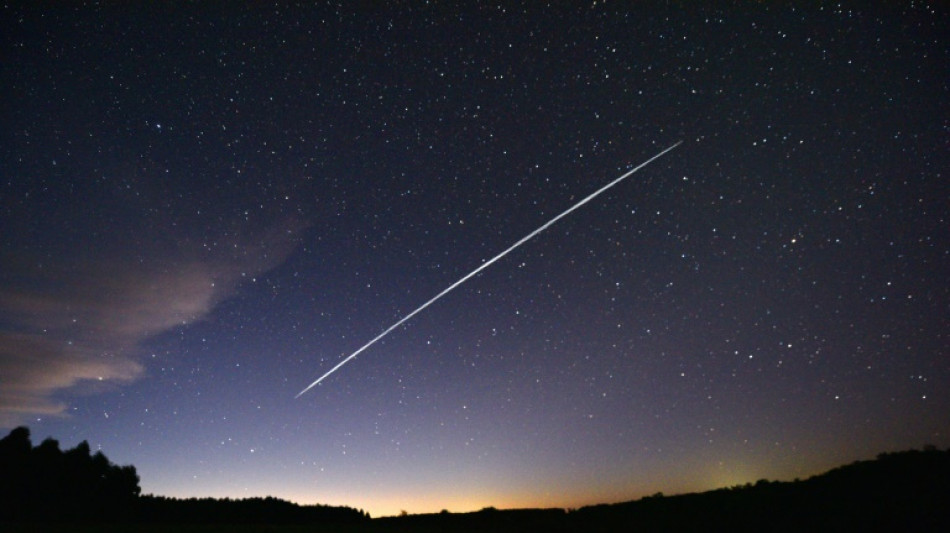
Dozens of SpaceX internet satellites lost to geomagnetic storm / Photo: ©

 Ed Sheeran returns to stage after Palestinian controversy

 Asian Games to open in Japan after troubled build-up

 Drone owners rush to offload devices ahead of Beijing ban

 Trump's beef policies irk Texas ranchers, testing their loyalty

 Nvidia, OpenAI CEOs to attend Xi dinner at White House

 Anthropic picks Accenture for in-house AI safety evaluation

 Balogun returns as Monaco beat Lens to continue strong Ligue 1 start

 'Pause' on overt repression in Venezuela, but reforms still needed: HRW

 Global stocks mixed as yen falls despite Bank of Japan rate hike

 Cuba hit with seventh major blackout of the year

 Murray out with concussion so Wentz will start for Vikings

 UN chief 'deeply regrets' US visa refusal to Abbas for annual meeting

 England quick Carse to face no charges over alleged nightclub assault

 Mancini brings nine newcomers into the first squad of his Italy comeback

 Czechs level Davis Cup tie against USA as South Korea eye Finals

 New France boss Zidane confirms Mbappe as captain after naming first squad

 California governor signs order to explore AI 'kill switch'

 Head leads run spree as Australia win Zimbabwe ODI series

 In-form Raphinha wants to finish career at Barcelona

 Warren Buffett steps down as Berkshire Hathaway chairman

 Carrick confident Man Utd can 'work through' tough time

 Mbappe ends Nike partnership to join Swiss brand On

 Liverpool boss Iraola puts Bournemouth love affair on hold

 'A disaster' if Man City do not win says Maresca after flawless start

 Kerry James Marshall: American 'blackness' painter celebrated in Europe

Up to 40 SpaceX high-speed internet satellites have been knocked out of orbit by a geomagnetic storm shortly after launch, but pose little threat to Earth as they burn up in the atmosphere, the company said.
Geomagnetic storms are caused by ejections of the solar corona into space, resulting in disturbances to the Earth's upper atmosphere and increased drag on objects in low orbits.
The latest 49 satellites from the Starlink network launched from the Kennedy Space Center in Florida on February 3 and successfully assumed their initial orbit, with their nearest approach to the surface 130 miles (210 kilometers) high.
The company places them into this region to carry out final checks before flying further into space.
On February 4, however, they were struck by the space weather event, Elon Musk's company said in a statement late Tuesday.
"These storms cause the atmosphere to warm and atmospheric density at our low deployment altitudes to increase. In fact, onboard GPS suggests the escalation speed and severity of the storm caused atmospheric drag to increase up to 50 percent higher than during previous launches," it said.
The Starlink team commanded the satellites into a safe mode, where they would fly edge-on -- like a sheet of paper -- to minimize drag as they sought shelter.
But despite the evasive maneuver, most were unable to raise their orbits, and as many as 40 "will reenter or already have reentered the Earth's atmosphere."
The company insisted they posed "zero collision risk" with other satellites and are designed to disintegrate upon re-entry, with no debris expected to hit the ground.
The UK Space Agency agreed in a blog post that there was "virtually no risk" since the satellites are built without any dense metallic components and should burn up entirely, but said it was monitoring closely. NASA has not yet commented.
Apart from increasing atmospheric drag, geomagnetic storms can wreak havoc with satellites' computer circuitry and thus cause them to fail, according to space industry analyst Seradata.
Whatever the exact cause, the loss could point to a design weakness in Starlink satellites' ability to withstand such storms, Seradata's David Todd wrote in a post.
But it is not expected to impact the overall functioning of the Starlink "constellation."
SpaceX has launched more than 2,000 of the satellites since May 2019, with more than 1,500 currently operational, providing internet coverage across most of the planet.
The company currently has regulatory approval for 12,000 satellites, with plans to expand even further.
Astronomers have raised concerns about their impact on ground-based astronomy as they add to a congested environment in Low Earth Orbit (LEO).
There are approximately 4,000 active satellites in this space, which extends to 1,200 miles above the surface, as well as 15,000 pieces of debris like rocket bodies and defunct probes, according to the UK Space Agency.
M.Furrer--BTB