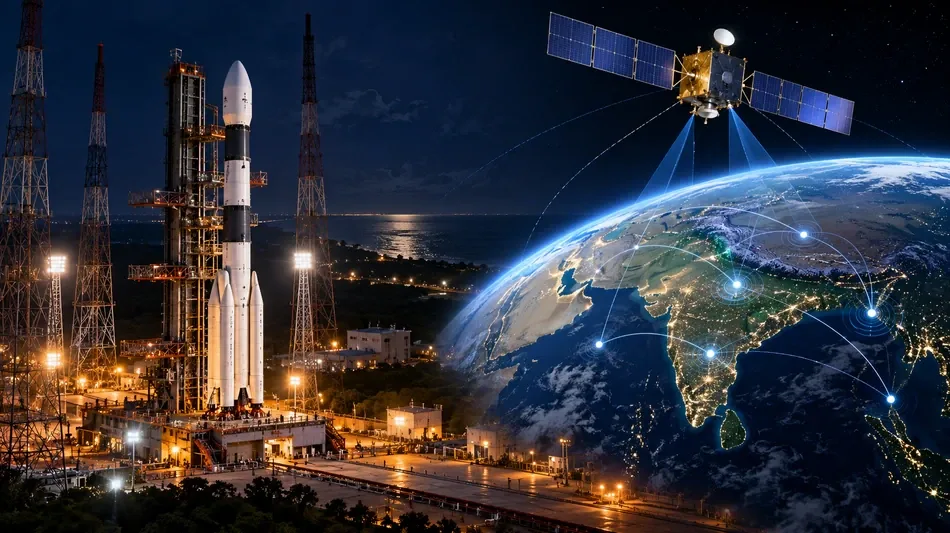
ISRO schedules NVS-03 navigation satellite launch for Friday

 Freshways milk-price cut deepens pressure on UK dairy farms

 Labour and National remain virtually tied as New Zealand vote count advances

 The Good Daughter adapts Karin Slaughter thriller with Rose Byrne and Meghann Fahy

 Heavy-lift drone evacuates wounded Ukrainian soldier from frontline kill zone

 Morrison says West Brom recovered after pressure from successive derby losses

 Britain considers 2027 state visit for Ukraine’s Zelensky

 Udinese Falls to Last Place in Serie A After Loss to Venezia

 BSG Chemie Leipzig Defeated by Regionalliga Leaders Rot-Weiß Erfurt

 Trump and Vance Pursue Secret Diplomacy with Iran Amid Military Pressure

 Inside SFFILM’s Operations: Jordan Menashe on Managing Doc Stories Logistics
The Indian Space Research Organisation (ISRO) is all set to launch NVS-03, the third entry in its next generation NavIC series of satellites, onboard ISRO’s Geosynchronous Satellite Launch Vehicle (GSLV).
The Indian Space Research Organisation (ISRO) is all set to launch NVS-03, the third entry in its next generation NavIC series of satellites, onboard ISRO’s Geosynchronous Satellite Launch Vehicle (GSLV).
This will be the 20th mission for the three-stage rocket, with 13 successes, 4 failures, and 2 partial failures to date.
The satellite will be launched on Friday (October 30, 2026) at 11.51 PM from the Second Launch Pad (SLP) at Satish Dhawan Space Centre in Sriharikota, Andhra Pradesh.
The launch and successful deployment of NVS-03 will be a crucial milestone for India’s indigenous navigation satellite systems especially after the setback from the previous NVS-02 satellite in the series. The NVS-02, after successful injection into the GTO orbit last year was unable to carry out the orbital manoeuvres required to reach its intended Geostationary Earth Orbit (GEO).
The NavIC series of satellites are intended to replace the ageing Indian Regional Navigation Satellite System (IRNSS) - India’s first generation of navigation satellites.
“The satellites are designed to provide accurate Position, Navigation and Timing (PNT) service to users in India as well as the region extending about 1500 km beyond the Indian landmass, which is its primary service area,” ISRO said.
NVS-03 carries both indigenous as well as internationally procured atomic clocks.
It also comes with an L1 frequency band enabling seamless integration of NavIC data into mainstream consumer electronics, including smartphones, automotive navigation units, and wearable personal fitness devices.
J.Bergmann--BTB