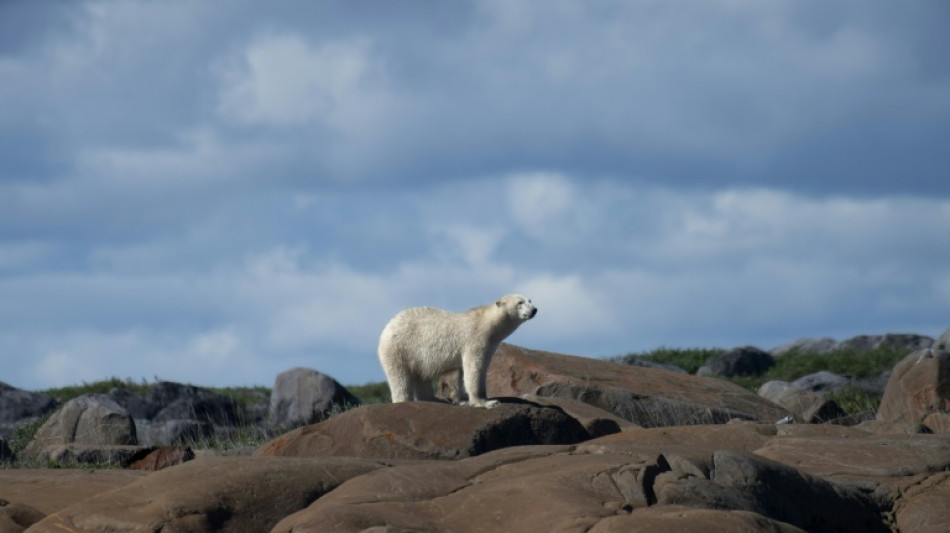
Polar bear hell: An ice pack that keeps receding / Photo: © AFP

 Braves clinch division title as Red Sox reach MLB playoffs
 Bordeaux-Begles hammer Stade Francais despite Jalibert injury

 Milan and Juventus end blips with home wins

 Bridgeman wins PGA Biltmore title with sizzling 61

 Williams injured as Bears shut down by Vikings

 US warns of rapid escalation in Middle East war

 Germany's far-right AfD celebrates another state election win

 Russia vows revenge for election-day attacks as poll shows ruling party win

 Spaun late shows snatches PGA Championship win

 Conceicao strikes as Juventus beat Atalanta

 Britain, Zverev-inspired Germany, Spain complete Davis Cup finals

 Man Utd salvage Fulham draw as pressure mounts on Carrick

 Spanish civil war drama 'The Black Ball' wins at Toronto festival

 Germany's Merz shaken by far-right and far-left gains in state votes

 Macron welcomes Canada's Carney to French Atlantic territory

 Fiorentina frustrate Napoli with Serie A draw, Como upset

 Five-star Man City top Premier League after Sunderland thriller

 Ukrainian drones hit Moscow on last day of Russian elections

 Multi-Asset Trading Venue Monochrome Exchange Announces IEO of Its Native Token, $MCR
 South Korea break Japan hearts to win Asian Games basketball gold
 Acosta takes first victory at Austrian MotoGP

 PSG president Nasser al-Khelaifi under investigation in France for conflict of interest

 China swim sensation, 13, sets Games record after Japan win early

 Drones hit Moscow as Russians go to the polls

 New England boss Fleming says 'wrong' to ask Stokes to end retirement

Sprawled on rocky ground far from sea ice, a lone Canadian polar bear sits under a dazzling sun, his white fur useless as camouflage.
It's midsummer on the shores of the Hudson Bay and life for the enormous male has been moving in slow motion, far from the prey that keeps him alive: seals.
Every year from late June, when the bay ice disappears -- shrinking until it dots the blue vastness like scattered confetti -- the bears must move onto shore to begin a period of forced fasting.
But that period is lasting longer and longer as temperatures rise.
The whole annual rhythm of the polar bear is in peril, and birth rates are dropping as they scavenge for food.
"There could be a beluga whale carcass they might be able to find, (or a) naive seal near shore, but generally they're just fasting. They lose nearly a kilogram of body weight every day that they're on land," said Geoff York, a biologist for Polar Bears International (PBI). An AFP team joined him on an expedition.
In the Arctic, global warming is occurring three or four times faster than elsewhere in the world, recent studies indicate.
According to a 2020 report published in the journal Nature Climate Change, this means the near-extinction of this iconic animal is approaching: From 1,200 individuals in the 1980s, the polar bear population in western Hudson Bay has dropped to about 800 today.
These days, this super predator of the Arctic sometimes has to feed on seaweed, as a mother and her cub were seen doing not far from the port of Churchill, the Manitoba town and self-declared "polar bear capital."
They are also moving closer to the cities. In Churchill, the bears a few years ago began frequenting the waste disposal site, a source of easy - but harmful - food for them.
Since then, the town has taken precautions. The dump is now guarded by cameras, fences and patrols. Across Churchill, people leave cars and houses unlocked in case someone needs to take refuge quickly after a bad encounter with this large carnivore.
The emergency number for the wildlife protection unit is posted on many walls.
Some areas, like schoolgrounds, are more closely monitored.
When they get an urgent call, Ian Van Nest, the provincial officer of the unit, and his colleagues jump into their pickup truck armed with a rifle and a spray can of repellent, wearing protective vests.
Sometimes the bears can be scared off with just "the horn on your vehicle," Van Neste said. Other times the animals need to be sedated, then kept in cages until winter rolls around and they are freed.
The fate of the polar bear should alarm everyone, said Flavio Lehner, a climate scientist at Cornell University, who notes that the Arctic is a good barometer of planetary health.
And since the 1980s, data show, the bay's summer ice pack has decreased by nearly half.
J.Horn--BTB