Prigozhin, Simonyan, Medvedev: the rise of the Russian hawk / Photo: © POOL/AFP/File

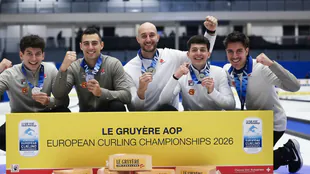 Italy Claims Curling Silver at European Championships in Ostrava
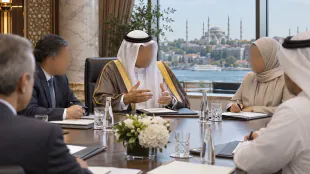 Kuwait finance minister holds economic cooperation talks at COMCEC
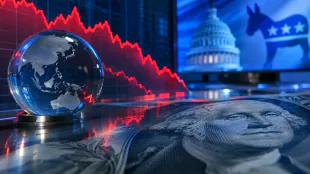
 Abdul El-Sayed declares victory in Michigan Senate contest

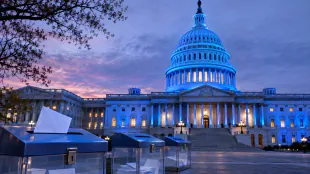 Democrats capture US Congress in sweeping midterm victory
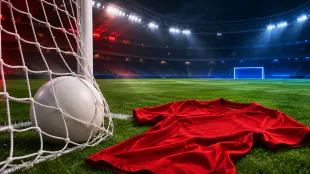 Manchester United rallies past Roma as PSG dominates in Champions League

 Qatar sees tentative opening for renewed regional diplomacy
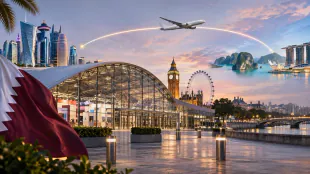 Qatar Tourism joins Pacific Asia Travel Association at London travel market
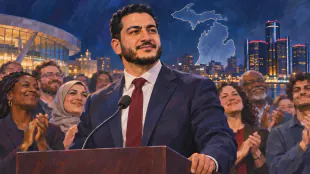 Abdul El-Sayed Wins Michigan Senate Seat in Historic Election
 Qatar media bodies discuss support for humanitarian initiatives

The first one challenged Ukraine's president to a fighter jet duel. The second has threatened Europe with nuclear apocalypse. The third has said cannibals roam Ukraine.
Russia's warmongers used to be relegated to the margins of society but now they are basking in the limelight after the Kremlin ordered its army to Ukraine.
These are Moscow's fiercest hawks, whose rise points to a new military fervour in Russia:
- Prigozhin: the warlord -
For years, Yevgeny Prigozhin did the Kremlin's bidding from the shadows, dispatching mercenaries from his private fighting force to conflicts in the Middle East and Africa, always denying involvement.
That changed with the Ukraine conflict. The 61-year-old both admitted he started the Wagner group and then began recruitment drives from Russia's prison network.
His offer? Fight in exchange for amnesty. The catch? Deserters and fighters who let themselves be captured would be summarily killed.
When video circulated showing an alleged Wagner deserter being executed with a sledgehammer, Prigozhin praised the killing, calling the dead man a "dog".
"Do not drink too much, don't take drugs, don't rape anyone," he told a group of prisoners who had served a six-month term and were being released into society.
Unlike Russia's generals, who have been criticised for shirking the battles, the stocky and bald Prigozhin regularly poses for pictures alongside mercenaries allegedly on the front lines.
Most recently, Prigozhin posted from the cockpit of a SU-24 fighter jet and challenged Ukrainian President Volodymyr Zelensky -- who has been pleading for jets -- to an aerial duel.
"If you want, let's meet in the skies. If you win, you will take (Bakhmut)," he said, referring to the longest battle of Russia's campaign.
The former hotdog seller from Saint Petersburg, who was himself jailed for nearly a decade during the Soviet era, has also tangled with Russia's top brass.
He clashed last month with the defence ministry over whose force had captured the town of Soledar in eastern Ukraine.
Prigozhin criticised the military's attempts to "steal the victory" from Wagner, pointing to his rising clout and the potential for dangerous rifts between him and officials in Moscow.
- Medvedev: the new convert -
For former Russian leader Dmitry Medvedev, the conflict has offered an opportunity to reinvent himself, shedding all traces of his liberal past to become one of Russia's most bellicose hawks.
The 57-year-old, now serving as deputy chairman of Russia's security council, was once famously photographed eating burgers with then-US President Barack Obama.
The picture now is very different.
"The defeat of a nuclear power in a conventional war can provoke the outbreak of a nuclear war," he warned ahead of a meeting of Ukraine's allies in Germany in January.
Medvedev has called US President Joe Biden "a strange grandfather with dementia" and referred to EU leaders as "lunatics".
And the Ukrainian government? "A bunch of crazy Nazi drug addicts," he said last November.
But Medvedev, once a regular on state television, is now mostly relegated to social media and his Telegram channel, which has more than one million subscribers.
"People often ask me why my messages are so harsh. The answer is this: I hate them," he said four months after the Kremlin launched its intervention in Ukraine.
"They are bastards and degenerates. They want us dead. They want Russia dead. And as long as I am alive, I will do everything I can to make them disappear."
- Simonyan: the information warrior -
Margarita Simonyan, the matriarch of Kremlin propaganda and the head of state-run television network RT, was already a vocal supporter of President Vladimir Putin before Russia's intervention in Ukraine.
Her rhetoric has since ratcheted up. The 42-year-old is a frequent guest on talk shows, where she launches tirades bristling with patriotic fervour and threats of nuclear apocalypse.
"Either we will win, or things will end badly for the whole of humanity," she said last May.
But the beginning of the offensive posed an immediate problem for Simonyan's network -- also known as Russia Today -- which was banned in most Western countries.
"Whenever they shut us down, we just used other (ways) to keep publishing... and passing on our message," Simonyan said in response.
Even though she routinely denounces this Western "censorship," Simonyan has also demanded that Russia ban foreign social media platforms -- a call Moscow has made good on.
"For 10 years I've been saying it: we still need to close everything, to ban it all, and to replace it with our own," she said.
In recognition of her work since the beginning of the conflict, Putin awarded her the Order of Honour in December.
"Thank you for slaying the cannibals," she told the Russian leader in accepting the award.
G.Schulte--BTB