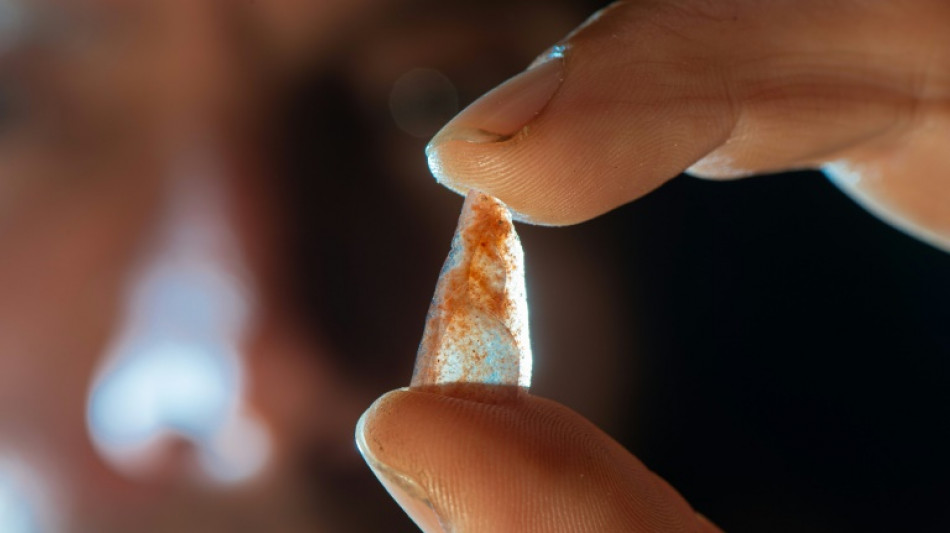
Homo sapiens in Europe used bow-and-arrow 54,000 years ago: study / Photo: © EUREKALERT!/AFP

 Italian garbagemen help recover lost 1 mln euro lottery ticket

 EU nations patch things up after Ceuta migration discord

 US hopeful Hormuz strait deal will be done 'today or tomorrow' after ship hit

 Infantino's problems mount as Wenger and key FIFA ally turn on him

 Oil edges higher, stocks gain as investors eye political risks

 Man Utd sign reported record £20mn sponsorship deal for training kit

 Stokes reveals England coaching ambition

 Cargo ship hit after Trump insists Iran talks could reopen Hormuz today

 BP profit soars as Mideast war roils energy prices

 Most stock markets gain, while oil prices edge up after plunge

 Most stock markets gain, while oil prices edge up after latest plunge

 Weak yen helps auto giant Toyota raise forecasts

 TRON DAO Joins Blockchain Application Stanford Summit at the Science of Blockchain Conference as a Sponsor

 Rockets, Starlink, AI: SpaceX faces its first Wall Street grilling

 After sparring over Ceuta, EU states seek lessons from crisis

 Forest fire spreads in Dutch nature reserve

 Japan sees 'urgent' need to boost military

 Myanmar ex-junta chief set for first Thailand visit as civilian leader

 New Zealand hooker Bell out of South Africa tour with calf strain

 Trump attorney general pick looks set to clear US Senate hurdle

 Agassi Sports Entertainment Launches Global "Let's Play" Pickleball and Padel Platform Initiative

 Death toll from Venezuela quakes rises past 6,000

 Shafique, Babar lead strong Pakistan reply against West Indies

 Defending champ Shelton finding tournament sweet spot in Montreal

 Democratic-led US states sue in latest challenge to Trump's tariffs

A cave in southern France has revealed evidence of the first use of bows and arrows in Europe by modern humans some 54,000 years ago, far earlier than previously known.
The research, published on Wednesday in the journal Science Advances, pushes back the age of archery in Europe by more than 40,000 years.
The use of the bow-and-arrow in Africa has been documented to date back some 70,000 years.
But the oldest previous evidence of archery in Europe was the discovery of bows and arrows in peat bogs of Northern Europe, notably Stellmoor in Germany, dating back 10,000 to 12,000 years.
The new research comes from the Mandrin rock shelter overlooking the middle valley of the Rhone River in southern France.
The Grotte Mandrin site, which was first excavated in 1990, includes layer upon layer of archaeological remains dating back over 80,000 years.
The researchers who conducted the latest study have documented previously that Neanderthals and their modern "cousins" -- Homo sapiens -- alternated in inhabiting the Mandrin cave.
A level known as the "Layer E" has been attributed to the presence of Homo sapiens some 54,000 years ago and is interposed between layers of numerous Neanderthal occupations.
The researchers conducted a functional analysis of flint artifacts found in Layer E that were more finely executed than the points and blades in the layers above and below.
Tiny flint points were the key because other elements of archery technology such as wood, fibers, leather, resins and sinew are perishable and rarely preserved in European Paleolithic sites.
- 'Too light to be efficient' -
For the study, the researchers reproduced the tiny flint points found in the cave, some of which are smaller than a US penny, and fired them as arrowheads with a replica bow at dead animals.
"We couldn't throw them at the animals any other way than with a bow because they were too tiny and too light to be efficient," said Laure Metz of Aix Marseille University, a co-author of the study along with Ludovic Slimak of the University of Toulouse.
"We had to use this kind of propulsion," Metz told AFP. "The only way that it was working was with a bow."
Fractures on the flint points were compared with scars found on the artifacts found in the cave, proving undoubtedly that they were used as arrowheads, the researchers said.
"Fractures for a lot of them, not all, were fractures of impact," Metz said. "And they are coming at the end of the point."
Metz said the evidence suggests that the Neanderthals and the Homo sapiens who used in the cave likely met at some point although "we don't know the nature of the meeting, whether it was nicely or not."
The Neanderthals who inhabited the Mandrin site continued to use traditional weapons, however, such as thrusted or hand-thrown spears and did not develop mechanically propelled weapons, she said.
"The traditions and technologies mastered by these two populations were thus profoundly distinct, illustrating a remarkable objective technological advantage to modern populations during their expansion into the European continent," the researchers said.
Metz said the occupants of the cave would have typically hunted horses, bison and deer and animal bones have been found inside.
C.Kovalenko--BTB