Future of Africa's flamingos threatened by rising lakes: study / Photo: © AFP

 Messi scores twice to set Leagues Cup record in Miami victory

 Asian stocks mostly down with tech firms back under pressure
 Back to the future as world champion Springboks host All Blacks

 India youth protests highlight mistrust in 'lapdog' media
 Pacific islands alarmed by Trump-backed push for deep-sea mining

 Erratic rains dictate menu at three-star Michelin restaurant in Brazil

 Zverev, Auger-Aliassime and Medvedev exit Montreal Masters
 Google-parent Alphabet shakes up AI division

 FIFA back Infantino, apologise for World Cup privatisation plan

 Auger-Aliassime out of Montreal ATP event with injury

 Colombian baby hippo of Escobar stock dies after rescue

 Preakness shifts 2027 dates to entice more Derby horses

 Guatemalan volcano eruption ends, locals return home

 WHO chief urges stronger Ebola response in DR Congo visit

 Newcastle appoint Jaissle as new head coach after Howe exit

 Swiss ski star Lara Gut-Behrami calls time on 18-year career

 US indicts leaders of Mexico's CJNG cartel, ups reward money

 Noosha Aubel: Είναι σε θέση να αντιμετωπίσει τα προβλήματα του Πότσδαμ;

 نوشا أوبيل: هل هي على مستوى التحديات التي تواجهها بوتسدام؟

 Former England fly-half Burns retires from rugby union

 Pakistan beat West Indies by eight wickets to level series

 Reusser holds lead as Vollering wins in Tour de France hills

 Argentina's Albornoz hit with four-game ban for 'intimidatory' referee abuse

 Guatemala volcano eruption eases off, but alert remains in place

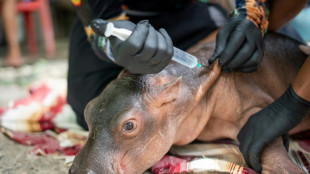 Baby hippo descended from Escobar's herd rescued in Colombia

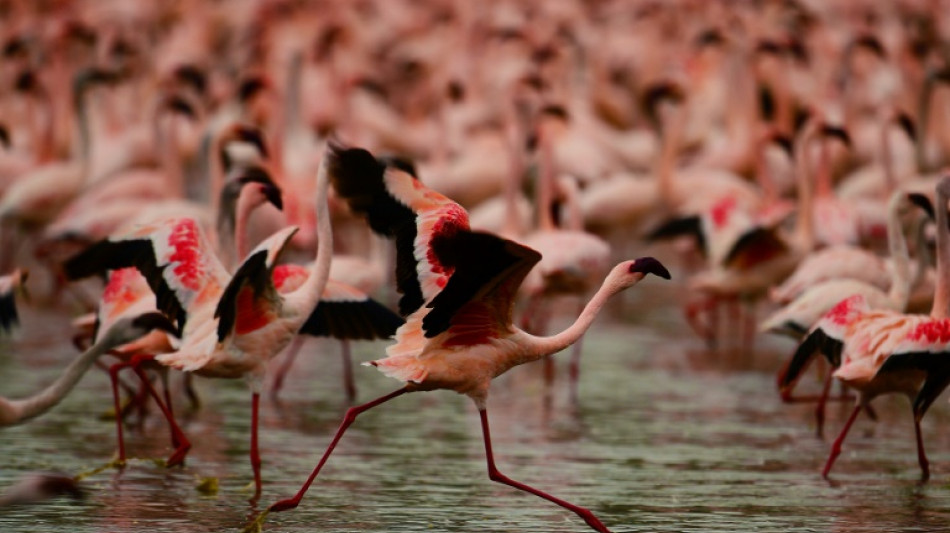
The lakes where Africa's flamingos congregate in spectacular numbers are producing less food for the iconic birds as their water levels rise, researchers said Friday, threatening the survival of a much-loved species.
Three-quarters of the world's lesser flamingos live in East Africa and more than a million birds at a time can gather at lakes in huge "flamboyances" for feeding and courtship.
But as these lakes expand to record highs, scientists have discovered they produce less of the unique algae upon which flamingos rely, putting at risk a species already in decline.
This is driving the distinctive, pink-plumed birds away from their usual habitats into unprotected areas in search of food, said Aidan Byrne, lead author of the research.
"They might be able to move elsewhere, but they could be lost from the region that they're currently in at these key feeding lakes," said Byrne, a PhD student jointly supervised by King's College London and the Natural History Museum.
Flamingos use their specialised beaks to feed on a particular type of algae that exists in salty, alkaline waters known as soda lakes.
These lakes are concentrated in Kenya, Tanzania and Ethiopia and despite being harsh landscapes, certain species -- including the flamingo and the algae they feast on -- have adapted to thrive there.
- 'Iconic species' -
But the lakes have risen to levels not seen in decades, driven in part by increased rainfall linked to climate change over the catchment areas.
This has greatly diluted the alkalinity and salinity of the water at these soda lakes.
Byrne and other researchers wanted to study the impact that had on biodiversity and found a "massive decline" in concentrations of the very algal blooms upon which flamingos survive.
Earlier studies had looked at the problem but its extent was not known until now, he said.
"We were surprised at the scale of the changes, and how much the flamingo habitats are threatened," he told AFP.
Erratic and extreme rainfall predicted for East Africa in future would only make the problem worse and "increase the threat to the species within the region", he added.
The study, published in the journal Current Biology, is the first to use satellite imagery to observe all 22 of the soda lakes that host flamingos across the East African region.
This was combined with climate records and bird observation data over more than 20 years.
The sharpest drops in algae concentrations were observed in Kenya, including at Nakuru, one of the most important flamingo feeding lakes in Africa known for hosting million-strong "flamboyances".
It expanded by roughly 90 percent between 2009 and 2022 while algal concentration halved.
Lake Bogoria and Lake Elmenteita, also tourist magnets for their brilliant flamingo displays, experienced steep declines as well.
And where algal blooms declined, so too did flamingo numbers, Byrne said, putting in doubt revenue from tourism as well.
Flamingo habitats in East Africa are protected whereas outside these ranges monitoring would be difficult and other threats -- including from humans -- could emerge, he said.
"They're just such an iconic species that are unique to these environments. If they're lost, it would be devastating," Byrne said.
T.Bondarenko--BTB