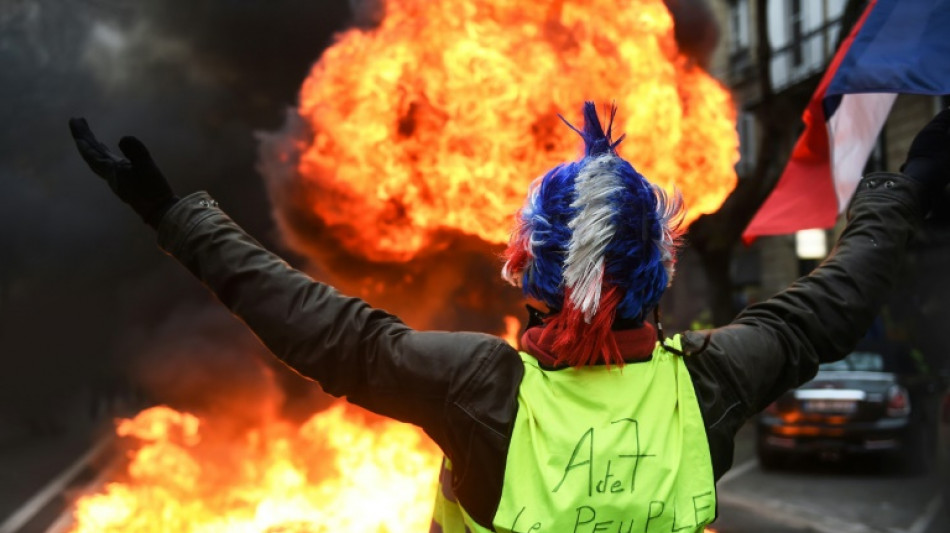
Is fractious France ready for an Olympics party? / Photo: © AFP

 Messi scores twice to set Leagues Cup record in Miami victory
 Asian stocks mostly down with tech firms back under pressure

 Back to the future as world champion Springboks host All Blacks
 India youth protests highlight mistrust in 'lapdog' media
 Pacific islands alarmed by Trump-backed push for deep-sea mining
 Erratic rains dictate menu at three-star Michelin restaurant in Brazil
 Zverev, Auger-Aliassime and Medvedev exit Montreal Masters

 Google-parent Alphabet shakes up AI division
 FIFA back Infantino, apologise for World Cup privatisation plan
 Auger-Aliassime out of Montreal ATP event with injury
 Colombian baby hippo of Escobar stock dies after rescue
 Preakness shifts 2027 dates to entice more Derby horses

 Guatemalan volcano eruption ends, locals return home
 WHO chief urges stronger Ebola response in DR Congo visit
 Newcastle appoint Jaissle as new head coach after Howe exit
 Swiss ski star Lara Gut-Behrami calls time on 18-year career
 US indicts leaders of Mexico's CJNG cartel, ups reward money

 Noosha Aubel: Είναι σε θέση να αντιμετωπίσει τα προβλήματα του Πότσδαμ;

 نوشا أوبيل: هل هي على مستوى التحديات التي تواجهها بوتسدام؟

 Former England fly-half Burns retires from rugby union
 Pakistan beat West Indies by eight wickets to level series
 Reusser holds lead as Vollering wins in Tour de France hills
 Argentina's Albornoz hit with four-game ban for 'intimidatory' referee abuse

 Guatemala volcano eruption eases off, but alert remains in place
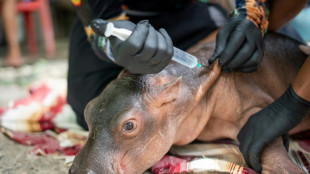 Baby hippo descended from Escobar's herd rescued in Colombia
Organisers of the Paris Olympics have promised a "great national party" for the country, but with 100 days to go, France's bitter politics and gloomy mindset are dampening the mood.
Those involved in the delivery of the Games, particularly chief organiser Tony Estanguet, remain relentlessly upbeat, encouraging their countryfolk to look on the bright side.
"It's my role to explain that it's a fantastic opportunity for our country to host this event, to welcome the world and also showcase what this country is about to do and deliver," he told reporters last Wednesday.
He said he wasn't surprised to hear complaints and doubts, however.
"We all know that before this kind of big event, there are always many questions, many concerns," he said.
The construction work is on track and the budget looks set to be relatively contained compared to the huge blow-outs seen at the Athens, London or Rio de Janeiro Games.
French President Emmanuel Macron cut a slightly frustrated figure as he inaugurated a new aquatics centre in early April, speaking as if the public and media were not giving organisers the credit they deserved.
"Take a bit of perspective and look at the history of previous Games," the 46-year-old urged reporters, promising the Paris edition would make the nation "proud".
- 'On the defensive' -
Instead of pride, the build-up has been marred by rows that go to the heart of a bitter national debate about identity and race.
Influential far-right politicians have criticised the official Games poster -- a Christian cross was omitted from a depiction of a Paris landmark -- as well as the choice of artists for the opening ceremony on July 26.
The prospect of an appearance by Franco-Malian R&B superstar Aya Nakamura caused an uproar among conservatives who criticised her supposed "vulgarity" -- something described as "pure racism" by France's culture minister.
Herve Le Bras, a veteran sociologist, said he was sceptical that the Olympics could serve as a moment of national celebration.
"Instead, there are lots of suggestions that they will underline the major fractures in France -- notably the fracture between Paris and the rest of the country," he told AFP in an interview.
Le Bras wrote a book in 2018 entitled "Feeling bad in a France that is doing well" that delved into the paradox of the national psyche.
Why does the country feel so bad about itself while being among the richest in the world, with one of the most generous social security systems, and a lifestyle that is envied across the globe?
A major survey by the Ipsos group last September found eight out of 10 people thought the country was in decline and nearly one in two said they felt angry and contrarian.
In another era -- during the decades of bullish post-war expansion in France, for example -- the country might have been more ready to celebrate the Olympics, Le Bras suggests.
"We had a sense then that everything was moving in the direction of progress. We're not in that sort of period now," he said. "We're on the defensive."
Jean Viard, another well-known sociologist, believes that the risk of terrorism and wars in Europe and the Middle East are weighing on people's minds.
"We live in an era where there is the climate danger, which feels like a war on the climate, the war in Ukraine, the war in Israel," he told AFP. "People feel like they are surrounded by violence."
- Money concerns -
The Olympics are also taking place at a time where the rising cost of living is causing economic hardship, making the often high ticket prices for events hard to stomach.
"You hear the same thing at all levels of society, 'We're organising a show, we're paying for it, but we are not able to take part'," Paul Dietschy, a sports historian at the Universite de Bourgogne-Franche-Comte in eastern France, told AFP.
Many trade unions have issued strike threats as they push for pay rises.
Other concerns include the fast-rising public debt -- just as new estimates emerge suggesting that taxpayers could end up with an Olympics bill of up to five billion euros ($5.4 billion).
And the gleaming new Olympic village has been unveiled at a time when the country faces a housing crisis.
"That makes people uneasy," Le Bras suggested.
Although past polls have shown majority support for the Olympics, a survey on March 25 by the Viavoice group found that 57 percent of respondents felt "little" or "no" enthusiasm about them in Paris.
Paris' deputy mayor Emmanuel Gregoire believes the mood will swing.
"Everyone was a little bit afraid about the security side during the Games and... now it is really changing," he said recently.
W.Lapointe--BTB