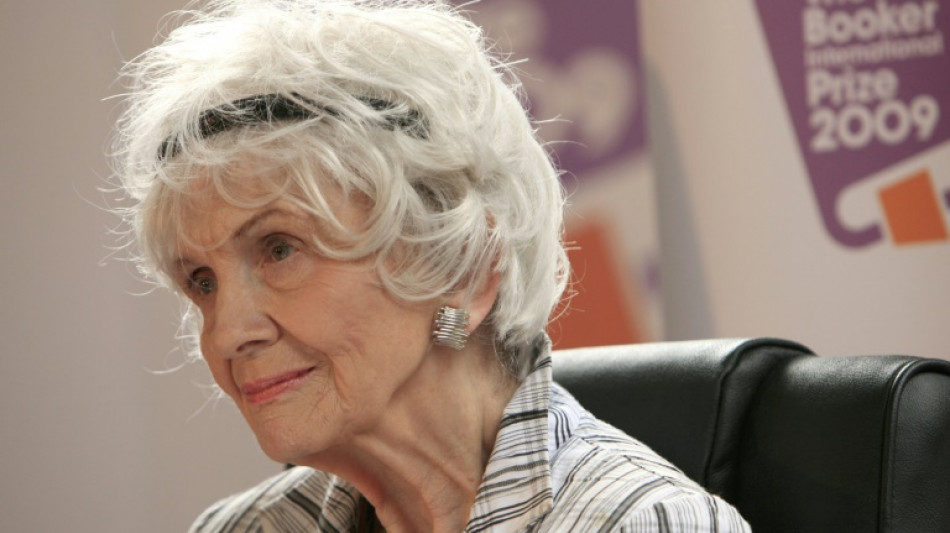
Alice Munro, Canada's 'Chekhov' / Photo: © AFP/File

 New Australia coach Kiss gives Japan starts to Ross, Amatosero

 'Stretch our money': Romanians face highest EU inflation

 Iran says close to Hormuz plan with Oman, but reopening depends on US

 Messi scores twice to set Leagues Cup record in Miami victory

 Asian stocks mostly down with tech firms back under pressure

 Back to the future as world champion Springboks host All Blacks

 India youth protests highlight mistrust in 'lapdog' media

 Pacific islands alarmed by Trump-backed push for deep-sea mining

 Erratic rains dictate menu at three-star Michelin restaurant in Brazil

 Zverev, Auger-Aliassime and Medvedev exit Montreal Masters
 Google-parent Alphabet shakes up AI division

 FIFA back Infantino, apologise for World Cup privatisation plan

 Auger-Aliassime out of Montreal ATP event with injury

 Colombian baby hippo of Escobar stock dies after rescue

 Preakness shifts 2027 dates to entice more Derby horses

 Guatemalan volcano eruption ends, locals return home

 WHO chief urges stronger Ebola response in DR Congo visit

 Newcastle appoint Jaissle as new head coach after Howe exit
 Swiss ski star Lara Gut-Behrami calls time on 18-year career

 US indicts leaders of Mexico's CJNG cartel, ups reward money

 Noosha Aubel: Είναι σε θέση να αντιμετωπίσει τα προβλήματα του Πότσδαμ;

 نوشا أوبيل: هل هي على مستوى التحديات التي تواجهها بوتسدام؟

 Former England fly-half Burns retires from rugby union

 Pakistan beat West Indies by eight wickets to level series

 Reusser holds lead as Vollering wins in Tour de France hills

Canadian author and Nobel laureate Alice Munro set her taut, acutely observed stories in the rural Ontario countryside where she grew up, focusing a stark lens on the frailties of the human condition.
Despite her vast success and an impressive list of literary prizes, Munro, who died Monday at the age of 92, long remained as unassuming and modest as the characters in her collections of short stories.
She had been suffering dementia for at least a dozen years, and died at her care home in Ontario, Canadian media reported.
When Munro was awarded the Nobel Prize in literature in 2013, the organizers dubbed her a "master of the contemporary short story" and noted that some critics considered her "a Canadian Chekhov."
Her characters were usually women who did not fit the stereotype of the beautiful, ravishing heroine, possibly reflecting the puritan values of her childhood.
"She is not a socialite. She is actually rarely seen in public, and does not go on book tours," commented American literary critic David Homel at the time.
She was sometimes described as the complete opposite of another great dame of Canadian literature -- Margaret Atwood.
Born on July 10, 1931, in Wingham, Ontario, she grew up in the countryside. Her father Robert Eric Laidlaw raised foxes and poultry, while her mother was a small town schoolteacher.
At just 11 years old, she decided she wanted to be a writer, and never wavered in her career choice.
"I think maybe I was successful in doing this because I didn't have any other talents," she explained in an interview once.
"I'm not really an intellectual," Munro said. "I was an okay housewife but I wasn't that great. There was never anything else that I was really drawn to doing, so nothing interfered in the way life interferes for so many people."
"It always does seem like magic to me."
-'Depth, wisdom and precision' -
Munro's first story, "The Dimensions of a Shadow," was published in 1950, while she was studying at the University of Western Ontario.
It was at school that she met her first husband James Munro. The couple married in 1951 and moved to Vancouver in western Canada, where they raised three girls.
In 1963, they bought a house in Victoria and opened a bookstore, Munro's Books, described by author Allan Fotheringham as "the most magnificent bookstore in Canada, possibly in North America."
Munro was three times awarded the Governor General's Award for fiction, first for "Dance of the Happy Shades" published in 1968. "Who Do You Think You Are" (1978) and "The Progress of Love" (1986) also won Canada's highest literary honor.
Her short stories often appeared in the pages of prestigious magazines such as The New Yorker and The Atlantic, with her last collection "Dear Life" appearing in 2012.
Critics praised her for writing about women for women, but without demonizing men.
She was likened to the 19th century Russian playwright Anton Chekhov for her subjects and her writing style.
Munro herself said she writes about the "underbelly of relationships," adding she set her stories in Canada "because I live life here at a level of irritation which I would not achieve in a place that I knew less well."
"There are no such things as big and little subjects," she had said. "The major things, the evils, that exist in the world have a direct relationship to the evil that exists around a dining room table when people are doing things to each other."
In a 2010 interview, she said she wanted readers "to feel something is astonishing -- not the 'what happens' but the way everything happens."
She added that "long short story fictions do that best" for her.
After Munro's first marriage ended in divorce in 1972, she took a post as a writer-in-residence at her alma mater in Ontario.
Four years later, she remarried, to geographer Gerald Fremlin, and published new works every four years on average -- though she did not publish new material in the last decade of her life.
Munro said in 2013 that she was "probably" not going to write anymore, and that "Dear Life" would be her last work.
Her story "The Bear Came Over the Mountain" was adapted for the screen by Sarah Polley as the film "Away from Her," and in 2009 she won the prestigious International Booker Prize for her body of work.
The Booker panel praised her originality and depth.
"Alice Munro is mostly known as a short story writer and yet she brings as much depth, wisdom and precision to every story as most novelists bring to a lifetime of novels," they said.
"To read Alice Munro is to learn something every time that you never thought of before."
J.Fankhauser--BTB