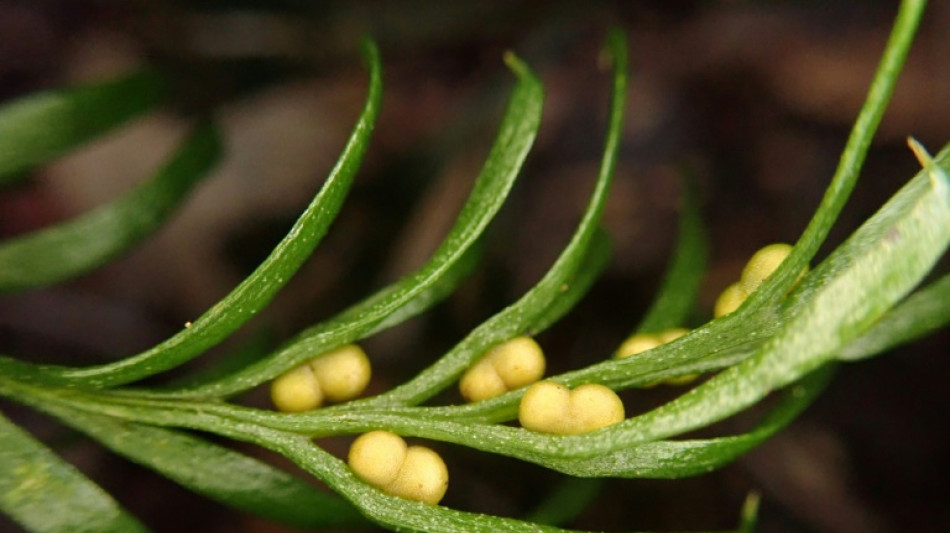
'Innocuous-looking' fern wins world record for largest genome / Photo: © Institut Botanic de Barcelona (CSIC)/AFP

 Stocks fluctuate after Wall St sell-off, crude holds losses on peace talks

 Ultra-reclusive Turkmenistan slowly opens up to tourists

 Marc Bloch, historian and Resistance hero, joins France's Pantheon greats

 Ronaldo 'a role model' says Portugal coach after slow World Cup start

 North Korea's Kim vows to accelerate military buildup

 Latin America's resurgent right notches another win in Colombia

 Trump threatens prison for damage to Washington Reflecting Pool

 Shortages ease in Bolivia as protest roadblocks dismantled

 England 'can beat any opponent' at World Cup, says Rice

 Alvarez says 'best for everyone' if he leaves Atletico

 Romanian parliament rejects liberal PM-designate

 Maduro ouster put Venezuela on 'the right path': interim leader

 Shooting in Montreal, Canada leaves three dead including suspect

 Balogun chases 'inevitable' Messi in wild Golden Boot race

 Belgium's Doku becomes father after World Cup controversy

 Magic Messi makes World Cup history to send Argentina into last 32

 Ghana coach Queiroz says playing England 'easiest' World Cup game

 Former Bayern stalwart Demichelis takes over at RB Leipzig

 Andy Burnham: 'King of the North' with Downing Street in his sights

 Latest developments in Europe's heatwave

 IMF director says Iran war fallout creating 'difficult moment' for Africa

 Hormuz: Traffic flows despite Iran's closure announcement

 Clive Davis: the starmaker who shaped modern music

 Qatar gas plant blast kills 13, injures dozens

 Oil falls as US waives Iranian crude sanctions

A small, seemingly unremarkable fern that only grows on a remote Pacific island was on Friday crowned the Guinness World Record holder for having the largest genome of any organism on Earth.
The New Caledonian fern, Tmesipteris oblanceolata, has more than 50 times more DNA packed into the nucleus of its cells than humans do.
If the DNA from one of the fern's cells -- which are just a fraction of a millimetre wide -- were unravelled, it would stretch out to 106 metres (350 feet), scientists said in a new study.
Stood upright, the DNA would be taller that than the tower that holds London's famous Big Ben bell.
The fern's genome weighed in at a whopping 160 gigabase pairs (Gbp), the measurement for DNA length.
That is seven percent larger than the previous record holder, the Japanese flowering plant Paris japonica.
The human genome is a relatively puny 3.1 Gbp.
If our DNA were unravelled, it would be around two metres long.
Study co-author Ilia Leitch, a researcher at the UK's Royal Botanic Gardens Kew, told AFP that the team was "really surprised to find something even bigger than Paris japonica".
"We thought we'd already reached the biological limit. We're really pushing at the extremes of biology," she said.
The fern, which grows five to 10 centimetres tall, is only found in New Caledonia, a French Pacific territory which has recently seen unrest.
Two members of the research team travelled to the main island, Grand Terre, in 2023 and worked with local scientists for the study, which was published in the journal iScience.
Guinness World Records awarded the fern its coveted "largest genome title".
The win by "this innocuous-looking" fern demonstrates that "record holders aren't always the showiest on the outside", Guinness World Records managing editor Adam Millward said.
- What's a genome again? -
Humans are estimated to have more than 30 trillion cells in our bodies.
Within each of those cells is a nucleus which contains DNA, which is like a "book of instructions that tells an organism like ourselves how to live and survive", Leitch explained.
All of an organism's DNA is called its genome.
So far, scientists have estimated the genome size of around 20,000 organisms, just a fraction of life on Earth.
Among animals, the marbled lungfish has the largest, with 130 Gbp.
While plants have the biggest genomes, they can also have incredibly small ones. The carnivorous Genlisea aurea's genome is just 0.06 Gbp.
But we humans need not feel inadequate when comparing ourselves to the mighty T. oblanceolata.
All the evidence suggests that having a huge genome is a disadvantage, Leitch said.
The more DNA you have, the larger your cells need to be to squeeze it all in.
For plants, bigger cells mean things like the pores of leaves have to be larger, which can make them grow more slowly.
It is also trickier to make new copies of all that DNA, limiting their reproductive abilities.
This means the most massive genomes are seen in slow-growing, perennial plants which cannot easily adapt to adversity or contend with competition.
Genome size can therefore affect how plants respond to climate change, changing land use and other environmental challenges caused by humans, Leitch said.
- What's all that DNA for? -
There could still be bigger genomes somewhere out there but Leitch thinks this fern must be near the limit.
"I cannot understand how an organism with all this DNA really functions," she said.
Scientists do not know what most of the DNA does in such huge genomes, she admitted.
Some say most of it is "junk DNA".
"But that's probably our own ignorance. Maybe it does have a function, and we have yet to find it," Leitch said.
Jonathan Wendel, a botanist at Iowa State University not involved in the research, agreed it was "astonishing" how much DNA the fern is packing.
But this only "represents the first step", he told AFP.
"A great mystery is the meaning of all of this variation -- how do genomes grow and shrink, and what are the evolutionary causes and consequences of these phenomena?"
F.Müller--BTB