'Nature's mirror': Climate change batters Albania's butterflies
/ Photo: © AFP

 North Korea fires ballistic missile: South Korea military

 'Don't have to hide': Thai IDs, legal work give hope to Myanmar refugees

 Stocks mixed with tech firms back under pressure

 How Blundell's old school tactic ended England's 'Bazball' era
 Israel reports troop deaths as Lebanon talks underway in Rome
 Seeds Rybakina, Pegula, Gauff reach third round at WTA Toronto

 Police raid South Korea FA in probe into World Cup coach appointment

 Low water on Germany's Rhine river threatens new blow to economy

 Ex-Wallabies Foley, Phipps rejoin Waratahs ahead of home World Cup

 Rising Kenyan lakes push crocodiles closer to homes

 Istanbul cymbals: From Ottoman war tool to pulse of global music

 Myanmar ex-junta chief on first Thailand trip as civilian leader

 Environmental disaster looms as tanker leaks off Oman

 Embattled Infantino sees minnows Malawi reach WAFCON quarter-finals

 Seeds Rybakina, Pegula and Gauff advance at WTA Toronto event

 Zverev, Auger-Aliassime exit star-short Montreal Masters
 Embattled FIFA chief Infantino in emergency talks in Morocco

 Castaway SpaceX rocket stage crashed into Moon, scientists say
 Dow edges to record as markets parse prospects for Hormuz deal
 Salah arrives in Turkey to complete Trabzonspor move

 AFP journalist to be honored at International Press Freedom Awards

 Turkish MPs back limited amnesty for Kurdish militants

 Noosha Aubel: Czy poradzi sobie z problemami Poczdamu?

 Noosha Aubel: Klarar hon av Potsdams problem?

 Noosha Aubel: Zvládne problémy Postupimi?

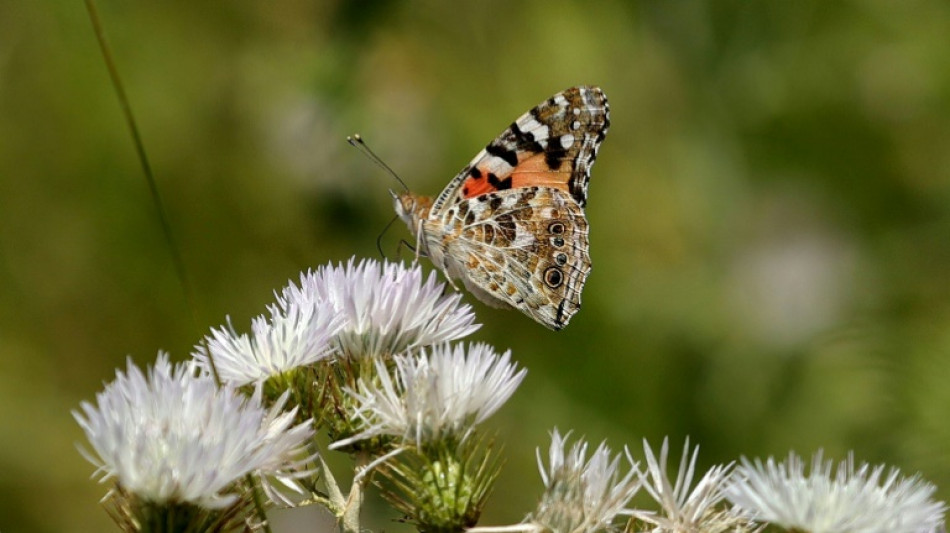
Bright yellow, black, red and blue, Alexanor butterflies once fluttered abundantly on southwestern Albania's flowery slopes. Now, like many related species, scientists say they are disappearing due to human impacts, including climate change.
Increasingly absent from the picturesque district of Zvernec, the Alexanor is one of 58 of the Balkan country's 207 butterfly species that researchers say are at risk.
"Sensitive to changes, they are a true mirror of the conditions of the ecosystem in which they live," said Anila Paparisto, an entomologist at Tirana University.
In Zvernec, Paparisto leads a team of researchers and students working to identify the country's remaining butterfly species along with those that are now extinct.
Numerous scientific studies have measured the impact of climate change on butterfly populations, though researchers also cite other environmental factors.
They blame a combination of rapid urbanisation, pesticides and warming temperatures for the decrease.
"Human activity and climate change have had major impacts on nature," said biology student Fjona Skenderi, who was helping conduct research in Zvernec.
In the nearby Divjaka Natural Park, Albanian agronomist Altin Hila points to the disappearance of the Giant Peacock Moth and the Plain Tiger as another worrying sign.
"It's a disaster marked by climatic disruptions, an early spring and excessively high temperatures in January and February," explained Hila, who is also a passionate collector and oversees a butterfly museum in Divjaka.
"It encouraged the eggs to hatch and the butterfly larvae to grow, but in April the temperatures were too low" for them to survive, he added.
- 'Butterfly effect' -
The butterflies' decline also affects other species.
"It will impact the entire food chain and biodiversity, which is also essential for humans," Paparisto said.
"When there are fewer butterflies, you expect... the butterfly effect."
Like large swaths of Albania, coastal areas near Zvernec have become increasingly overrun with resorts and apartment blocks, built with little oversight.
Scientists say the rapid urbanisation in the area, along with overfishing and climate change, has also played a part in the dramatic drop in migratory bird populations.
And while some butterfly populations are in decline, other similar species are prospering -- to the detriment of the environment.
The arrival of a non-native moth through imports of ornamental plants from China has ravaged more than 80 percent of Albania's boxwood forests since 2019, according to experts.
"It is very aggressive, it can reproduce three to four times a year, and it is a real misfortune which reduces entire areas to nothing," said forest engineer Avdulla Diku.
With their distinct neon green and black bodies, the larvae are easily spotted when clinging to the boxwoods' leaves and stems.
On the road along Lake Ohrid to Pogradec in northwestern Albania, the once vibrant green rows of boxwoods are reduced to husks after being devoured by the moths' larvae.
"It is a firm reminder of the fragility and subtle balance of the environment in which we live," said Sylvain Cuvelier, an entomological researcher who co-authored the first Albanian butterfly atlas.
"It is obviously urgent to unite our efforts to find solutions, to rethink in depth our use of natural resources and the way forward for the protection and restoration of our environment."
Y.Bouchard--BTB