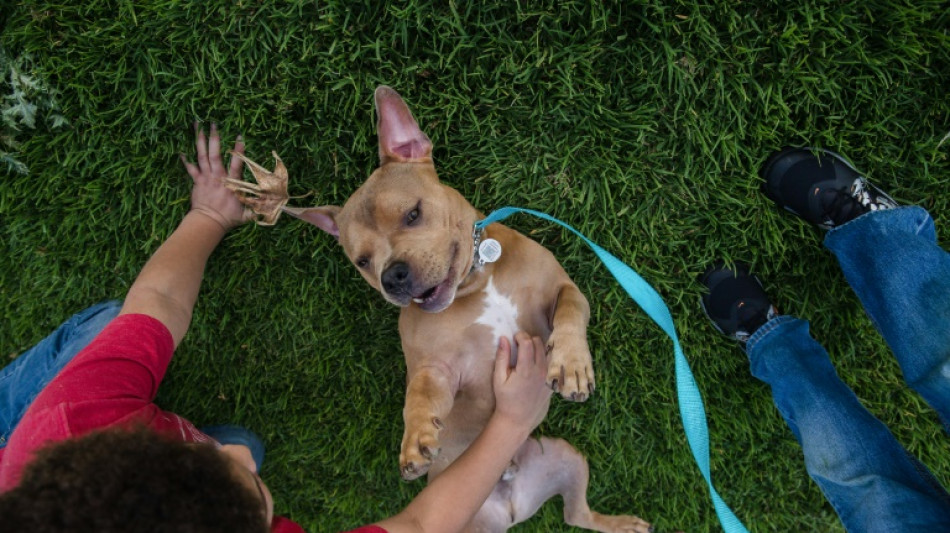
Contrary to popular belief, a dog's breed won't predict behavior / Photo: © AFP/File

 Trump threatens EU over 'hostile' Canada association plan

 Argentine judge orders suspension of Falklands oil project

 Carrick takes the blame as troubled Man Utd suffer League Cup misery

 Barcelona hit seven in Racing Santander rout
 Amorim's Milan beaten by Benfica, Sunderland make dream European return

 US stocks fall, dollar gains after Fed lifts interest rates

 Seahawks rule out Darnold for Sunday game at Arizona
 Mbappe explains Ceuta shirt stance after criticism

 Improving Atletico cruise to comfortable win over Osasuna
 Candidate for UN chief calls for AI regulation akin to nuclear weapons

 O'Neill expects Celtic recovery after Old Firm misery

 Man City midfield trio backed to emulate Rodri and Silva
 'We're losing control,' AI pioneer Yoshua Bengio tells AFP

 WHO eyes 'encouraging' signs in DRCongo fight against Ebola

 Liga boss criticises Real Madrid trio for Ceuta shirt incident

 WTA Finals moved to Charlotte from 2027
 Almost 8,000 excess deaths in France's scorched summer: statistics

 Ex-president's lengthy war crimes sentence shocks Kosovo

 US House faces test on sweeping Russia sanctions bill

 British PM says to make 'difficult decisions' as inflation rises

 TotalEnergies pumps up controversy in France with cut-price gas

 Global fuel price demos: a round-up

 Leverate Launches MCP for Traders to Connect AI Assistants With Trading Platforms

 MEXC Launches $1M "Discover Your Wall Street DNA" Campaign to Help Traders Find Their Market Fit

 Emporio Armani names Dario Vitale new creative director

They're well-known stereotypes: rottweilers and pit bulls are aggressive, while Labradors and golden retrievers are extra friendly.
But a genetic study published in the journal Science on Thursday involving more than 2,000 dogs paired with 200,000 survey answers from owners demonstrates that the widespread assumptions are largely unfounded.
To be sure, many behavioral traits can be inherited -- but the modern concept of breed offers only partial predictive value for most types of behavior -- and almost none whatsoever for how affectionate a dog will be, or conversely, how quick to anger.
"While genetics plays a role in the personality of any individual dog, specific dog breed is not a good predictor of those traits," said senior author Elinor Karlsson, of UMass Chan and the Broad Institute of MIT and Harvard.
"What we found is that the defining criteria of a golden retriever are its physical characteristics -- the shape of its ears, the color and quality of its fur, its size -- not whether it is friendly," she added.
Lead author Kathleen Morrill explained that understanding the relationship between breeds and behavior could be the first step in understanding the genes responsible for psychiatric conditions in humans, like obsessive disorders.
"Although we can't really ask a dog themselves about their problems or thoughts or anxieties, we do know that dogs lead rich emotional lives and experience disorders that manifests in their behavior," she said on a press call.
- Implications for legislation -
The team sequenced the DNA of 2,155 purebred and mixed-breed dogs to search for common genetic variations that could predict behavior, and combined this info with surveys from 18,385 pet-owner surveys from Darwin's Ark.
The site is an open-source database of owner-reported canine traits and behaviors.
Because existing stereotypes are so powerful, the team designed their questionnaires to account for owner bias.
They established standard definitions for reporting traits such as biddability (dog response to human direction), dog-human sociability (how comfortable dogs are with people, including strangers), and toy-directed motor patterns (how interested they are in toys).
Physical and aesthetic traits were also surveyed.
In all, Karlsson and Morrill found 11 locations on the dog genome associated with behavior differences, including biddability, retrieving, pointing at a target and howling.
Among these behaviors, breed did play some role -- for example, beagles and bloodhounds tend to howl more, border collies are biddable, and Shiba Inus are far less so.
However, there were always exceptions to the rule.
For example, even though Labs had the lowest propensity for howling, eight percent still did. While 90 percent of greyhounds didn't bury their toys, three percent did frequently.
"When we looked at this factor that we called agonistic threshold, which included a lot of questions about whether people's dogs reacted aggressively to things, we weren't seeing an effect of breed ancestry," Karlsson added.
Overall, breed explained just nine percent of variation in behavior, with age a better predictor of some traits, like toy play. Physical traits, however, were five times more likely to be predicted by breed than behavior was.
The idea runs counter to widespread assumptions that have informed legislation. For example, Britain has banned pit bull terriers, as have many US cities.
- Human disorders -
Prior to the 1800s, dogs were primarily selected for functional roles such as hunting, guarding and herding, the team said in their paper.
"By contrast, the modern dog breed, emphasizing confirmation to physical ideals and purity of lineage, is a Victorian invention," they wrote.
Modern breeds carry genetic variations of their ancient predecessors, but not at the same frequencies -- explaining the behavior divergence within breeds.
The next steps, said Morill, would be digging more into compulsive behaviors in dogs, and connections to human obsessive-compulsive disorder.
One intriguing finding was that dog sociability toward humans was "incredibly heritable in dogs," even though it wasn't breed dependent.
The team found a location in dog DNA that could explain four percent of the sociability differences between individuals -- and that location corresponds to an area of the human genome responsible for long term memory formation.
"It could be that understanding human sociability in dogs helps us understand how brains develop and learn. So we're kind of just scratching the surface," said Morill.
D.Schneider--BTB