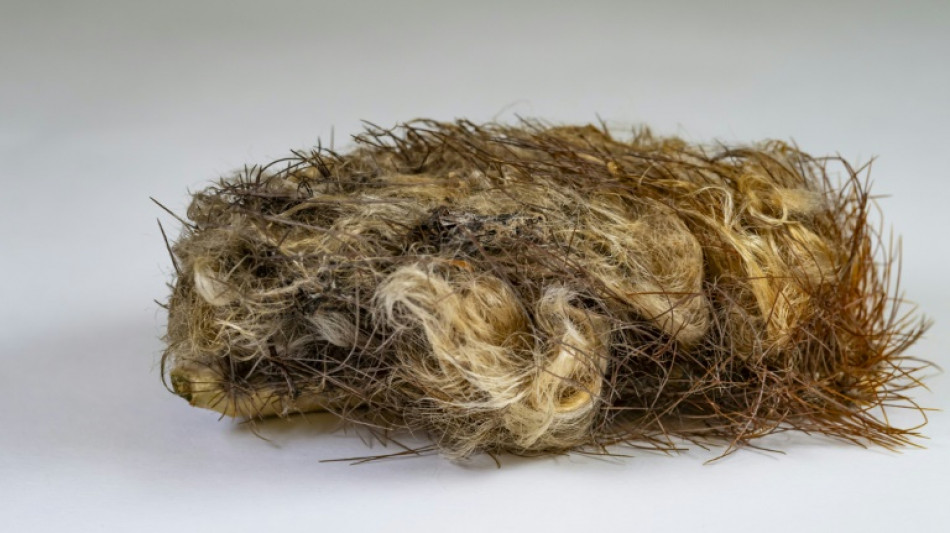
Rare Florida cactus becomes first US species lost to sea rise / Photo: © FLORIDA MUSEUM/AFP

 Hundred hero Duckett punishes New Zealand after Stokes sparks England revival

 South Korea coach bereft of answers with World Cup hopes on knife-edge

 Mistrial declared in deadly Los Angeles fire case

 Verstappen wants to stay at Red Bull – in a fast car, says Mekies

 Usyk says vacating heavyweight world title belts
 Germany sees hottest temperature on record of 41.3C: weather service
 Teenager Antonelli dominates practice for Austrian GP

 Japan say bring on Brazil at World Cup but wary of revenge mission

 Stocks recover from tech tremors as oil prices fall

 How heatwaves are dangerous to human health

 Europe heatwave shattering temperature records: UN
 Farm workers wilt in sweltering Italian shanty town

 Keys to face Maria in Eastbourne final

 Venezuela earthquakes toll doubles amid desperate rescue efforts

 Mercedes dominate opening practice at Austrian GP

 Wawrinka announces farewell fete with Federer and Murray

 Lukashenko will always be threat to Ukraine: Belarus opposition leader

 European heatwave's unlikely accomplice: an ocean 'cold blob'

 Japan's progress paying off at World Cup, says Troussier

 Dozens of international teams rushing to Venezuela: UN
 Floods kill two in Taiwan as twin storms approach Japan

 In the heat, Ivorians don't think twice about using aircon

 Belgium cancels Waterloo battle reenactment due to heat

 Mayweather-Pacquiao rematch postponed indefinitely

 Four injured, flights cancelled in Japan as twin storms approach

A rare species of tree cactus has gone extinct in Florida, in what is believed to be the first species lost to sea level rise in the United States, researchers said Tuesday.
The Key Largo tree cactus (Pilosocereus millspaughii) was restricted to a single small population in the Florida Keys, an archipelago off the southern tip of the state, first discovered in 1992 and monitored intermittently since then.
But salt water intrusion caused by rising seas, soil erosion from storms and high tides, and herbivory by mammals placed significant pressure on the last population.
By 2021, a once-thriving group of roughly 150 stems in an isolated mangrove forest had dramatically declined to six fragile, struggling fragments, which researchers relocated for off-site cultivation in a bid to ensure their survival.
"Unfortunately, the Key Largo tree cactus may be a bellwether for how other low-lying coastal plants will respond to climate change," said Jennifer Possley, the director of regional conservation at Fairchild Tropical Botanic Garden.
Possley is the lead author on a study published Tuesday in the Journal of the Botanical Research Institute of Texas documenting the decline of the species.
Key Largo tree cacti continue to grow on a few scattered Caribbean islands, including northern Cuba and parts of the Bahamas.
These plants can reach heights exceeding 20 feet (six meters) and feature cream-colored flowers with a garlic scent that gleam in moonlight, drawing bat pollinators. Their vivid red and purple fruits are also highly attractive to birds and mammals.
Human-caused climate change is leading to water from melting ice sheets and glaciers flowing into the world's oceans.
Additionally, as water in the ocean warms it expands slightly. Both factors contribute to sea level rise.
M.Furrer--BTB