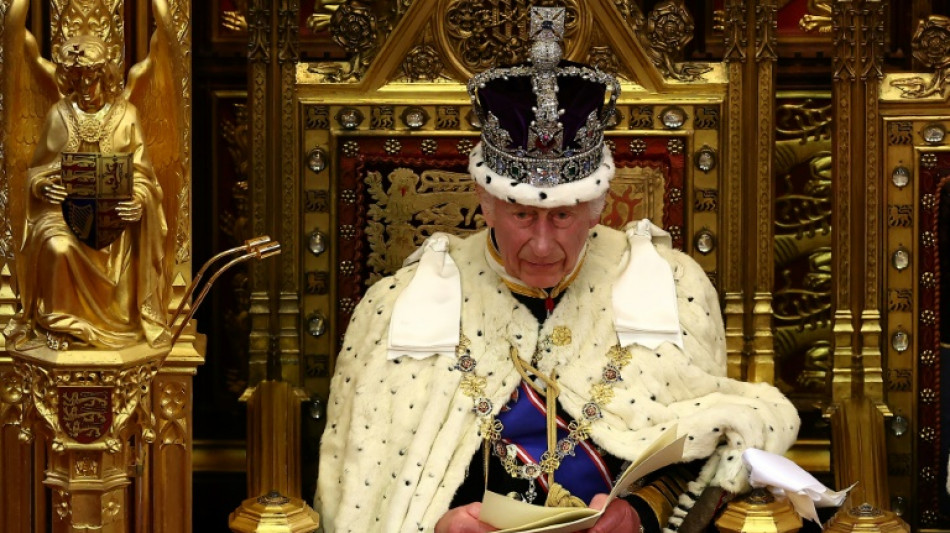
UK's Labour govt programme laid out in king's address / Photo: © POOL/AFP

 UK Anti-Doping confirm former world champ Parker's ban lifted
 French winemakers dread 'smoky taste' after wildfires
 Stocks diverge with earnings, tech in focus
 England recall batsman Lawrence for Pakistan series
 Siemens shares plunge on disappointing guidance raise
 New Australia coach Kiss gives Japan starts to Ross, Amatosero
 'Stretch our money': Romanians face highest EU inflation
 Iran says close to Hormuz plan with Oman, but reopening depends on US

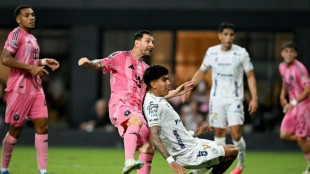 Messi scores twice to set Leagues Cup record in Miami victory
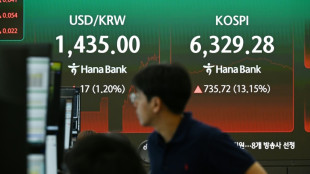 Asian stocks mostly down with tech firms back under pressure
 Back to the future as world champion Springboks host All Blacks
 India youth protests highlight mistrust in 'lapdog' media
 Pacific islands alarmed by Trump-backed push for deep-sea mining
 Erratic rains dictate menu at three-star Michelin restaurant in Brazil
 Zverev, Auger-Aliassime and Medvedev exit Montreal Masters
 Loar Holdings Inc. Reports Q2 2026 Record Results and Upward Revision to 2026 Outlook
 Embattled Infantino sees minnows Malawi reach WAFCON quarter-finals
 Seeds Rybakina, Pegula and Gauff advance at WTA Toronto event
 Zverev, Auger-Aliassime exit star-short Montreal Masters
 Embattled FIFA chief Infantino in emergency talks in Morocco
 Castaway SpaceX rocket stage crashed into Moon, scientists say

 Dow edges to record as markets parse prospects for Hormuz deal
 Salah arrives in Turkey to complete Trabzonspor move
 AFP journalist to be honored at International Press Freedom Awards

 Turkish MPs back limited amnesty for Kurdish militants
King Charles III outlined Labour's first programme for government in 15 years on Wednesday, with promises of economic stability and tougher action on irregular immigration to improving relations with Europe soured by Brexit.
"We will unlock growth and take the brakes off Britain," Prime Minister Keir Starmer said in introductory remarks to the King's Speech, a centuries-old tradition full of pomp and ceremony that details the laws the government proposes to make over the next 12 months.
Despite its name, the address, which marks the official start of the new parliamentary session, is not written by the monarch as head of state but by the government. It was centre-left Labour's first such speech since it was last in power in 2010.
Labour returned to government following a landslide win against the Tories earlier this month.
Wearing the diamond-studded Imperial State Crown, a Royal Navy outfit and long robe, Charles delivered Labour's proposals from a golden throne in the House of Lords upper chamber after travelling from Buckingham Palace in a carriage procession.
The speech included more than 35 bills, including measures to enforce public spending rules and an independent assessment of future budgets to prevent a repeat of former prime minister Liz Truss's disastrous 2022 mini-budget that tanked the economy.
The legislation fleshed out several announcements already made, such as the launching of a wealth fund to draw investment into the UK and of a publicly owned body tasked with boosting clean energy by 2030.
Labour also announced an acceleration of housebuilding, plans to renationalise Britain's much-maligned rail services.
There was also detail of a new border security command with beefed-up "counter-terror powers" to curb "immigration crime" -- Starmer's pledge to "smash the gangs" behind small boats crossings of the Channel by migrants from northern France.
A bill to boost workers' rights, including a ban on zero-hour contracts, and strengthened protections for renters were also included, as were plans to reform the unelected House of Lords by scrapping the right of those with hereditary titles to sit there.
Ex-prime minister Rishi Sunak's proposal to phase out smoking also made it, as did plans for a football regulator.
Also included was a pledge to repeal a controversial act that granted conditional immunity to perpetrators of crimes in Northern Ireland during the Troubles era of sectarian violence.
"This is a hungry party," former Labour minister Tony McNulty told AFP before the speech. "They are chomping at the bit to show that they can get back to being what they see as the natural party of government."
- Ceremonial 'hostage' -
The day's proceedings started when royal bodyguards ritually searched the basement of the Palace of Westminster for explosives -- a legacy of the failed attempt by Catholics to blow up parliament in 1605.
The king travelled Buckingham Palace, escorted by mounted cavalry, en route to the Houses of Parliament.
A smattering of anti-monarchy protesters chanted "Not my king" outside parliament, while the Metropolitan Police said 10 members of activist group Youth Demand were arrested on suspicion of conspiracy to cause public nuisance.
Tradition at the ceremony dictates that an MP is ceremonially held "hostage" in the palace to ensure the king's safe return.
A parliamentary official known as Black Rod had the door of the lower chamber House of Commons slammed in their face, a tradition that symbolises parliament's independence from the monarchy.
MPs then followed Black Rod to the upper chamber, where King Charles, as head of state, gave the speech to assembled lords and ladies in red and ermine robes, plus invited members of the elected Commons.
In keeping with the convention that the monarch is above politics, keen environmentalist Charles remained expressionless throughout, as he did during the last address in November when Sunak's government announced new oil and gas licences.
"That's the job," said McNulty, a British politics lecturer at Queen Mary University of London, noting however: "There's probably much in this King's Speech that he will favour rather than the other one he had to read out."
D.Schneider--BTB