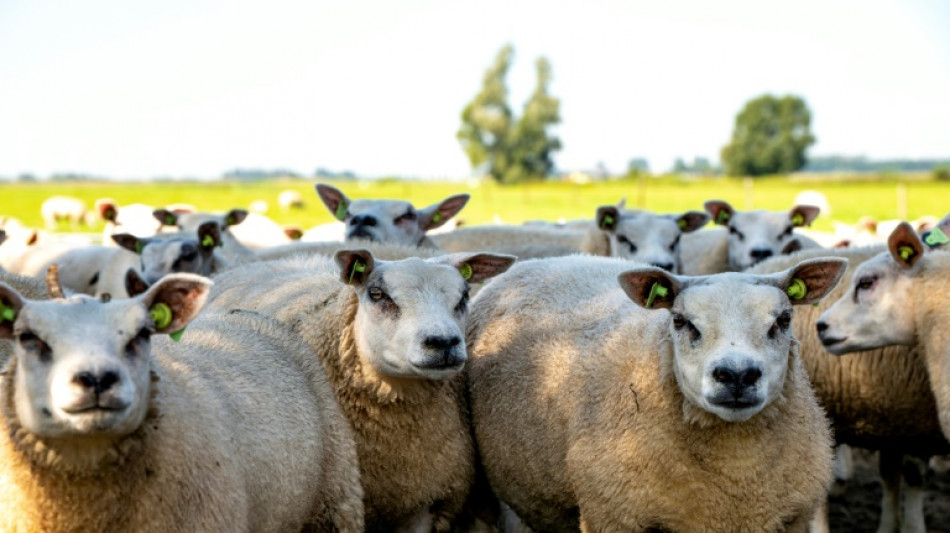
Bluetongue anguish for Dutch farmers / Photo: © AFP

 Britain's EasyJet flies into US hands as takeover confirmed

 Real Madrid sign Ivory Coast winger Yan Diomande

 How online disinformation fuelled Ceuta migrant surge

 Inevitable AI Group Raises $6M From Aleph to Launch AI-Native SaaS Companies

 Suspected Ebola death on boat heading for DR Congo capital

 England selector North not 'hung up' on Stokes absence

 UK Anti-Doping confirm former world champ Parker's ban lifted

 French winemakers dread 'smoky taste' after wildfires

 Stocks diverge with earnings, tech in focus

 England recall batsman Lawrence for Pakistan series
 Siemens shares plunge on disappointing guidance raise

 New Australia coach Kiss gives Japan starts to Ross, Amatosero

 'Stretch our money': Romanians face highest EU inflation

 Iran says close to Hormuz plan with Oman, but reopening depends on US

 Messi scores twice to set Leagues Cup record in Miami victory

 Asian stocks mostly down with tech firms back under pressure

 Back to the future as world champion Springboks host All Blacks

 India youth protests highlight mistrust in 'lapdog' media
 Pacific islands alarmed by Trump-backed push for deep-sea mining
 Erratic rains dictate menu at three-star Michelin restaurant in Brazil

 Zverev, Auger-Aliassime and Medvedev exit Montreal Masters

 Loar Holdings Inc. Reports Q2 2026 Record Results and Upward Revision to 2026 Outlook

 Embattled Infantino sees minnows Malawi reach WAFCON quarter-finals

 Seeds Rybakina, Pegula and Gauff advance at WTA Toronto event

 Zverev, Auger-Aliassime exit star-short Montreal Masters
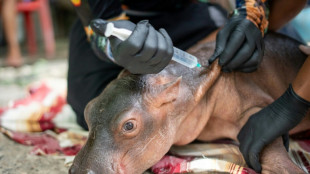
One sheep dribbles, another limps, a third can barely stand: the bluetongue virus is causing havoc for Dutch farmer Erik van Norel, who thought he had seen the back of it.
Still recovering from the impact of the virus last year, the 41-year-old thought the nightmare was finally over -- then bluetongue staged a comeback on his farm.
Bluetongue is a non-contagious, insect-borne viral disease that affects sheep and cows but not pigs or horses. It is difficult to control once it takes hold.
In September 2023, when the BTV-3 strain of the virus broke out in the Netherlands, Van Norel rounded up his ill animals and transported them on his quad bike to the stable.
Some died within 12 hours. He lost 80 animals in total, roughly three quarters of the sheep that fell sick.
"The situation was desperate. There was nothing I could do," he told AFP, surrounded by his flock in Oosterwolde, in the north of the Netherlands.
Symptoms include excessive salivation, the swelling of lips, tongue, and jaw, and the loss of offspring for pregnant animals, in proportions varying from farm to farm.
Unlike bird flu for example, an animal infected with the virus is not automatically slaughtered.
Bluetongue is rarely fatal for cows, but leads to a dramatic drop in milk production.
The virus poses no danger to human health.
Dutch authorities have registered outbreaks of the virus in 6,384 places, with the rate steadily rising.
However, farming union LTO says this is hugely underestimated, as farmers are no longer taking blood samples from all infected animals.
The virus has also been recorded in France, Belgium and Germany. Nearly 1,200 Belgian farms are affected, according to figures out Tuesday, a tripling in three weeks.
France is dealing with an "explosion" of cases that have quadrupled in eight days, according to authorities at the agriculture ministry.
And in Germany, officials have detected 3,212 cases by August 22, also a concerning rate of growth.
- 'She's dribbling a lot' -
Van Norel says he is now battling through "season two" of the bluetongue disaster but thanks to vaccination, his animals are less sick than last year.
Nevertheless, the impact on his farm is clearly visible.
He approaches one sheep that is staying away from the rest of the flock.
"The mouth is very sensitive, you can see she is hardly eating and she is getting very thin," he said.
"She's dribbling a lot, she's also had diarrhoea. All the symptoms show that she is sick," concluded Van Norel.
But he thinks this particular sheep will survive, but is not so sure for six others taken to the "sick bay" in a meadow behind the stable. They have recovered but are now suffering from complications.
Swollen legs prevent them from walking or even standing upright. Those who don't recover are put down "out of respect for the animals," Van Noren.
Vaccination does not stop the animals contracting the disease but eases the symptoms. Around 10 percent of his sheep are dying from bluetongue, compared to 75 percent last year.
- 'Bankrupt' -
Dutch farmers have three vaccines available. The government sped up approvals before the insects that carry the disease became more active over the summer.
But LTO points out that all the costs, from buying the vaccine to vet fees, are borne by the farmers.
"The government has done its job with the vaccines but, given the current social impact on sheep farmers and milk producers, we want the ministry to do more," said Heleen Prinsen, animal welfare official at LTO.
"In Germany, France and Denmark, farmers get a payment for the vaccines," Prinsen told AFP, urging the European Union to come up with a joint response to the virus.
It is too early to put a figure on the total damage to the industry, she said. But it is sure that it represents yet another "tough financial hit" for farmers.
A man as gentle as a lamb, Van Norel inherited the farm from his uncle and is passionate about his job.
But he says that bluetongue cost him "ten of thousands of euros" last year, which had a "huge impact" on his business.
He managed to absorb the cost but he is not sure he can take many more episodes of the virus. "That will mean going bankrupt," he said.
R.Adler--BTB