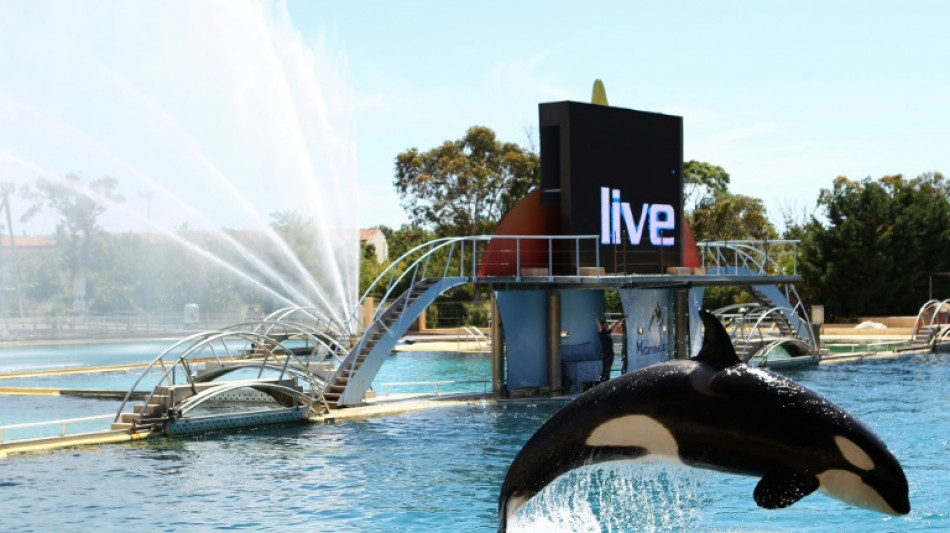
Worry for orcas in French marine park spikes after video / Photo: © AFP/File

 Italy Claims Curling Silver at European Championships in Ostrava

 Kuwait finance minister holds economic cooperation talks at COMCEC

 Abdul El-Sayed declares victory in Michigan Senate contest

 Democrats capture US Congress in sweeping midterm victory

 Manchester United rallies past Roma as PSG dominates in Champions League

 Qatar sees tentative opening for renewed regional diplomacy
 Qatar Tourism joins Pacific Asia Travel Association at London travel market

 Abdul El-Sayed Wins Michigan Senate Seat in Historic Election

 Qatar media bodies discuss support for humanitarian initiatives

A video posted online of two orcas circling in an algae-infested pool in southern France has brought a fresh wave of worldwide concern for cetaceans Wikie, 24, and her 11-year-old calf Keijo.
France has been struggling to find a new home for mother and son after their owner, a marine park on the French Riviera, closed down over a law banning shows featuring marine mammals.
Founded in the city of Antibes in 1970, Marineland closed to the public in January following a drop in attendance and the 2021 law.
In February, the park's management submitted a request to urgently transfer the two orcas -- also known as killer whales -- and 12 dolphins to two parks in Spain, but the move was blocked by Spanish authorities saying the facilities were adapted for them.
"The situation at Marineland Antibes is an emergency," said Canada-based NGO TideBreakers in a social media post after publishing the video.
"Leaving them in a shut-down facility, confined to a crumbling, decrepit tank, is simply not an option," it said.
Should the two orcas fall ill, they "will likely be euthanised or succumb to the deteriorating environment".
The video, shot by drone early this month, shows the two orcas and dolphins in tanks the edges of which are green with algae, amid installations previously used for other marine animals in brackish water.
Contacted by AFP, the park management said that the orca and dolphin pools remained well-maintained and that about 50 employees were still working for the animals' wellbeing.
The algae visible in the images were a normal phenomenon, it said, explaining that algae pores present in the filtered seawater that fills the pools developed each spring as the water warms up.
They were not harmful to the animals and were regularly removed by brushing, management said.
- 'Alternative solutions' -
This explanation was backed up by Mike Riddell, who managed the park for 26 years before being dismissed in an ownership change in 2006.
AFP pictures taken in May 2020 during a press visit showed similar fine algae covering the edges of the the pool.
But the TideBreakers footage prompted strong reactions which, according to the park's management, even included death threats against staff.
Officials said they share the NGO's concerns, but the park's attempts to find an emergency solution together with the staff of France's environment minister Agnes Pannier-Runacher have come to nothing.
Contacted by AFP, ministry officials said authorities were "ensuring that the animals continue to be housed under good conditions, pending their future destination", and that the park was seeking "alternative solutions" moving forward.
Following the Spanish ban decision, Marineland had hoped to transfer the orcas to a park in Japan. But the move was blocked by the French government, which demanded a transfer to a European park with higher welfare standards.
But a solution involving the only such facility, in Tenerife, Spain, was vetoed last month by the Spanish government which said the facilities there "did not meet the requirements", according to French officials.
NGOs including One Voice and Sea Shepherd have requested permission to send specialists to Marineland to check on the orcas.
Born in captivity, the two mammals are unable to survive alone.
The longer term, the French ministry and NGOs agree, should see the establishment of a marine sanctuary where orcas and dolphins could be cared for in semi-wild conditions.
Such a solution would cost two to three million euros ($2.2-3.3 million) per year, according to Riddell.
It is estimated that Wikie and Keijo still have decades to live, under adequate conditions.
M.Furrer--BTB