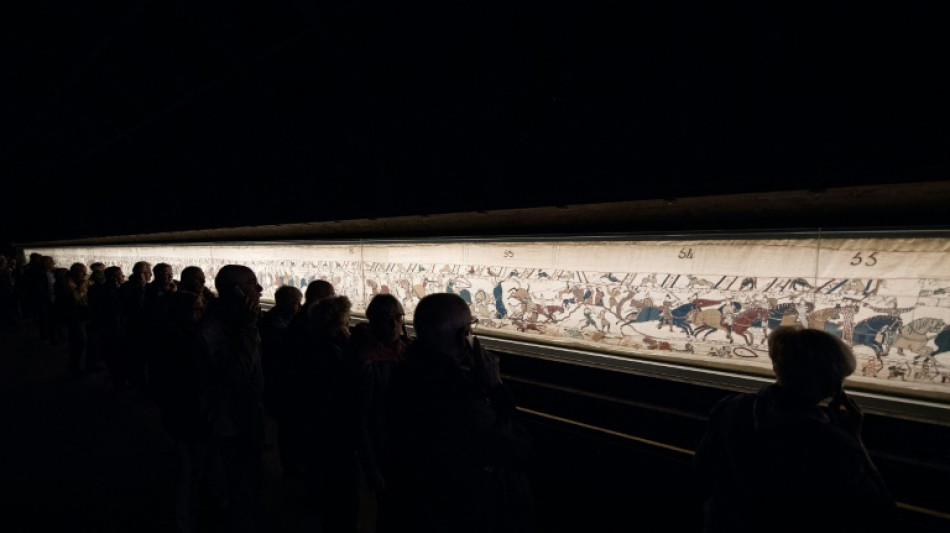
Fast facts on the Bayeux Tapestry / Photo: © AFP

 Abdul El-Sayed declares victory in Michigan Senate contest

 Democrats capture US Congress in sweeping midterm victory

 Manchester United rallies past Roma as PSG dominates in Champions League

 Qatar sees tentative opening for renewed regional diplomacy

 Qatar Tourism joins Pacific Asia Travel Association at London travel market

 Abdul El-Sayed Wins Michigan Senate Seat in Historic Election

 Qatar media bodies discuss support for humanitarian initiatives

 Galloway accuser could not foresee publishing-sector fallout, lawyer argues

 New York City Center revives In the Heights as a timely community story

 Godzilla Minus Zero shifts focus toward postwar human drama

Here are five things to know about the Bayeux Tapestry, the priceless 11th-century work that French President Emmanuel Macron announced Tuesday will be loaned to Britain in 2026-2027.
- Giant of history -
Embroidered in wool thread, the tapestry depicts the Norman conquest of England in 1066 under William the Conqueror, an event that marked the history of England, France and Europe.
Its origins have been the subject of speculation.
Some studies indicate it was probably designed and made in England.
According to some historians, Bishop Odo of Bayeux -- William's half-brother -- commissioned the work in 1077 to decorate the new cathedral in his hometown, Bayeux, in France's Normandy region.
The artisans' identities have been lost to time.
The tapestry is 70 metres (230 feet) long, 50 centimetres (20 inches) wide and weighs a whopping 350 kilogrammes (772 pounds), according to Unesco, which has listed it on its Memory of the World Register.
- Long story -
Made of nine panels, the work is an "embroidered story", said Antoine Verney, head conservationist at its usual home, the Bayeux Museum.
The tapestry features 626 characters, 202 horses and 58 scenes -- an embroidered epic recounting the events leading up to William's conquest at the Battle of Hastings, in which England's King Harold famously died after taking a French arrow in the eye.
- Fragile -
The tapestry, which was last repaired in 1870, is in need of a restoration, at an estimated cost of two million euros ($2.3 million).
In January, French Culture Minister Rachida Dati said the government would foot the full bill.
But that project is now on hold, the Bayeux Museum told AFP Tuesday.
An expert study in 2020 found around 24,200 stains and 10,000 holes.
The work is sensitive to micro-vibrations, handling and humidity, and must not receive more than 50 lux, a very dim light, said Verney.
- Museum upgrade -
Since 1983, the tapestry has been displayed in a long U-shaped hall.
The Bayeux Museum, which received 429,000 visitors last year, is planning a 38-million-euro renovation from 2025 to 2027.
- Unprecedented loan -
It will be the first time the tapestry has been loaned to England, after two aborted plans: once in 1953 for the coronation of Queen Elizabeth II, and once in 1966 for the 900th anniversary of the Battle of Hastings.
The tapestry has only left Bayeux twice, to be displayed at the Louvre in Paris: once in 1803, on Napoleon's orders, and once in 1944, in tribute to the British and US troops who fought to free France from Nazi German occupation.
H.Seidel--BTB