Taliban mark fourth year in power in Afghanistan / Photo: © AFP

 Manchester United rallies past Roma as PSG dominates in Champions League

 Qatar sees tentative opening for renewed regional diplomacy
 Qatar Tourism joins Pacific Asia Travel Association at London travel market
 Abdul El-Sayed Wins Michigan Senate Seat in Historic Election
 Qatar media bodies discuss support for humanitarian initiatives

 No. 22 UCLA defeats No. 5 Arizona 84-75 despite Kharchenkov's 38 points

 Vessel operator seeks witnesses after Vancouver grounding

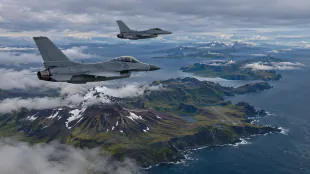 US Air Force deploys F-16 fighters to remote Aleutian base for readiness drill

 Bezos grant helps Seattle nonprofit move thousands of families toward housing

 Shrini Srivastava joins crew of Varanasi-Delhi Vande Bharat Sleeper service

 Nearly Half of Australian Workers Overqualified, Survey Finds

Afghanistan's Taliban authorities marked the fourth anniversary of their takeover on Friday buoyed by Russia's first official recognition of their government, a step they hope other countries will follow.
Helicopters circled above Kabul, dropping flower petals over the city to mark the Taliban seizure of the capital on August 15, 2021.
Taliban members and supporters leaned out of trucks and rickshaws on the streets below waving the black-and-white "Islamic Emirate of Afghanistan" flags.
They also carried yellow jerry cans -- a common receptacle for homemade bombs during the 20-year war against US-led forces.
Celebrations were organised across the country, although a military parade like the one held with much fanfare last year at the Bagram airbase, once the linchpin for US-led operations, was cancelled without public explanation.
A gathering was held instead at the enormous Loya Jirga Hall in Kabul, where hundreds of men listened to ministers praise the government's achievements.
Supreme Leader Hibatullah Akhundzada, who remains largely secluded in the southern Taliban heartland of Kandahar, did not attend but, in a statement read by a spokesman, hailed the return of security to Afghanistan.
"Our people were saved from corruption, oppression, usurpation, narcotics, theft, plunder and looting in the light of Islamic laws," the statement said.
"A positive environment was created for the rebuilding and reconstruction of Afghanistan."
The speeches did not mention the steep challenges facing a country gripped by one of the world's worst humanitarian crises, according to the United Nations.
In Jalalabad in the east, farmer Zabihullah -- who like many Afghans only uses one name -- celebrated the Taliban takeover but also hoped authorities would address poverty and unemployment.
"They should address the bad situation in the country, because of unemployment poor Afghans are going from one country to another, some die, some are detained, it is a chaotic situation," the 45-year-old told AFP.
The Taliban government remains largely isolated on the global stage over restrictions imposed under their severe interpretation of Islamic law, with women facing restrictions the UN has deemed "gender apartheid".
The International Criminal Court issued arrest warrants in July for two senior Taliban leaders, accusing them of crimes against humanity over the persecution of women and girls who are banned from most education and work.
Women and girls are also barred from parks and gyms, and from travelling without a male guardian.
- International engagement -
The Taliban authorities scored a victory in July when Russia became the first country to officially recognise their administration.
Kabul also enjoys close ties with China, Qatar and several Central Asian states.
The Taliban government has reported talks in Kabul with officials from Western states, including Norway, Britain and the United States.
International Crisis Group analyst Ibraheem Bahiss said women's rights are still important to the international community but other issues, particularly security, take precedence.
"Even Europe -- because it has a core interest with migration -- has continued to pursue engagement," he told AFP, although discussions with Taliban authorities on women's rights were "a complete non-starter".
The Taliban authorities have almost no internal opposition but struggle with economic fragility, international aid cuts and the influx of four million Afghans expelled from neighbouring countries.
The Revolutionary Association of the Women of Afghanistan (RAWA) condemned any engagement with the Taliban authorities in a statement.
Contrary to its claims, RAWA said, the Taliban government "is not dedicated to ensuring peace and human dignity but is bent on destroying the last vestiges of our people's most basic rights".
Independent experts appointed by the UN Human Rights Council called on the international community on Thursday not to normalise relations with the Taliban authorities and to reject their "violent and authoritarian rule".
"Operating without legitimacy, the Taliban enforces an institutionalised system of gender oppression, crushes dissent, exacts reprisals, and muzzles independent media," they said in a statement.
E.Schubert--BTB