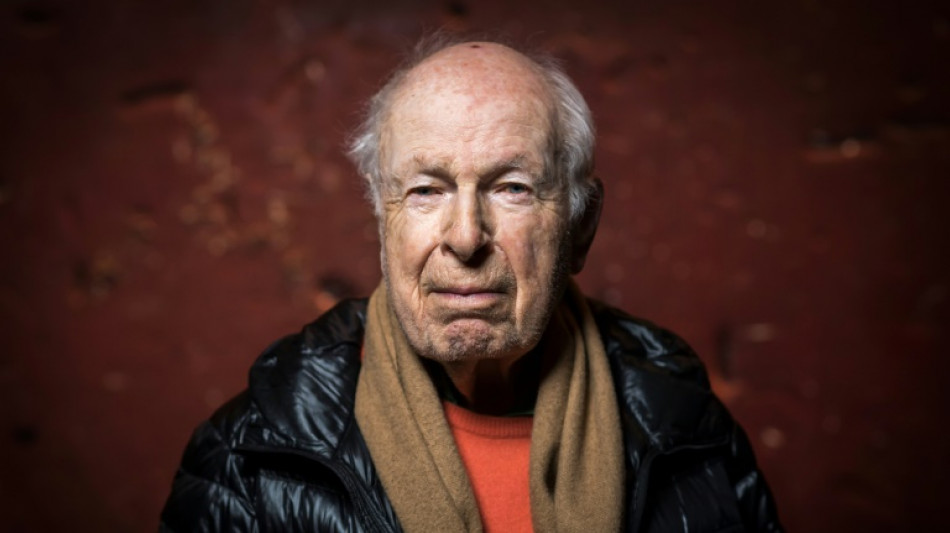
Peter Brook: mystical giant who changed theatre forever / Photo: © AFP/File

 Wildfires raze neighborhoods in US northwest city of Spokane

 Trump attorney general pick says has reached deal with senators after standoff
 Star Australian broadcaster faces trial for sexual assault
 Oil prices sink on Middle East hopes, yen extends gains after joint intervention

 Millions of Thais banish the booze for Buddhist Lent

 Returning to 'Ted Lasso' after break 'effortless': Hannah Waddingham

 Trump says new Iran talks set to start after calling off massive attack

 Four Al-Fayed survivors told they were trafficking victims

 Ariana Grande withdraws from London musical, seeks to 'step back'

 Sudan army drone attack on Darfur court kills 35

 At least 72 died in Spain's Ceuta migrant rush, Spain says
 Russian teen Liutova wins WTA Memphis title
 Zverev remains wary of 12-day Masters events

 Wimbledon champ Noskova ready for 'new opportunity'

 Japan's Kuwaki wins women's British Open to clinch first major title

 Sabalenka aims to bounce back in Toronto after Wimbledon disappointment

 Iran says close to Hormuz deal with Oman, after US suspends attack plan
 'Spider-Man' soars to huge $355 million opening in North America

 Handbag tosses and high-heeled sprints: Amsterdam celebrates Drag Olympics

 Trump's on-again-off-again war against Iran: in his own words
 Dodgers land Tigers pitching ace Skubal in MLB trade deadline blockbuster

 Infantino struggling to survive, says former IOC marketing chief

 OPEC+ boosts September production by 188,000 barrels/day
 Rescuers recover climber Nirmal Purja's body after avalanche disaster
 Fire toll mounts in Greece as blazes spread
Peter Brook, who has died aged 97, was among the most influential theatre directors of the 20th century, reinventing the art by paring it back to drama's most basic and powerful elements.
An almost mystical figure often mentioned in the same breath as Konstantin Stanislavsky, the Russian who revolutionised acting, Brook continued to work and challenge audiences well into his 90s.
Best-known for his 1985 masterpiece "The Mahabharata", a nine-hour version of the Hindu epic, he lived in Paris from the early 1970s, where he set up the International Centre for Theatre Research in an old music hall called the Bouffes du Nord.
A prodigy who made his professional directorial debut at just 17, Brook was a singular talent right from the start.
He mesmerised audiences in London and New York with his era-defining "Marat/Sade" in 1964, which won a Tony award, and wrote "The Empty Space", one of the most influential texts on theatre ever, three years later.
Its opening lines became a manifesto for a generation of young performers who would forge the fringe and alternative theatre scenes.
"I can take any empty space and call it a bare stage," he wrote.
"A man walks across an empty space whilst someone else is watching him, and this is all that is needed for an act of theatre..."
For many, Brook's startling 1970 Royal Shakespeare Company production of "A Midsummer Night's Dream" in a white-cube gymnasium was a turning point in world theatre.
It inspired actress Helen Mirren to abandon her burgeoning mainstream career to join his nascent experimental company in Paris.
- African odyssey -
Born in London on March 21, 1925, to a family of Jewish scientists who had immigrated from Latvia, Brook was an acclaimed director in London's West End by his mid-20s.
Before his 30th birthday he was directing hits on Broadway.
But driven by a passion for experimentation that he picked up from his parents, Brook soon "exhausted the possibilities of conventional theatre".
His first film, "Lord of the Flies" (1963), an adaptation of the William Golding novel about schoolboys marooned on an island who turn to savagery, was an instant classic.
By the time he took a production of "King Lear" to Paris a few years later, he was developing an interest in working with actors from different cultures.
In 1971 he moved permanently to the French capital, and set off the following year with a band of actors including Mirren and the Japanese legend Yoshi Oida on an 8,500-mile (13,600-kilometre) odyssey across Africa to test his ideas.
Drama critic John Heilpern, who documented their journey in a bestselling book, said Brook believed theatre was about freeing the audience's imagination.
"Every day they would lay out a carpet in a remote village and would improvise a show using shoes or a box," he later told the BBC.
"When someone entered the carpet the show began. There was no script or no shared language."
But the gruelling trip took its toll on his company, most of whom fell ill with dysentery or tropical diseases.
Mirren later described it as "the most frightening thing I have ever done. There was nothing to hold onto."
She parted company with Brook soon after.
He "thought that stardom was wicked and tasteless... I just wanted my name up there," she told AFP.
- 'Mahabharata' masterpiece -
Brook continued to experiment at the Bouffes du Nord, touring his productions across the globe.
His big landmark after "The Mahabharata" was "L'Homme Qui" in 1993, based on Oliver Sacks' bestseller about neurological dysfunction, "The Man Who Mistook his Wife for a Hat".
Brook returned to Britain in triumph in 1997 with Samuel Beckett's "Happy Days" and his actress wife Natasha Parry in the lead.
Critics hailed him as "the best director London does not have".
After turning 85 in 2010, Brook relinquished leadership of the Bouffes du Nord but continued to direct there.
Eight years later, aged 92, he wrote and staged "The Prisoner" with Marie-Helene Estienne -- one of the two women with whom he shared his life.
The real-life story was based on his own spiritual journey to Afghanistan just before the Soviet invasion to shoot a film called "Meetings with Remarkable Men" in 1978.
It was adapted from a book by mystical philosopher George Gurdjieff, whose sacred dances Brook performed daily for years.
Quiet-spoken, cerebral and charismatic, Brook was often seen as something of a Sufi himself.
But Parry's death in 2015 shook him. "One tries to bargain with fate and say, just bring her back for 30 seconds," he said.
Yet he never stopped working despite failing eyesight.
"I have a responsibility to be as positive and creative as I can," he told The Guardian. "To give way to despair is the ultimate cop-out," he said.
L.Dubois--BTB