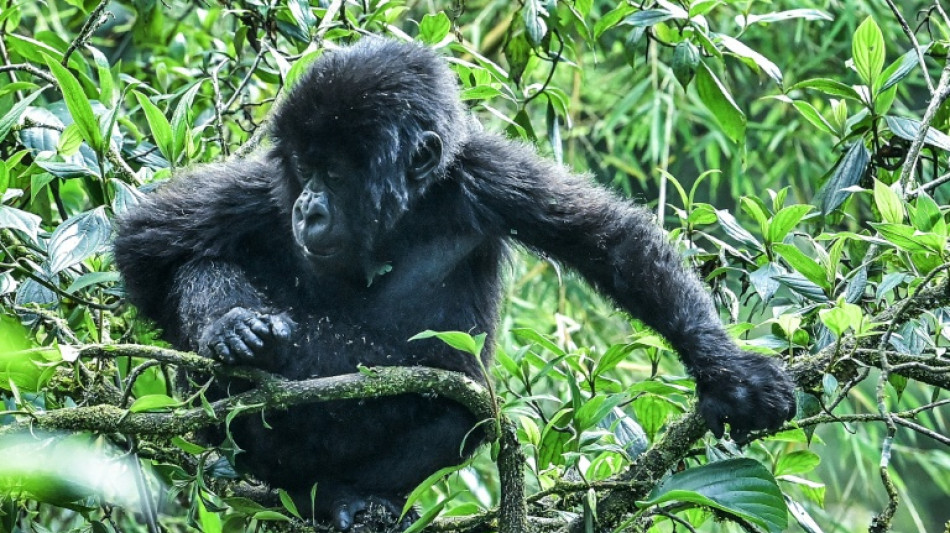
Overcrowding kills infant gorillas in Rwanda habitat / Photo: © AFP

 Manchester United rallies past Roma as PSG dominates in Champions League

 Qatar sees tentative opening for renewed regional diplomacy

 Qatar Tourism joins Pacific Asia Travel Association at London travel market

 Abdul El-Sayed Wins Michigan Senate Seat in Historic Election

 Qatar media bodies discuss support for humanitarian initiatives

 No. 22 UCLA defeats No. 5 Arizona 84-75 despite Kharchenkov's 38 points
 Vessel operator seeks witnesses after Vancouver grounding

 US Air Force deploys F-16 fighters to remote Aleutian base for readiness drill
 Bezos grant helps Seattle nonprofit move thousands of families toward housing

 Shrini Srivastava joins crew of Varanasi-Delhi Vande Bharat Sleeper service

 Nearly Half of Australian Workers Overqualified, Survey Finds

Celebrities, politicians and conservationists took turns to announce names for 40 infant gorillas in a glamorous ceremony in Rwanda, where the endangered creatures face a deadly threat from overcrowding.
Around half of the babies will not make it to adulthood due to vicious inter-family fights that are threatening decades of conservation work, experts say.
Efforts over the past half-century have helped the gorilla population recover from critical levels in the Virunga Massif that spans Rwanda, Uganda and the Democratic Republic of Congo.
But increased numbers also make the adult male gorillas, known as silverbacks, clash more frequently, with devastating results.
"Silverbacks fight as they try to protect their territories," said Eugene Mutangana, conservation management expert at the Rwanda Development Board.
"The infants end up dying because the silverback that wins eliminates the young ones," he told AFP.
He said around half of all young gorillas born over the past decade have been killed in this way.
None of that was mentioned as celebrities such as Hollywood actor Michelle Yeoh and "Transformers" director Michael Bay enjoyed the naming ceremony in the foothills of Volcanoes National Park.
"I hear he is such a good-looking baby gorilla, and being a movie director I promise I am going to make him a famous gorilla movie star," said Bay, who named his gorilla Umurage, meaning "heritage".
- Short but vicious fights -
Rwanda has launched an ambitious programme to expand the gorillas' habitat by 23 percent that will see around 3,400 human households relocated from the edge of Volcanoes National Park.
But the programme will take more than 10 years to complete, Mutangana acknowledged.
And in the meantime, scarcity of land causes the deadly incidents to continue.
A ranger in the park, who asked not to be named, said he had taken tourists to see gorillas only to come across dead infant ones.
"When families meet, which is not frequent... the males often fight," he told AFP.
"We leave them to fight. They are normally short but vicious fights. The silverback which wins ends up hitting the infant on hard surfaces until it dies."
He said grieving mothers will often isolate themselves from the new dominant male.
"It is a sad sight," the ranger said.
Extreme temperatures were also a cause of death for infant gorillas, he added.
Julius Nziza, lead medic at Rwanda's Gorilla Doctors Office, said many infants were also left injured by the fights.
"We don't intervene because it is a natural phenomenon. We only intervene when it is human-induced or life-threatening infections like a serious respiratory disease," he said.
"The problem can be dealt with through expanding the habitat."
- Recovery, revenue -
The number of gorillas in Rwanda fell to just 242 in 1981, according to a study by the late conservationist Dian Fossey.
Conservation efforts, including anti-poaching patrols, community engagement, veterinary care, habitat protection and monitoring led to a gradual recovery, though they are still classed as endangered by the International Union for Conservation of Nature.
The population has lately climbed to over 1,000 and is rising by four percent annually, though it could be double that without the infant deaths, Nziza said.
Conservation work is also undermined by the presence of numerous armed groups in the remote hills of Virunga, and illegal mining and logging operations.
Humans have encroached on more than half of the protected region, and around 130 rangers have been killed over the years trying to protect it.
The armed clashes have disrupted gorilla feeding and breeding patterns.
The naming ceremony was a high-profile event highlighting the relative success of the country's conservation efforts.
The gorillas have also become a valuable source of tourism revenue, bringing in around $200 million last year, according to the Rwanda Development Board -- with visitor numbers limited by high permit prices of around $1,500.
Y.Bouchard--BTB