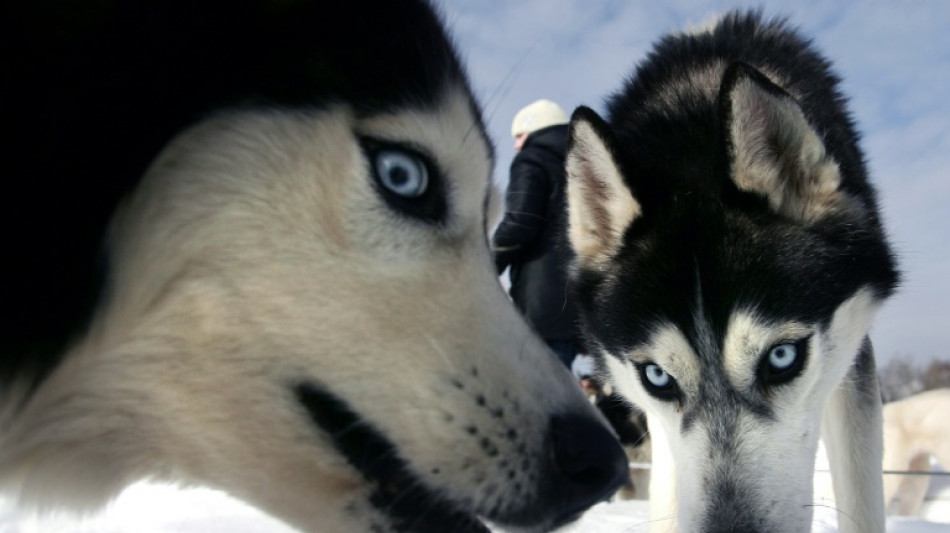
Ancient Siberian dogs relied on humans for seafood diets / Photo: © AFP/File

 Welsh FA withdraws support for Infantino's FIFA re-election bid

 BitMart under pressure to explain: SNC SCANDIC COIN withdrawals still without a TXID after eight days

 Iran denies negotiating with US after Trump announces talks

 What Europe can learn from Australia's 'Black Summer' wildfires

 Oil prices sink on Iran hopes, yen gains after joint intervention

 Wildfires raze neighborhoods in US northwest city of Spokane

 Trump attorney general pick says has reached deal with senators after standoff

 Star Australian broadcaster faces trial for sexual assault

 Oil prices sink on Middle East hopes, yen extends gains after joint intervention

 Millions of Thais banish the booze for Buddhist Lent

 Returning to 'Ted Lasso' after break 'effortless': Hannah Waddingham

 Trump says new Iran talks set to start after calling off massive attack

 Four Al-Fayed survivors told they were trafficking victims

 Ariana Grande withdraws from London musical, seeks to 'step back'

 Sudan army drone attack on Darfur court kills 35

 At least 72 died in Spain's Ceuta migrant rush, Spain says

 Russian teen Liutova wins WTA Memphis title

 Zverev remains wary of 12-day Masters events

 Wimbledon champ Noskova ready for 'new opportunity'

 Japan's Kuwaki wins women's British Open to clinch first major title

 Sabalenka aims to bounce back in Toronto after Wimbledon disappointment

 Iran says close to Hormuz deal with Oman, after US suspends attack plan

 'Spider-Man' soars to huge $355 million opening in North America

 Handbag tosses and high-heeled sprints: Amsterdam celebrates Drag Olympics

 Trump's on-again-off-again war against Iran: in his own words

As early as 7,400 years ago, Siberian dogs had evolved to be far smaller than wolves, making them more dependent on humans for food including sea mammals and fish trapped below the ice, a new study showed Friday.
Robert Losey of the University of Alberta, who led the research published in Science Advances, said the findings helped explain the growth in the early dog population, as people put them to work for hunting, herding and sledding.
"The long term changes in dog diet have really been oversimplified," he told AFP, explaining that prior work had focused only on two main ideas to explain how dogs transitioned from wolves, a process that began some 40,000 years ago.
The first of these was that friendlier wolves approached human camps during the Ice Age to scavenge for meat, eventually became isolated from their wild counterparts, and were then intentionally bred into dogs.
The second was that some dogs evolved a better capacity to digest starches following the agricultural revolution, which is why some modern dog breeds have more copies of the AMY2B gene that creates pancreatic amylase.
To study ancient dog diets in more depth, Losey and colleagues analyzed the remains of around 200 ancient dogs from the past 11,000 years, and a similar number of ancient wolves.
"We had to go to collections all over Siberia, we analyzed those bones, took samples of the collagen, and analyzed the protein in labs," he said.
Based on the remains, the team made statistical estimates for body sizes.
They also used a technique called stable isotope analysis to generate dietary estimates.
They discovered that dogs of 7,000-8,000 years ago "were already quite small, meaning that they just couldn't do the things that most wolves were doing," said Losey.
This in turn led to greater dependence on humans for food, and reliance on small prey and scavenging, rather than prey bigger than themselves, which wolves hunt.
"We see that dogs have marine diets, meaning they're eating fish, shellfish, seals and sea lions, which they can't easily get themselves," he said.
Ancient dogs were found to be eating fish "in areas of Siberia where the lakes and rivers are frozen over for seven to eight months of the year."
Wolves of the time, and today, were hunting in packs and mainly eating various species of deer.
- Benefits and challenges -
These new diets brought dogs both benefits and challenges.
"Beneficial because they could access stuff from humans, and those are oftentimes easy meals, but it came with the costs of all these new diseases and problems, like not enough nutrition," said Losey.
While the new bacteria and parasites they were exposed to could have helped some adapt, some dog populations might not have survived.
Most of the first dogs of the Americas died out, for unclear reasons, and were replaced by European dogs -- though it's not thought colonization was to blame.
Those dogs that did survive acquired more diverse gut microbiomes, helping them further in digesting more carbohydrates associated with life with humans.
O.Bulka--BTB