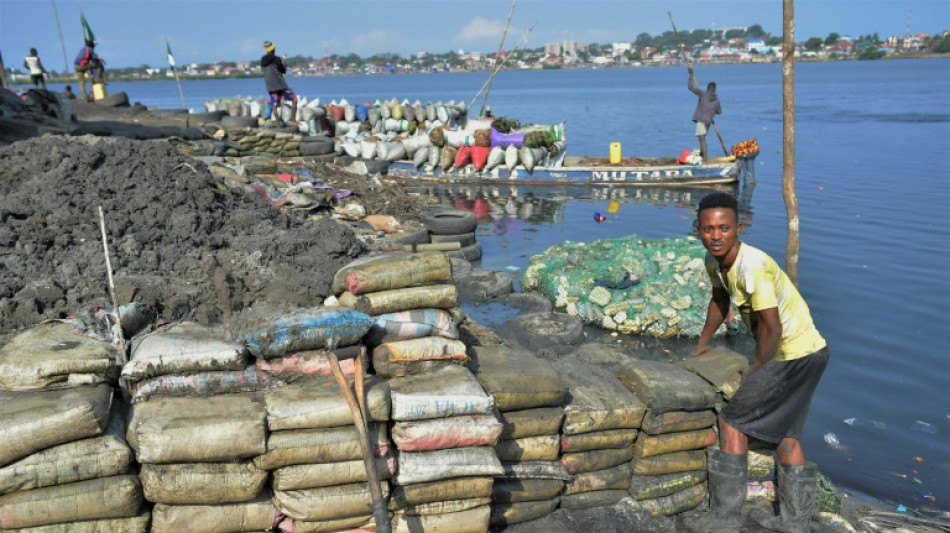
In Sierra Leone, the people fighting the sea to build a home / Photo: © AFP

 Commanders hand champion Seahawks their first loss

 Dupont scores twice to send Toulouse top of Top 14

 Ireland beat Israel but no handshakes due to war in Gaza

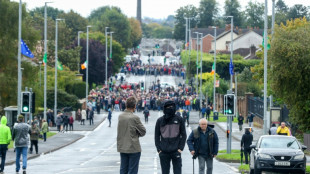
 Tense standoff over flashpoint N.Ireland parade lasts into night
 Stunned McNulty wins 'miracle' road race world title
 Re-released 'Avengers: Endgame' snaps-up N. America box office lead
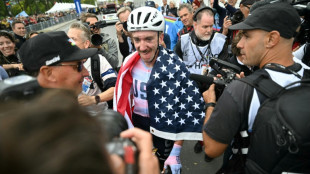 American McNulty wins shock road race world title
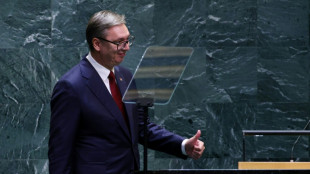
 Serbia's President Aleksandar Vucic announces resignation

 Tuchel urges Bellingham to play with 'rage'

 Russian strikes on Ukraine kill 8

 Bavuma, Miller hit centuries as South Africa clinch series

 Spain bring in Le Normand for injured Garcia

 UK Labour party meets buoyed by Burnham but seeking concrete plans

 Nor'easter lashes US east with punishing rain and wind

 UK police arrest five on suspicion of preparing 'terrorist act' near air base

 Washington denounces Iran's truce proposal as 'cynical'

 Armani sprinkles glitter on discreet elegance at Milan show
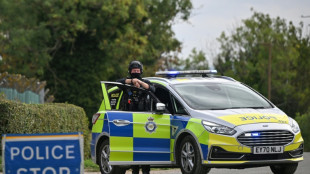 UK police arrest five for preparing 'terrorist act' as incident near air base probed

 อเล็กซ์ โบดี และศาสตราจารย์ ดร. ดีเทอร์ ลาซิก ลงนามสัญญาสำหรับ ALPHA WHEY และ BODI เครื่องดื่มให้พลังงาน

 China teen blows away the field for record-setting gold at 'sad' Games

 Alex Bodi och prof. dr. Dieter Lazik tecknar avtal om ALPHA WHEY och BODI Energidryck

 Alex Bodi i prof. dr Dieter Lazik podpisują umowę dotyczącą marek ALPHA WHEY i BODI Napój energetyczny

 Ο Alex Bodi και ο καθηγητής Δρ. Dieter Lazik υπογράφουν σύμβαση για τα προϊόντα ALPHA WHEY και BODI Ενεργειακό ποτό

 アレックス・ボディ氏とディーター・ラジク教授が「ALPHA WHEY」および「BODI エナジードリンク」に関する契約を締結

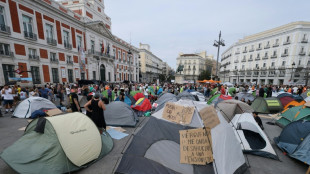 Housing protesters dig in for long stay in Madrid square

Off a path in Cockle Bay, a slum in Sierra Leone's capital Freetown, lies the squat, tin-roofed house where Lamrana Bah lives and works.
The widowed mother of six, who sells soft drinks from her front porch, built the home from the ground up -- or, more precisely, from the water up.
Most of the houses here were constructed on land "reclaimed" from the sea.
In a process known here as banking, residents pile layers of tyres, rubbish and sacks of earth into the water, pack the ballast with mud, and then build homes on top.
It is a unique solution to Freetown's problem of overcrowding, rooted in its geography and exacerbated during a decade-long civil war.
"Banking" displays the resourcefulness of a community who with their own muscle and meagre savings battle the sea to make a place of their own.
But their unauthorised homes also face perils ranging from floods to fire, and struggle with lack of roads and basic services.
- 'Local technology' -
Bah used to live in an ordinary apartment in the city, but after her husband died she could no longer afford the rent.
She spent $350 between 2014 and 2018 to build her Cockle Bay home, which has electricity but no running water.
"My mother doesn't pay rent any more and we don't have issues with anyone -- we stay in our own house, so I'm happy for that," her son, Prince Anthony, told AFP reporters visiting the area late last year.
Like most structures in the slum, it is one storey high and was initially built from corrugated iron. Bah later fortified it with cement walls.
The settlement has since expanded, leaving her house some 500 metres (yards) from the water's edge.
About a third of Freetown's estimated 1.5 million residents live in slums, according to the city.
The population mushroomed during the 1991-2002 civil war, when hundreds of thousands fled violence in the provinces. By the time the fighting ended, many had built new lives and stayed.
But the city nestles on a peninsula between the Atlantic and mountains, and informal expansion in either direction is dangerous.
In 2017, a landslide ripped through a hillside settlement, killing more than 1,000 people.
In the alleyways of Cockle Bay, women hawk nuts and doughnut-like "puff cake" snacks, while men on wooden boats bring charcoal to shore to sell.
The slum is home to community-run schools and at least one mosque -- all built on banked land.
Not all residents are poor. In an older area, large, solid houses painted pale yellow and green are shaded by lime, coconut, pawpaw and avocado trees.
"We live here happy (with) no problems -- you see the children playing?" said Fatu Dumbuya, a 33-year-old hairdresser threading a weave into a client's braids while, nearby, her husband hauled mud to bank more land.
In the late afternoon sun, one of her children was doing homework while another ran about with neighbours.
Dumbuya, who used to live in town with her in-laws, said she is happier now in her own home.
Banking, her client said proudly, "is a local technology."
- Floods and fires -
The Federation of Urban and Rural Poor (FEDURP), a community-based organisation, estimates some 198,000 people live in Freetown's seafront settlements.
"Our main challenges are flooding and fire accidents," said Nancy Sesay, a lifelong resident of Susan's Bay, a banked community near the city centre.
Its shoreline is a pile of discarded clothing and plastic bottles.
Some 7,000 residents were left homeless after a 2021 blaze. In January, another fire tore through the community.
"When it rains, we don't sleep -- the garbage will rise up and float with a very bad stench, and everyone will be shouting… 'Wake up'", Sesay said, walking along a putrid waterway next to which children were washing themselves. Upstream, pigs poked around in the rubbish.
Lack of access roads makes it hard for ambulances or fire trucks to arrive in emergencies.
But many residents have no desire to leave.
Sesay sells toiletries and cosmetics in nearby Dove Cut market -- work she could not do if she had to commute.
"Every year, in the last five to seven years, we have been having disaster events during the rainy season", said Joseph Macarthy, head of the Sierra Leone Urban Research Centre.
"For many people, it doesn't matter whether their life has been exposed to disaster... once they're here, they know they can be assured of having (a bit of money) that may fetch them at least a plate of rice."
- Climate risk-
UN chief Antonio Guterres this month warned coastal flooding driven by warming seas could affect nearly 900 million people, forcing "a mass exodus of entire populations on a biblical scale."
Freetown's mayor says the solution is to create more economically attractive destinations outside the city.
"It's not Freetown they want, it's jobs, it's food, it's opportunities to access healthcare", Mayor Yvonne Aki-Sawyerr told AFP.
"If you give it to them somewhere else, they'll go somewhere else."
The city is nonetheless working to improve conditions in existing slums. Together with development agencies, it introduced public toilets and water taps in Susan's Bay.
But the city and local organisations have urged residents to stop expanding further.
"At the end of the day, we will have no sea," said Andrew Saffa, an administrative officer with FEDURP.
"And when the sea comes and takes its land back, it causes a lot of disasters."
O.Bulka--BTB