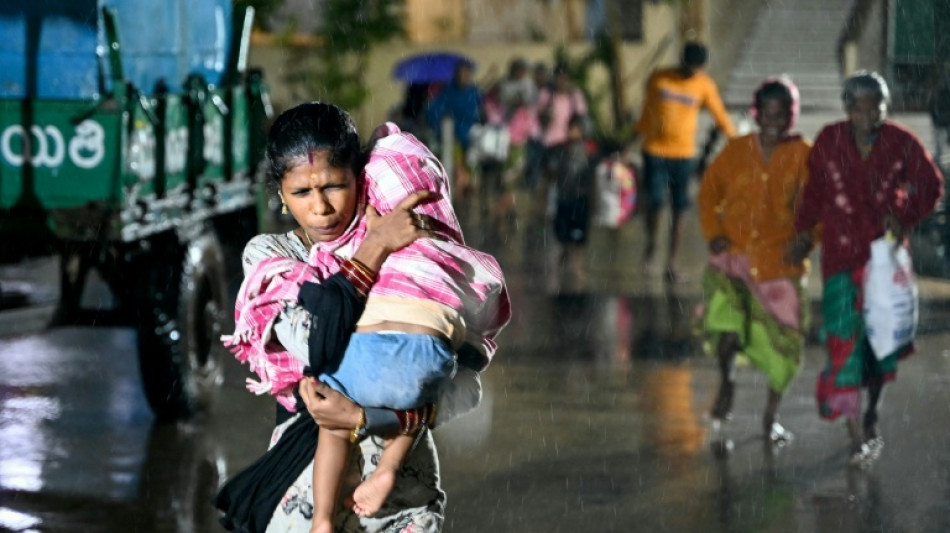
Three killed by storm in southern India / Photo: © AFP

 Freshways milk-price cut deepens pressure on UK dairy farms

 Labour and National remain virtually tied as New Zealand vote count advances

 The Good Daughter adapts Karin Slaughter thriller with Rose Byrne and Meghann Fahy

 Heavy-lift drone evacuates wounded Ukrainian soldier from frontline kill zone

 Morrison says West Brom recovered after pressure from successive derby losses

 Britain considers 2027 state visit for Ukraine’s Zelensky

 Udinese Falls to Last Place in Serie A After Loss to Venezia

 BSG Chemie Leipzig Defeated by Regionalliga Leaders Rot-Weiß Erfurt

 Trump and Vance Pursue Secret Diplomacy with Iran Amid Military Pressure

 Inside SFFILM’s Operations: Jordan Menashe on Managing Doc Stories Logistics
Ferocious winds and torrential rain lashed India's southeastern coast after a cyclone made landfall on Wednesday, killing at least three people before the storm weakened, officials said.
Cyclone Arnab hit southeastern Andhra Pradesh state as a "very severe cyclonic storm", with winds of 125-135 kilometres (77-84 miles) per hour and gusts reaching 150 kph in the early hours of Wednesday morning, the India Meteorological Department (IMD) said.
Torrential rain was recorded -- as much as 30 centimetres (nearly 12 inches) in parts of Andhra Pradesh and Odisha states, IMD said, with the storm weakening into a "deep depression" throughout Wednesday afternoon.
"Three people have lost their lives, and 31 homes have been damaged," Narendra Singh Bundela, Inspector General of India's National Disaster Response Force (NDRF) told reporters.
Andhra Pradesh Chief Minister Nara Chandrababu Naidu thanked officials who had "worked tirelessly throughout the night".
Around 50,000 people were told to move to safer areas in Andhra Pradesh and another 48,000 in neighbouring Odisha.
"Our homes get flooded, and we have to stay in the water," said Rajeshwari, 65, who gave only one name and had been taken to a government-run shelter near Kakinada.
Overnight, gales battered trees and heavy rain lashed the port city of Kakinada, close to the heart of the storm, as powerful waves crashed ashore.
Residents on Wednesday emerged onto flooded streets to what appeared to be limited damage in the city.
- 'Safe indoors' -
Emergency officials were also busy clearing uprooted trees and other debris from affected roads in the coastal region.
"Thank God, there was not as much damage this time," said businessman Hussain, 43, who uses one name.
Sadiq, 40, a Kakinanda city resident, told AFP that the situation had become "very dangerous" on Tuesday night, but early warnings from authorities had helped people prepare.
"Many people locked their houses and moved to safer places", he said.
Cyclones, called hurricanes in the North Atlantic and typhoons in the Pacific, are a regular menace in the Bay of Bengal and northern Indian Ocean.
The storm season, however, has been turbocharged by the El Nino weather phenomenon that has contributed to unprecedented warming.
Neighbouring Sri Lanka and Nepal had also issued warnings.
Nepal's disaster authority warned that the storm would move inland towards the Himalayas, bringing heavy rainfall and "a high risk of heavy snowfall, snowstorms and avalanches".
Nepal is still recovering from a catastrophic August 26 flood triggered by a glacial mountain collapse, which killed more than 1,400 people and left over 5,000 missing.
C.Kovalenko--BTB